
As an Amazon Associate I earn from qualifying purchases.
Your closet is full, the rail is tight, and still you stand in front of it feeling that you have nothing to wear. The problem is rarely a shortage of clothes. It is a shortage of connection, pieces bought one at a time, in colors that do not meet, for days you do not actually live. A capsule wardrobe solves that as a system. You audit what you own, choose a palette, keep core pieces that mix freely, and dress from simple outfit formulas instead of starting again every morning.
The Fashion Updates
A Closet That Works as One
Audit what you own, fix a palette, choose core pieces that all combine, and dress from formulas instead of from a full and silent closet.
Key Takeaways
- Start with a closet audit, not a shopping list, and keep only pieces that fit, suit your real week, and work with at least three other things you own.
- Build your palette from two or three neutrals and a few accent colors that flatter you, so new pieces arrive already able to combine.
- Choose core pieces for versatility first, a coat, trousers, jeans, skirts, knitwear, shirts, and shoes that carry many outfits rather than one occasion.
- Dress from outfit formulas, repeated combinations with interchangeable parts, so a small wardrobe produces a wide range of looks.
- Fill gaps slowly, buy for fit and fabric, and care for and repair what you keep, because a capsule only works when its pieces stay in good condition.
Table of Contents
- Key Takeaways
- Start With a Closet Audit, Not a Shopping List
- Build Your Color Palette Around What You Own
- Choose Core Pieces That Earn Their Place
- Tops, Bottoms, and Layers That Mix Freely
- Dresses, Shoes, and Accessories as Connectors
- Outfit Formulas Replace Morning Guesswork
- Fill Gaps Slowly and Buy for Fit and Fabric
- Care, Repair, and Storage Keep the System Working
- A Small Wardrobe for Travel, Work, and Weekends
- Review the Capsule and Let It Change
- Our view
- Frequently Asked Questions
- Sources
- Recommended
Start With a Closet Audit, Not a Shopping List
A capsule begins with evidence. Take everything out, category by category, and look at what you actually wear, what fits, what needs repair, and what has sat untouched while you reached past it.
| Core piece | Why it earns its place | What it pairs with |
|---|---|---|
| Well-fitting trousers in a neutral | Covers work, dinner, and travel in one shape | Knitwear, shirts, blazers, loafers, trainers |
| Dark jeans with a clean finish | Bridges casual and smart without looking like workwear | Tees, blouses, jackets, boots, heels |
| White or striped shirt | Sharpens soft pieces and layers under almost anything | Trousers, jeans, skirts, knitwear, coats |
| Fine knit sweater or cardigan | Adds warmth and texture without bulk | Shirts, dresses, trousers, skirts |
| Tailored blazer or structured jacket | Gives polish to simple bases in seconds | Jeans, dresses, tees, trousers |
| Versatile coat in your main neutral | Finishes every cold-weather outfit you own | Everything in the capsule |
| Simple dress in a palette color | One-piece outfit for days with no time to build one | Boots, heels, trainers, jackets, cardigans |
| Loafers, ankle boots, and clean trainers | Three shoe shapes cover most settings | Trousers, jeans, dresses, skirts |
Sort into keep, repair, and release piles
Work through one category at a time and try things on rather than judging them on the hanger. Keep what fits and earns wear. Set aside what only needs a button, a hem, or a proper clean. Release what no longer fits your life, however much it once cost. Older wardrobe-planning guidance from NC State Extension uses the same three-way sort, keep, restyle or repair, and discard or give away, after a full inventory of what is on hand. The United Nations makes a related point in its ActNow fashion guidance, urging people to curb consumption, wear pieces repeatedly, and pass unwanted clothes on instead of sending them to landfill.
Count what you really wear
Note the pieces you reach for weekly. They reveal your real uniform, the shapes, lengths, and fabrics you trust. If five similar tops do all the work while a rail of occasion pieces waits, your capsule should be built around the workers, not the waiting. WRAP research on design for longevity found that a large share of clothing in an average wardrobe had not been worn for a long period,

Build Your Color Palette Around What You Own
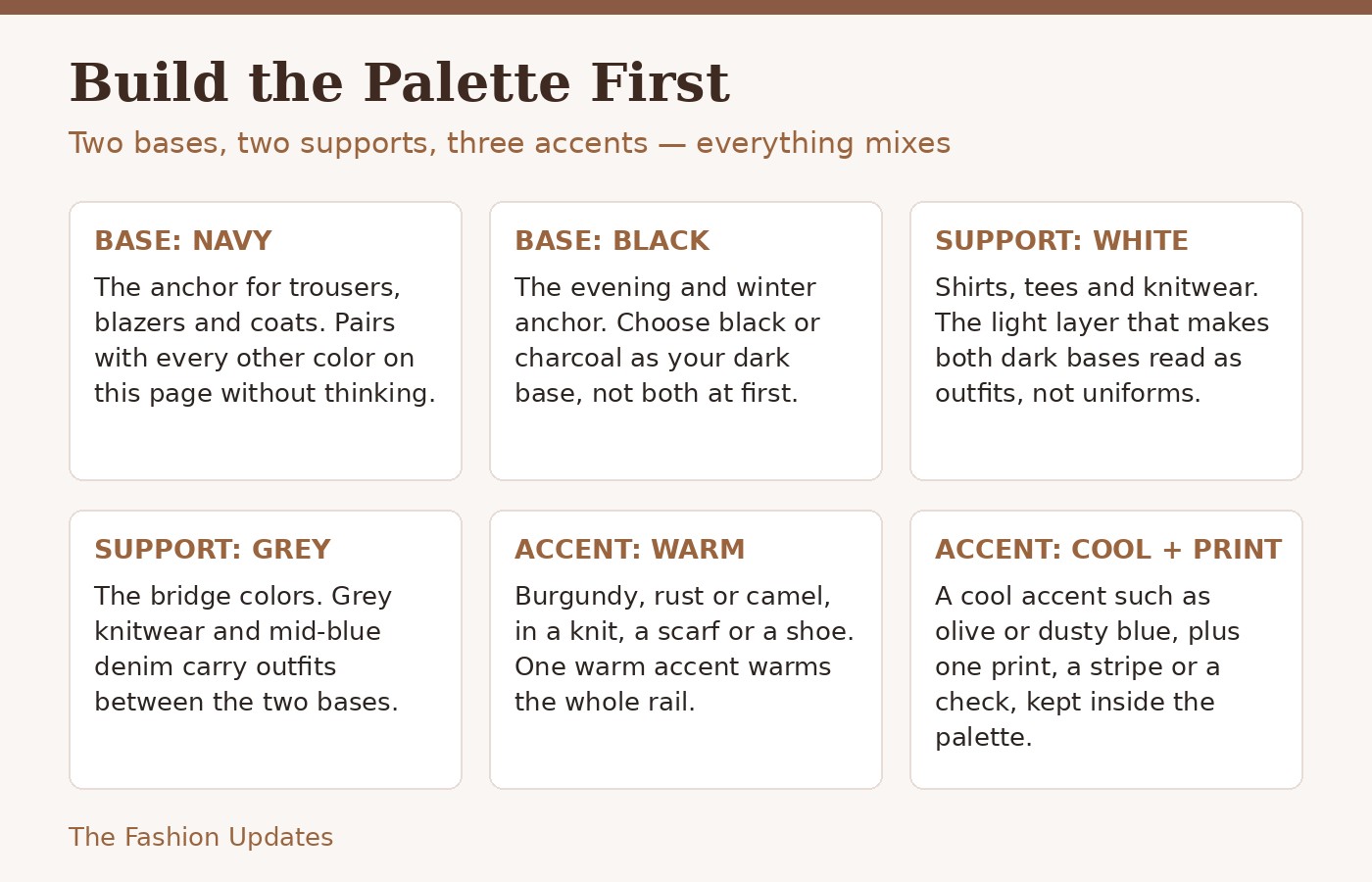
Choose two or three neutrals first
Pick the neutrals that already dominate your keep pile and flatter you near the face, perhaps navy and white, black and grey, or brown, cream, and olive. Neutrals carry coats, trousers, shoes, and bags, the expensive and long-lived parts of the wardrobe. Purdue Extension teaching on consumer clothing treats color, fabric, and wardrobe planning as connected choices rather than separate purchases, which is exactly how a palette should be used. If you are unsure which neutrals suit you, start with our skin undertone guide, then test the shortlist against your face in daylight.
Add accents you already love
Accents are where personality lives, in a knit, a scarf, a lip color, or a dress. Choose a few that sit happily beside your neutrals and beside each other. Keep accents in the minority so they refresh the neutrals instead of competing with them. Our nail polish colors for skin tone guide and our how to apply nail polish guide can help you test an accent cheaply before you commit it to a coat.
Test the palette before you buy
Lay out your keep pile in palette groups and photograph it. Gaps become obvious, a third neutral with no shoes to match, or five accent tops and no plain bottom to calm them. That photograph becomes your shopping filter. Anything that cannot join at least three existing outfits does not enter, however appealing it looks alone. This discipline is the practical side of the circular thinking in the Ellen MacArthur Foundation work on fashion and circularity, which argues for clothes being used more and for longer rather than replaced quickly.
Choose Core Pieces That Earn Their Place
Let your real week set the proportions
List your activities in a normal fortnight and give each a rough share of your time. If most days are workdays, your capsule needs more work-ready bottoms and layers than party dresses. If weekends dominate, the balance reverses. NC State wardrobe guidance in its clothing and sense material makes the same point, that careful planning should begin by analysing activities in terms of clothing needs, then inventorying what you have. For work capsules, our men’s trousers guide shows, in a partner’s or family member’s wardrobe as much as your own, how one well-chosen staple shape can anchor many outfits, and the same logic applies to your own trousers.
Quality here means fit, fabric, and finish
A core piece earns its place over many wears, so seams, lining, buttons, and fabric recovery matter more than a label. WRAP work on circular business models stresses keeping clothing in circulation for as long as possible, and that starts with pieces that can survive circulation.

How many pieces is enough
Tops, Bottoms, and Layers That Mix Freely
Tops that work hard in several roles
Choose a small set in your palette, a shirt that can be tucked or worn open, tees in a weight that sits smoothly under knitwear, a blouse for smarter days, and knitwear in two weights. Avoid tops that only work with one particular bottom. The Federal Trade Commission explains in threading your way that labels must list fiber content, country of origin, and the responsible business, so read that label to judge whether a top will wash, breathe, and keep its shape in the role you are giving it.
Bottoms set the tone
Two or three bottoms in different shapes usually outperform six in the same cut. A tailored trouser, a jean, and a skirt or second trouser in another texture give you range. Check rise, hem length, and pocket placement with the shoes you will actually wear. A hem that only works with one heel height quietly removes outfits. Our best belts for men guide is worth reading alongside this section if you share wardrobe planning with a partner, because a belt that finishes a trouser outfit is a connector in exactly the same way in any wardrobe, and the principle of one good belt over several poor ones is pure capsule thinking.
Layers are the multiplier
A blazer, a cardigan, a denim or utility jacket, and a proper coat can turn five bases into a season of outfits. Layers also solve the temperature problem that makes people abandon good clothes. Textile Exchange reporting on preferred fiber and materials shows how much of the fiber market is still conventional rather than preferred, which is a practical reason to choose layer fabrics you will keep and wear for a long time instead of treating them as disposable.

Dresses, Shoes, and Accessories as Connectors
One or two dresses, chosen for range
Pick dresses that accept layers and different shoes. A dress that works with trainers and a cardigan in the day, then with heels and a jacket at night, earns more than three dresses that each do one thing. For warmer months, the fit thinking in our swimsuit body type guide applies to a holiday capsule too, and our best swimsuits guide can supply the one swim piece a travel capsule needs rather than a drawer of them.
Shoes decide more than you think
Limit yourself first to the shoe shapes your week requires, perhaps trainers, loafers or flats, ankle boots, and a smarter heel or boot. Every extra pair should add a new capability, weather, formality, or distance, not just a new color. Comfort is a system issue, so use our stop heels hurting guide before a heel earns a place, and check our healthiest heel height guide when you choose the height you will actually live in. If boots are part of your capsule, our women’s cowboy boots guide, our what to wear with cowboy boots guide, and our break in cowboy boots guide together show how one distinctive pair can still work as a connector when its color sits inside your palette.
Accessories should repeat, not scatter
A watch, simple earrings, one structured bag, one softer bag, a belt, and a scarf in your accents will finish most outfits. Scatter, ten unrelated bags and piles of costume jewellery, adds choice without adding outfits. Our cross necklaces for women guide is a good example of choosing one meaningful, repeatable piece.

SONGMICS Storage Cubes, Set of 6 Odorless Foldable Storage Boxes | Closet Organizers for Shelf, 10.2 x 10.2 x 11 Inches, Fabric, Bedroom, Living Room, Multicolor, TINA Collection, URFB226X01
Offer 18.98 $
List Price
Outfit Formulas Replace Morning Guesswork
Write down formulas that already work
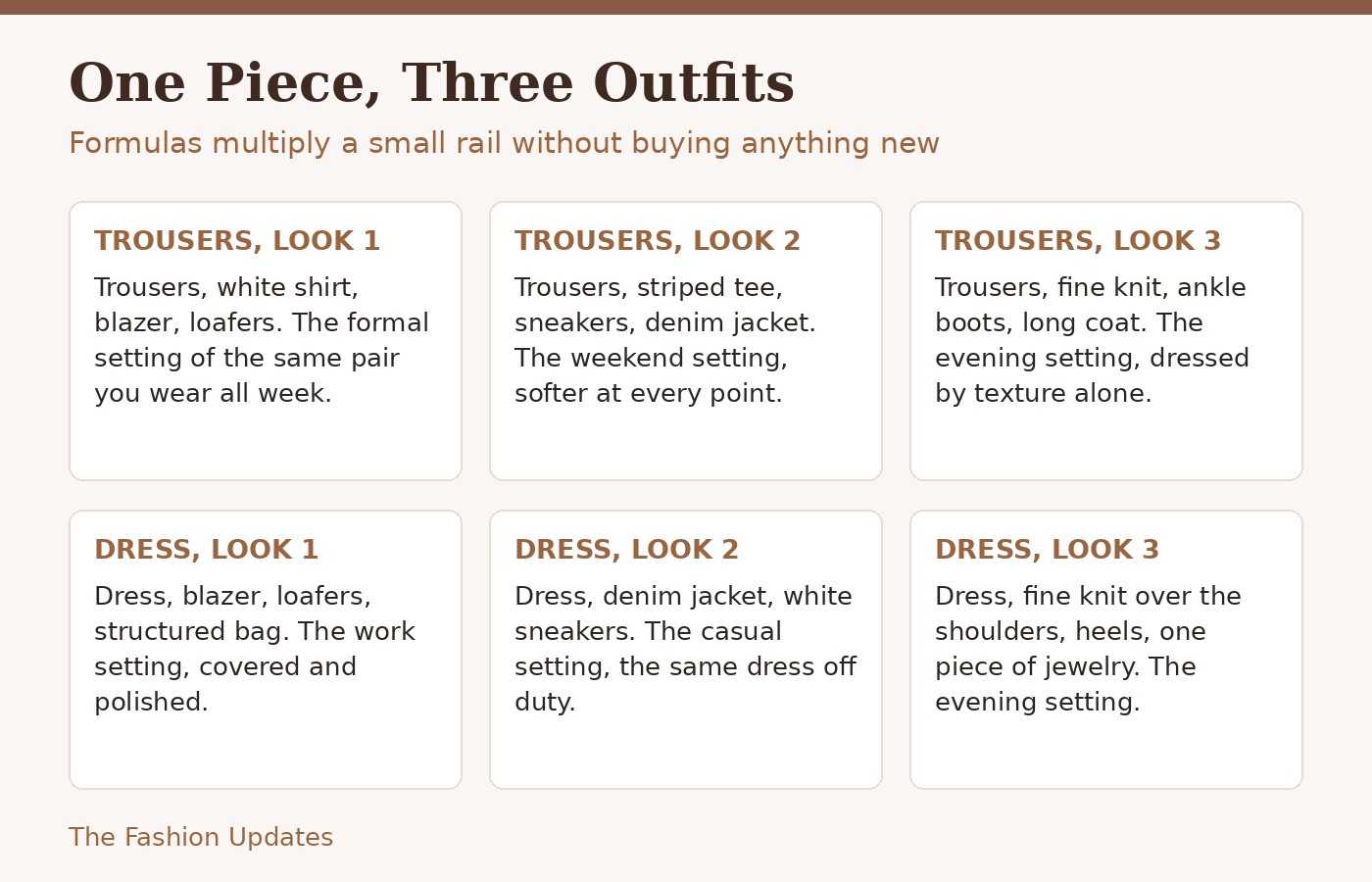
Start from outfits you have worn and felt right in, photographed if possible. Name the pattern in each, the proportions, where the volume sits, which layer finishes it. Those are your proven formulas. Build the capsule to serve them, and retire formulas that only worked once, for one event, with effort. Inspiration helps at this stage, provided it is filtered through your palette, and our best fashion magazines guide and our best fashion documentaries guide are good sources to browse with your formula list open beside you.
Rotate pieces inside each formula
The same formula with a different top, shoe, or accent is a different outfit to everyone who sees you, and more importantly it feels different to wear. This is where a capsule repays its planning. The Ellen MacArthur Foundation vision in its fashion work is of clothes kept at their highest value during use, and rotation is how an individual wardrobe does exactly that, spreading wear evenly so favourites are not worn to death while good pieces idle.
Keep a short list for difficult mornings
Save three complete outfits, head to toe, for days when you are late, tired, or low. Include the shoes, bag, and outer layer, not just the clothes. A capsule that only works when you have time and energy to experiment has missed its purpose.
Fill Gaps Slowly and Buy for Fit and Fabric
Shop from a written gap list
Your list might read, plain navy trouser that fits at the waist, cream knit that is not see-through, waterproof boot. Fashion Revolution reporting in its Fashion Transparency Index found that most major brands still do not disclose their annual production volumes, a reminder that the wider system is set up to sell volume. Your gap list is your defence, because it defines need before you meet marketing. If you are buying for someone else as well, our Mother’s Day gifts guide shows the same discipline applied to giving, one considered piece over a pile of guesses.
Judge fit in motion and fabric by the label
Try a possible core piece sitting, reaching, walking, and layered as you will wear it. Check the fiber label and care label together. The FTC textile guidance on fiber content is your tool here, since a beautiful shape in a fabric that wrinkles, pills, or cannot be cleaned in your routine will leave the rotation quickly.
Give every new piece a trial period
Hang a new piece where you will see it and build its three outfits within the first days. If you cannot, return it while you still can rather than demoting it to the back of the rail, where it becomes next audit’s problem. The United Nations reporting on fast fashion and waste notes that doubling the lifespan of clothing could cut its greenhouse gas emissions substantially, and the personal version of that finding is simple, buy pieces you will still be wearing when they are no longer new, and let the rest stay in the shop.
Care, Repair, and Storage Keep the System Working
Wash according to need and label
Follow the care label first, sort by color and fabric, and treat stains promptly. The American Cleaning Institute sets out in its laundry basics guidance to sort by color and care instructions, treat stains before washing, and choose settings that match the fabric, all of which protects the pieces a capsule depends on. Many garments need airing rather than a full wash after one wear, especially knitwear and trousers. Our best women’s deodorant guide is a practical companion here, since freshness routines affect how often clothes need washing, and our hair removal creams guide covers the small grooming choices that sit alongside a considered routine.

Jack & Rose Travel Steamer for Clothes,100-240V Portable Iron,15s Heat Up,Steamer & Iron 2 In 1, Travel Size,Large Ceramic Heat Panel,for Global and Europe
Offer 37.59 $
List Price
Repair at the first sign of failure
A loose button, a small split at a seam, or a hem coming down is a ten-minute fix now and a retired garment later. Keep a tiny kit, needles, thread in your neutrals, spare buttons, and safety pins, and use it the week you notice the problem. WRAP guidance on design for longevity identifies fit and fabric quality as central to how long clothes stay in active use, and repair is how you defend both after purchase.
Store so pieces stay ready
Give the capsule air and space. Crowding crushes shape, hides pieces, and recreates the full-but-nothing-to-wear problem inside a smaller rail. Store out-of-season pieces clean, folded or boxed, and keep everyday pieces visible at eye level where your formulas can find them. A short seasonal swap, rather than a permanent overflow rail, keeps the working wardrobe honest about what it actually contains.
A Small Wardrobe for Travel, Work, and Weekends
One core, three settings
For work, lean on the tailored trouser, shirt, blazer, and loafers. For weekends, the same trousers soften with a tee and trainers, while jeans take over with the same knitwear and coat. Nothing in that switch required new tops or layers, only different combinations of pieces you already own. That is the system working.
Packing is a capsule inside the capsule
A trip is the easiest place to prove your palette. Choose one neutral base for the trip, add two or three accents, and pack by formula, complete outfits that share shoes and a layer, rather than by individual favourite pieces. The EPA textiles data page notes that discarded clothing is the main source of textiles in municipal solid waste, which is a sobering backdrop for travel buying.
Handle exceptions without breaking the system
Weddings, funerals, interviews, and very formal events will occasionally need something outside the core. Borrow, rent, or keep one reliable occasion piece in a palette color rather than building a parallel wardrobe for rare days. The capsule is a working system for ordinary life, not a rule that must survive every exception unaided. Treating exceptions as exceptions is what keeps the core small and useful.
Review the Capsule and Let It Change
Review by wear, not by feeling
Look at what you actually wore, what needed repair, what you avoided, and what you wished you had. Feelings about clothes are unreliable after a single bad morning, but a season of avoidance is data. The UN ActNow guidance to ask whether you will wear a possible purchase many times before buying it works just as well in reverse at review time. Pieces that fail that test, even after honest attempts in different formulas, can be released without guilt.
Change one variable at a time
If outfits feel stale, change an accent, a shoe shape, or a layer before rebuilding the whole palette. Small changes refresh many combinations at once, which is the economic advantage of a system over a collection of outfits. Keep notes on what you changed and whether it worked, so the next review starts from knowledge rather than a vague sense that something is off.
Keep the long view
The Met Costume Institute collection shows how classic shapes keep returning across centuries, which is why a timeless core outlasts passing trends. The aim was never the smallest possible wardrobe. It was a wardrobe where everything works, where mornings are calm, and where money goes to pieces that earn it repeatedly. Fashion Revolution work through its transparency index keeps attention on how clothes are made and disclosed, and a capsule reader brings the same attention home, asking of each piece what it is made of, how long it will last, and how often it will be worn. A wardrobe that can answer those questions, piece by piece, is built.
Our view
We believe a capsule wardrobe works when it is treated as a system, not a shopping challenge. Audit honestly, choose a palette you will actually live in, keep core pieces that mix freely, and dress from formulas you trust. Buy slowly, care properly, and let the wardrobe change as your life does. A full closet stops being a problem the moment its pieces start working together.
— The Fashion Updates
Frequently Asked Questions
How many pieces should a beginner capsule wardrobe have?
There is no required number. Start with what survives your audit, then check coverage, two ordinary weeks, a smarter event, bad weather, and a trip. Many working capsules land at a few dozen pieces including shoes, but coverage matters more than the count.
Do I have to get rid of everything that is not neutral?
No. Neutrals should carry the expensive, long-lived foundations, while accents in colors you love provide the variety. A capsule with no personality will not be worn, and an unworn capsule helps no one. Keep accents that sit happily beside your neutrals.
What if my weight or size changes often?
Build the core around shapes with some flexibility, wrap styles, knitwear, elasticated or adjustable waists, and layers that work open or closed. Keep a small range of sizes for your most-worn basics if that is your reality, and audit by fit first at every review.
Can a capsule wardrobe work for a job with a dress code?
Yes, and it often works better there than anywhere, because the setting is predictable. Weight your proportions toward work, keep weekend pieces as variations on the same palette and formulas, and hold one reliable occasion piece for formal exceptions.
How do I stop a capsule from feeling boring?
Rotate pieces inside your formulas, change accents and accessories before changing foundations, and use texture, knit, stripe, denim, leather, and shine, to vary outfits within the same palette. Boredom usually means too little variation in texture and finishing pieces, not too few clothes.
Should I buy a whole new capsule at once?
No. Audit first, wear what you have in new combinations, and fill written gaps one at a time in priority order. Buying everything at once recreates the original problem, a rail of untested pieces that have never had to work together.
How We Pick What We Recommend
Every guide on The Fashion Updates follows the same review process — what we compare, what we check, and what we leave out.
Sources
- WRAP — Design for Longevity
- WRAP — Circular Business Models Guide for Fashion
- Ellen MacArthur Foundation — Fashion
- EPA — Textiles: Material-Specific Data
- United Nations — ActNow for Zero-Waste Fashion
- UN News — Fast Fashion Fuelling Global Waste Crisis
- FTC — Threading Your Way Through the Labeling Requirements Under the Textile and Wool Acts
- Textile Exchange — Preferred Fiber and Materials Market Report
- Purdue Extension — Consumer Clothing, Beginner Level
- NC State Extension — Well Dressed at Small Cost
- NC State Extension — Clothing Dollars and Sense
- Fashion Revolution — Fashion Transparency Index 2023
- American Cleaning Institute — Laundry Basics
- The Metropolitan Museum of Art — Costume in The Metropolitan Museum of Art