As an Amazon Associate I earn from qualifying purchases.
Sunglasses can look striking on a display and wrong within a minute on your face, sliding down, pinching at the temples, or making your features look wider, longer, or sharper than they are. The problem is rarely taste. It is a mismatch between a frame and the shape and proportions it has to balance. This guide works as a diagnostic first, helping you measure and identify your face shape, then matching frame shapes, lens categories, UV standards, and fit measurements to that result, so you choose once and wear the pair without thinking about it.
The Fashion Updates
Frames That Fit Your Face
Measure your face shape first, then match frame lines, lens coverage, and the three arm numbers that decide whether a pair fits all day.
Key Takeaways
- Identify your face shape from measurements first, comparing forehead, cheekbone, jaw, and face length, and let that result choose the frame shape.
- Choose a frame that contrasts your shape, adding angles to a round face, curves to a square face, and width where your face is narrowest.
- Read the three frame numbers before you try a pair, because lens width, bridge width, and temple length predict fit better than a size label.
- Buy only lenses with a stated 100 percent UV or UV400 claim, since tint darkness, polarization, and price do not prove UV protection.
- Match the lens category to the light you actually face, and never use a very dark category for driving.
Table of Contents
- Key Takeaways
- Start With Your Face Shape, Not the Frame Rack
- How to Identify Your Face Shape
- Oval, Round, and Square Faces
- Heart, Diamond, and Oblong Faces
- Read the Frame Measurements Before You Try
- Lens Categories, Tints, and Polarization
- UV Protection Is a Standard, Not a Shade
- Frame Color, Undertone, and Proportion
- Fit Checks, Care, and When to Replace
- Our view
- Frequently Asked Questions
- Sources
- Recommended
Start With Your Face Shape, Not the Frame Rack
Most disappointing pairs were chosen for a color or a trend, and only tested for balance once they were on. The same proportion first thinking runs through our swimsuit guide by body type, where the fit problem chooses the cut before the print does.
| Face shape | Frame shapes that balance it | What to avoid |
|---|---|---|
| Oval | Most shapes, especially square, rectangular, and aviator frames in proportion to face width | Oversized frames that overwhelm balanced proportions |
| Round | Rectangular, square, and angular frames, clear bridges, upswept cat-eye corners | Round frames and curved shapes that repeat the face |
| Square | Round, oval, and softly curved frames, thinner rims, higher bridges | Sharp rectangular frames that repeat the jaw |
| Heart | Bottom-heavy, oval, and light rimless frames, low-set temples | Top-heavy frames and wide, decorated brow lines |
| Diamond | Oval, cat-eye, and browline frames with detail at the brow | Narrow frames that sit inside the cheekbone width |
| Oblong | Tall, oversized frames, decorative temples, deeper lenses | Narrow, small, and short frames that leave the length unbroken |
Why contrast, not copying, creates balance
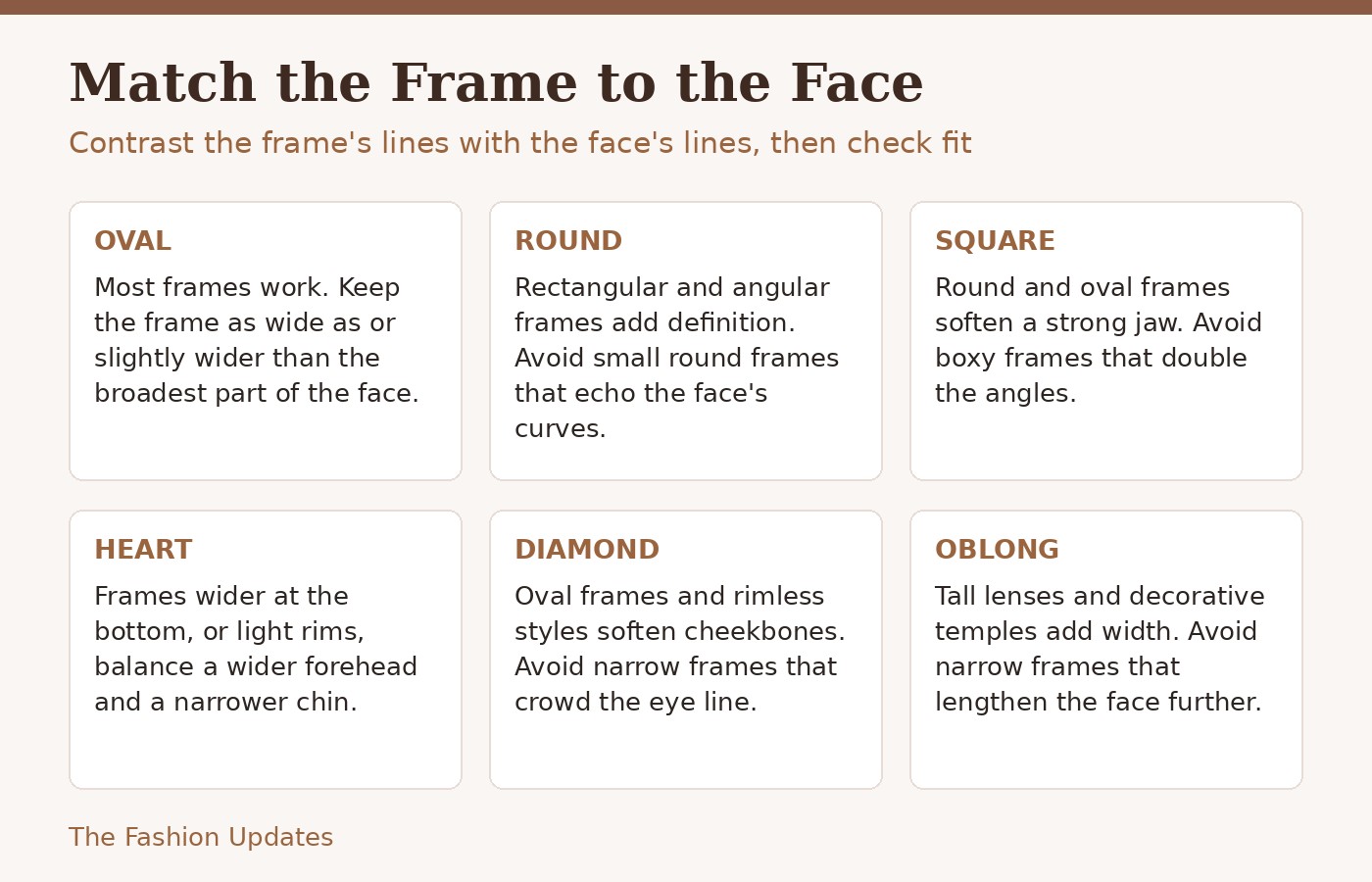
A frame balances a face by supplying what the face does not already have. A round face already has curves, so an angular frame adds definition. A square face already has angles, so a curved frame softens the jaw. Copying your own shape doubles it. Frame shape is also coverage: the American Academy of Ophthalmology notes that large lenses offer the largest shield, and wraparound styles prevent rays entering from the side.
How to Identify Your Face Shape
The four measurements to take
Pull your hair back, stand in even light, and use a flexible tape or a straight-on photograph. Measure your forehead across its widest point, your cheekbones from outer point to outer point, your jaw from the angle below one ear to the center of the chin and double it, and your face length from hairline center to chin tip. The pattern matters more than any single number: which measurement is widest, and how length compares with width, decides the shape. If you wear makeup with sunglasses, our best makeup foundations guide helps, because a frame resting on the cheeks will disturb base makeup all day.
Reading the pattern for each shape
An oval face has balanced measurements, no single widest point, and a gently rounded jaw, with length a little greater than width. A round face has similar width and length, full cheeks, and no sharp jaw angle. A square face has forehead, cheekbones, and jaw at similar widths with a strong jaw angle. A heart face is widest at the forehead and narrows to a pointed chin. A diamond face is widest at the cheekbones, with a narrower forehead and jaw. An oblong face is notably longer than wide. If two labels seem close, choose the one matching your jaw. Identification is not only about looks: the National Eye Institute advises choosing sunglasses that fit well and block light coming in around the lenses.
Oval, Round, and Square Faces
Our celebrities to follow for fashion inspiration works best after this diagnostic, once you know which shapes to look for on faces like yours.
Oval faces need proportion, and round faces need angles
An oval face can wear most shapes, so the work is keeping scale honest: choose a frame about as wide as the broadest part of your face, and avoid lenses so large they swallow your features. Rectangular frames add structure and aviators follow the natural balance. A round face needs the opposite treatment: length and definition. Rectangular and square frames add the angles the face lacks, a clear bridge makes the eyes look wider set, and upswept cat-eye corners lift the cheek line. Avoid round frames and heavy curved rims, which repeat the face and make it read fuller.

SUNGAIT Ultra Lightweight Rectangular Polarized Sunglasses Men UV400 Protection (Gunmetal Frame Silver Mirror Lens, 62) Metal Frame 2458QKSY
Offer 13.72 $
List Price
That angular, mid-width style suits oval and round faces in bright, reflective light. It is less useful for a narrow diamond face, where a wider brow line balances better. Pair a sharper frame with simpler jewelry, as in our cross necklaces for women guide, so the angles do not compete.
Square faces need curves and a softer rim
A square face needs softening at the jaw and forehead. Round and oval frames, curved aviators, and thinner rims reduce the sense of width and angle, and a bridge sitting a little higher lengthens the face. Avoid boxy rectangular frames, flat-bottomed lenses, and thick straight brow bars, which repeat the jaw line. A soft tortoise or translucent rim also reads gentler than a solid black block. Our guide to stopping heels hurting applies the same principle elsewhere: fix the structure rather than enduring it.
Heart, Diamond, and Oblong Faces
Our hair care tips guide is relevant too, because hairstyle changes apparent forehead width and can shift a borderline reading.
Heart faces need weight at the bottom
A heart face is widest at the forehead and narrowest at the chin, so a top-heavy frame makes the forehead wider and the chin smaller. Choose bottom-heavy frames, oval shapes, light colors, and thin lower rims that add presence at cheek and jaw level, with low-set temples. Avoid decorated brow lines, dark thick top bars, and wide cat-eye tops that flare where the face is already widest.

SOJOS Trendy Large Oversized Cat Eye Sunglasses for Women 70s UV400 Designer Shades SJ2231, Dark Blue/Brown
Offer 9.99 $
List Price
A softened, light cat-eye with its detail low and at the corners can suit a heart face when the top bar stays thin. A heavy, sharply flared cat-eye does the opposite, so judge this style by its brow line, not its name.
Diamond faces need width at the brow, oblong faces need height
A diamond face has prominent cheekbones with a narrower forehead and jaw, so the frame should add width above the cheekbones: oval frames, browline styles, and cat-eye shapes with detail at the brow all work, and the frame should be at least as wide as the cheekbones. An oblong face needs the opposite of lengthening: taller lenses, deeper frames, and horizontal detail that breaks the vertical line. Oversized square frames and decorative temples add width and shorten the apparent length, while small, narrow frames leave the full length exposed. Our what to wear with cowboy boots guide shows the same trick in an outfit, where one horizontal anchor balances a long silhouette.
Read the Frame Measurements Before You Try
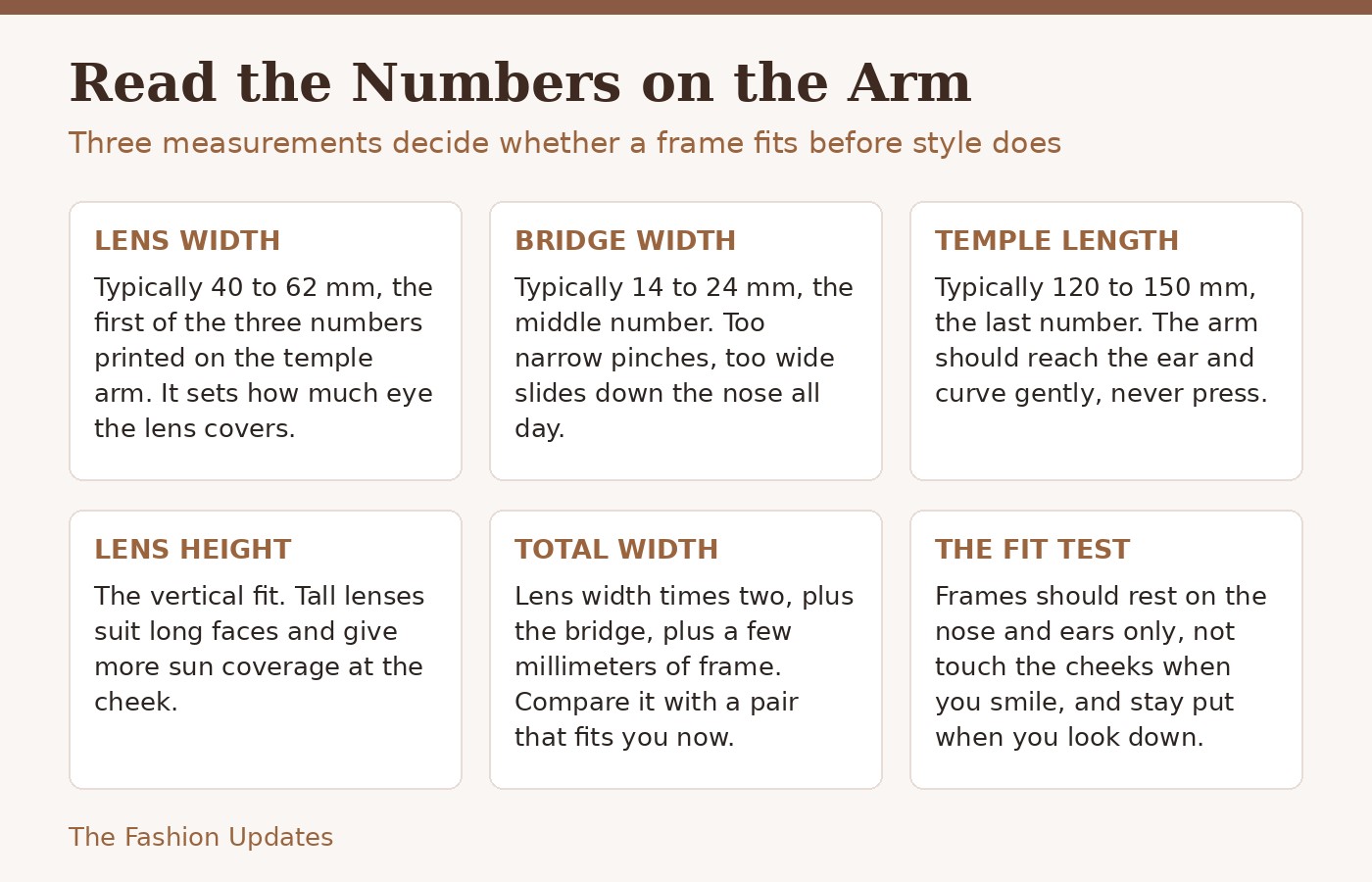
Every frame carries three numbers, usually printed inside a temple arm, in the form 52, 18, 140: lens width, bridge width, and temple length in millimeters. They predict fit more reliably than small, medium, or large labels, which vary by brand. The American Optometric Association stresses in its sunglasses checklist that the frame should fit close to the eyes and contour to the face, preventing exposure from all sides.
Lens width, bridge width, and temple length, in plain terms
Lens width is the horizontal width of one lens at its widest point, commonly in the high forties to low sixties in millimeters, and it sets the frame’s scale against your face width. Bridge width is the distance between the two lenses, commonly in the mid teens to low twenties, and it decides whether a pair sits high, pinches, or slides. Temple length is the arm from hinge to tip, commonly 135 to 150, and it decides whether the arm reaches comfortably behind the ear. Compare a new pair’s numbers with a pair you own that fits, and change one variable at a time. Add lens height, the vertical depth that drives coverage, and total frame width, which should roughly match your face width at the temples. Prevent Blindness makes the same point in its guide on choosing UV protection, recommending sunglasses comfortable to wear and large enough to shield the eyes from most angles.
Nose pads, bridge fit, and temple grip
Two frames with identical numbers can sit differently because of bridge design. Adjustable nose pads suit narrow or high bridges and lift the frame off the cheeks. A molded saddle bridge suits wider, lower bridges and spreads weight, but cannot be adjusted. Temples should touch lightly behind the ear, and the frame front should not rest on your cheekbones when you smile. If a pair touches your lashes when you blink, the bridge fit is wrong regardless of shape. For long outdoor days, our best women’s deodorant guide is a practical companion, since heat turns a marginal fit into a slipping one by midday.
Lens Categories, Tints, and Polarization
Lens darkness is described by a filter category, a scale from 0 to 4 measuring how much visible light a lens lets through. The College of Optometrists sets out the filter categories from the BS EN ISO 12312-1 standard: category 0 lets through over 80 percent of light, category 1 over 43 to 80 percent, category 2 over 18 to 43 percent, category 3 over 8 to 18 percent, and category 4 over 3 to 8 percent. The category describes comfort and glare only. It says nothing about ultraviolet protection, which is checked separately below.
Choosing a category, and what tint color does
Category 0 and 1 lenses are very light tints with limited glare reduction. Category 2 is the everyday middle ground for ordinary sunshine. Category 3 is the standard choice for bright sun, the beach, and water. Category 4 is reserved for extreme glare such as glaciers. The same College guidance limits road use to categories 0 to 3, and lenses letting through less than 75 percent of light are not suitable at twilight or night, so never drive in category 4. Tint color is a separate choice: gray keeps colors natural, brown and amber raise contrast, and green balances the two. The American Academy of Ophthalmology explains in its guide to recommended types that color and darkness tell you nothing about ultraviolet blocking. Our nail polish colors for skin tone guide uses the same warm and cool logic for smaller accents.
Polarized, photochromic, and mirrored lenses
Polarized lenses cut reflected glare from water, roads, and snow, but polarization itself does not block ultraviolet light, so a polarized pair still needs its own UV claim checked on the label.

FINTIE Sunglasses Case, Hard EVA Shell Shockproof Sport Glasses Case (Orange)
Offer 9.99 $
List Price
A rigid case protects any of these lens types between wears. Polarized and mirrored coatings scratch when a pair is carried loose in a bag, so storage is part of the lens decision, not an extra.
UV Protection Is a Standard, Not a Shade
Ultraviolet protection is the health core of a pair of sunglasses, and it is invisible: a clear lens can block it fully and a very dark lens can block almost none. The U.S. Food and Drug Administration advises in its guidance on staying safe in the sun to choose sunglasses with a UV400 rating or 100 percent UV protection on the label, which block more than 99 percent of UVA and UVB radiation. Treat any pair without a stated percentage or UV400 claim as unproven, however good it looks.
What UV400 means, and the standards behind the label
UV400 means the lens blocks light up to 400 nanometers, covering the UVA and UVB ranges, and a 99 to 100 percent UVA and UVB claim makes the same promise in different words. In the United States, nonprescription sunglasses are regulated as medical devices, a status the FDA sets out in its guidance document covering impact resistance and labeling. The national standard ANSI Z80.3 establishes requirements for noncorrective sunglass lenses, covering transmittance and durability, as the ANSI blog explains in its summary of ANSI Z80.3 requirements. ISO 12312-1 does similar work internationally and sits behind the filter categories above.
Why coverage, hats, and timing still matter
Even a fully blocking lens only protects what it covers, and light enters around a small or loose frame. The Centers for Disease Control and Prevention advises in its guidance on reducing risk to wear wraparound sunglasses that block both UVA and UVB rays, alongside shade and a wide brimmed hat. The Skin Cancer Foundation gives the same layered advice in its expert answers, reminding readers to wear UV blocking sunglasses and a wide brimmed hat. The Environmental Protection Agency explains in its UV Index descriptions that bright surfaces can double exposure at high index levels. Johns Hopkins Medicine adds in its guide on how sunglasses help that lens material matters, since polycarbonate has built in UV protection while other materials rely on a coating. The Vision Council notes in its article on the science behind the style that ultraviolet damage is cumulative.

Frame Color, Undertone, and Proportion
Once shape, measurements, category, and UV claim are settled, color is a safe place to express taste. The useful order is undertone first, then contrast, then finish, because a frame in the wrong undertone can make skin look tired even when the shape is perfect. Our guide to finding your skin undertone is the diagnostic to run first if you do not know whether you are warm, cool, or neutral.
Warm, cool, and neutral undertones in frames
Warm undertones tend to suit tortoise, warm brown, gold, amber, and olive frames. Cool undertones tend to suit black, silver, charcoal, blue based tortoise, and icy translucent frames. Neutral undertones can wear both families and should choose by contrast: a deeper frame for definition, a lighter one for a softer look. Test a frame in daylight, not shop light, and look at your skin rather than the frame. Also run the cheek test: smile fully, and if the lower rim touches and presses foundation onto the lens, try a higher bridge, adjustable pads, or a smaller lens height.
Fit Checks, Care, and When to Replace
The five minute movement test
Put the pair on and look up, look down, shake your head gently, bend to tie a shoe, and smile. The frame should not slide, press at the temples, touch the cheeks, or brush the lashes. Look at a straight edge and move the glasses slowly; lines should stay straight, and wavy lines mean poor lens quality.
Cleaning, storage, and when to replace
Rinse dust off with water before wiping, clean with a microfiber cloth, and avoid paper towels, which grind grit into coatings. Store the pair in its case, and never leave sunglasses on a hot dashboard, where heat can warp the fit you measured. Replace a pair when the lens is scratched across the center of vision, a coating is peeling, the frame no longer holds its adjustment, or the UV claim was never stated and cannot be verified; an optical shop can test blocking with a photometer. Children need the same standard, not a toy version. Our guide to healthy heel height makes the parallel point for shoes, and our women’s cowboy boots guide applies the same replace on condition, not on fashion, rule.
Our view
We believe the best sunglasses are the pair you stop noticing, because the shape balances your face, the bridge sits without sliding, and the lens claim was verified before the color was admired. Measure your face first, choose contrast over copying, read the three frame numbers, and refuse any lens without a stated UV standard. Face shape then becomes a short set of instructions for finding a pair that protects as well as it flatters.
— The Fashion Updates
Frequently Asked Questions
How do I find my face shape if I am between two shapes?
Use the shape that matches your jaw and your widest measurement. If you are between round and oval, shop the round advice first, since angular frames flatter both.
What sunglasses suit a round face best?
Rectangular, square, and angular frames with a clear bridge suit a round face best, because they add definition and length. Avoid round and small circular frames, which repeat the face shape.
Are darker lenses always more protective?
No. Tint darkness controls visible light and glare, described by the filter category, and says nothing about ultraviolet blocking. Only a stated 100 percent UV, 99 to 100 percent UVA and UVB, or UV400 claim describes protection.
What do the three numbers on the temple arm mean?
They are lens width, bridge width, and temple length in millimeters, in that order. Compare them with a pair that already fits you, and change only one measurement at a time.
Can I drive in category 4 sunglasses?
No. Category 4 lenses let through only about 3 to 8 percent of visible light and are intended for extreme glare such as glaciers.
Do polarized sunglasses replace UV protection?
No. Polarization cuts reflected glare, which improves comfort, but it does not itself block ultraviolet light. A polarized pair still needs its own stated UV claim on the label.
How We Pick What We Recommend
Every guide on The Fashion Updates follows the same review process — what we compare, what we check, and what we leave out.
Sources
- American Academy of Ophthalmology — How to Choose the Best Sunglasses to Avoid Sun Damage
- American Academy of Ophthalmology — Recommended Types of Sunglasses
- American Optometric Association — Do Your Sunglasses Really Protect Your Eyes from the Sun?
- FDA — Tips to Stay Safe in the Sun: From Sunscreen to Sunglasses
- FDA — Guidance Document for Nonprescription Sunglasses
- National Eye Institute — Protecting Your Eyes from the Sun’s UV Light
- CDC — Reducing Risk for Skin Cancer
- Skin Cancer Foundation — Expert Answers to Your Sun Protection Questions
- Prevent Blindness — Choosing UV Protection
- Johns Hopkins Medicine — How Sunglasses Help Protect Your Eyes’ Health
- College of Optometrists — Tints and Driving
- ANSI Blog — ANSI Z80.3 Sunglasses Requirements
- EPA — UV Index Descriptions
- The Vision Council — Celebrating National Sunglasses Day: The Science Behind the Style