
As an Amazon Associate I earn from qualifying purchases.
A swimsuit can look perfect on a hanger and fail in the first five minutes in the water, riding up, digging in, going sheer, or leaving you tugging at a strap instead of swimming. The problem is rarely your body. It is a mismatch between a cut and the job that cut has to do. This guide works as a fit diagnostic by body shape, matching necklines, rises, support features, and fabrics to the specific problem each one solves, so you can choose once and then get on with the day.
The Fashion Updates
Fit First, Then Style
A shape-by-shape diagnostic for necklines, rises, support, and fabrics — so the suit works in the water, not just in the mirror.
Key Takeaways
- Start with the fit problem you want solved, support, coverage, leg movement, or torso length, and let that problem choose the cut before color or print does.
- Match the neckline and strap structure to your bust, because a decorative neckline cannot do the work of an underwire, a wide band, or adjustable straps.
- Choose the rise and leg opening for your hips and thighs, since the wrong rise creates digging, riding, and constant adjustment no fabric can fix.
- Read the fabric label for fiber content and elastane percentage, because recovery, chlorine resistance, and opacity in water depend on that blend.
- Prefer coverage and a stated UPF rating when sun protection matters, and rinse and dry every suit promptly so the fit you bought lasts.
Table of Contents
- Key Takeaways
- Start With the Fit Problem, Not the Print
- Read Your Shape Honestly
- Bust Support Is a Structure, Not a Neckline
- Necklines That Solve Specific Problems
- Waist, Tummy, and Torso Length
- Hips, Thighs, and the Right Rise
- Shoulders, Back, and Balance
- Fabric Decides Whether the Fit Lasts
- Sun Protection, Coverage, and Skin
- Fit Checks and Care That Protect the Fit
- Our view
- Frequently Asked Questions
- Sources
- Recommended
Start With the Fit Problem, Not the Print
Most disappointing suits were chosen for a color, and only tested for fit once wet. Name your recurring problem first, straps slip, the bust feels unsupported, the leg elastic digs, the suit goes sheer, and let it narrow the cut. Only then choose a color. For specific picks to test after this diagnostic, our best swimsuits guide owns the product shortlist.
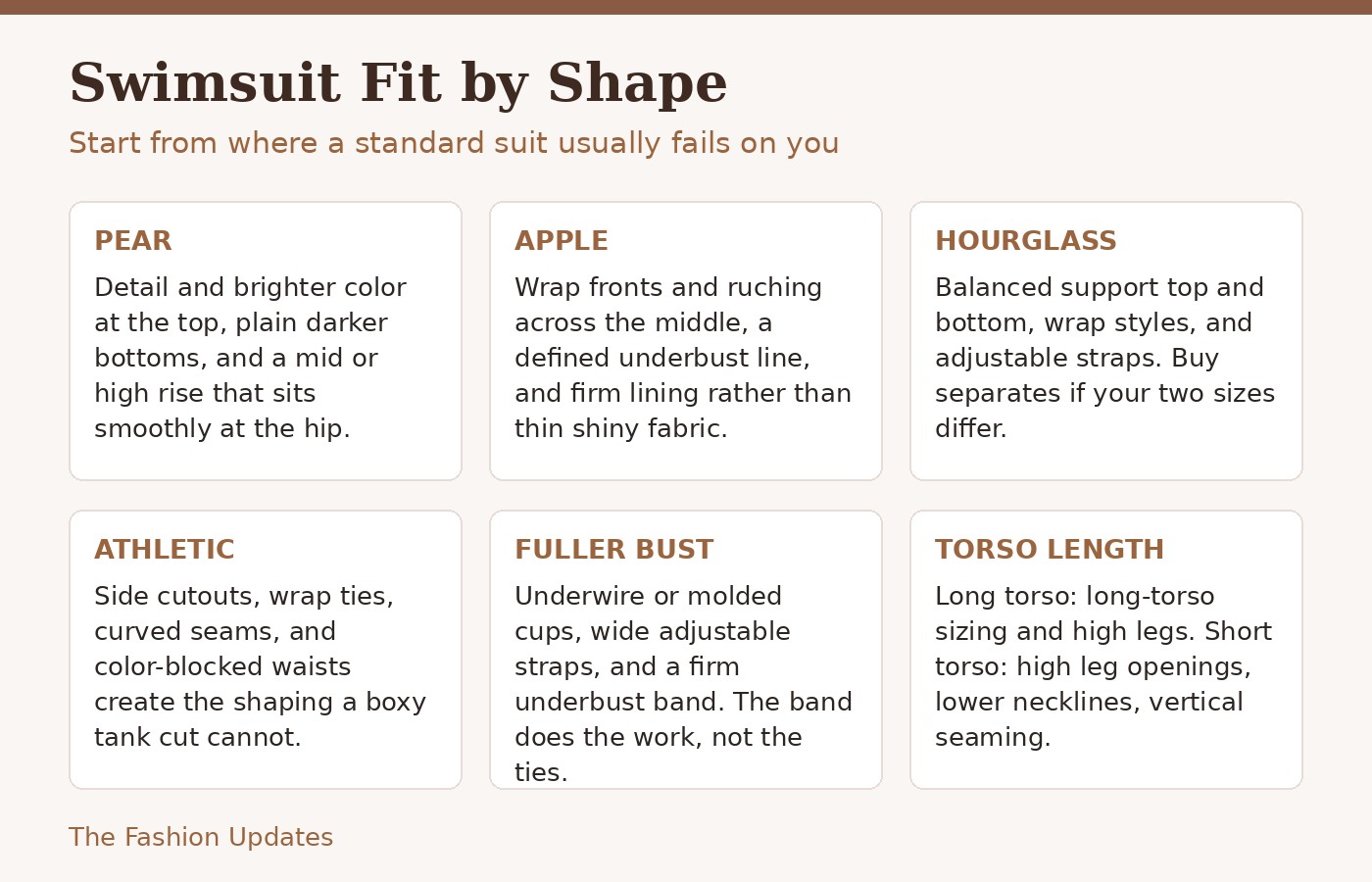
| Body shape or fit need | Best cuts and features to try first | What to avoid |
|---|---|---|
| Fuller bust | Underwire or molded cups, wide adjustable straps, firm underbust band | Thin halter ties alone, bandeau with no band |
| Smaller bust | Molded cups, texture at the bust, scoop or sweetheart neckline | Longline tops that flatten, compression with no cup shaping |
| Pear shape | Plain, darker bottoms, mid or high rise, detail at the top | Low, tight hipster bands, busy print on the bottom |
| Apple shape | Wrap fronts, ruching, one piece with a defined underbust | Thin, shiny, unlined fabric across the tummy |
| Athletic shape | Side cutouts, wrap ties, curved seams, color blocked waists | Straight, boxy tank cuts with no waist shaping |
| Hourglass | Balanced support top and bottom, wrap styles, adjustable straps | Fixed sets when your top and bottom sizes differ |
| Long torso | Long torso sizing, adjustable straps, high leg, separates | Standard one pieces that pull at shoulder and leg |
| Short torso | High leg openings, lower necklines, vertical seaming | Long, high neck one pieces that bunch at the waist |
| Broad shoulders | Asymmetric or V necklines, detail at the hip | Boat necklines, thin straps set very wide |
| Narrow shoulders | Halter and high neck styles, detail at the shoulders | Deep, narrow racer cuts that pull the line inward |
Why the problem comes first
Breast tissue has limited internal support. The University of Portsmouth explains in its sports bra research that the breast moves independently when the body moves, and that skin and Cooper’s ligaments are its main natural support. The same anatomy is at work in surf, which is why structure has to carry a fuller bust.
Color and print come second
Print placement changes how proportions read. A darker, plain bottom with a brighter top draws the eye upward for a pear shape, and a print across the bust adds visual volume for a smaller bust. Use those tools after the cut is right. If undertone guides your color choice, use our skin undertone guide rather than guessing in changing room light.
Read Your Shape Honestly
Body shape labels are tools, not verdicts. Use the label that describes where a standard suit usually fails on you. If suits feel fine at the hip and short in the body, torso length is your real category.
Pear, apple, hourglass, athletic, and in between
A pear shape carries more width at the hip than at the bust. An apple shape carries fullness through the midsection with slimmer legs. An hourglass shape has a defined waist with bust and hip in balance. An athletic shape has a straighter waist. None needs correcting. Each predicts which rises and necklines will sit smoothly and which will dig or gap. If you need a different size on top and bottom, buy separates, because a fixed set that fits the larger half will sag on the other half in the water.
Measurements that actually help
Three measurements predict swim fit better than dress size. Your underbust predicts whether a band will stay put, your fullest hip whether a rise will dig, and your torso loop, from one shoulder down through the legs and back up, whether a one piece will pull. For long, hot days, our best women’s deodorant guide is a practical companion, since band areas are where heat and friction collect.
Bust Support Is a Structure, Not a Neckline
A neckline describes an opening. Support describes a system, a cup, band, strap, and fabric tension working together. Confusing the two is the most common reason a beautiful suit disappoints a fuller bust, and why a smaller bust can end up flattened by compression it never needed.
What actually holds a bust up in water
The band does most of the work. A firm, ideally adjustable band under the bust anchors the suit so straps are not carrying the whole load on your neck. Cups shape and separate, whether molded, sewn, or underwired, and wider straps distribute what remains. Lift your arms, bend, and walk in the changing room. If the band rides up or the bust shifts below the cup, the system is not working. For active days, choose a genuinely structured style.

Miraclesuit Women's Swimwear Rock Solid Starr Underwire Tummy Control One Piece Swimsuit, Black, 16
New starting from 170.00 $
That construction suits fuller busts and long active days. It is less necessary for a smaller bust or a quiet sunbathing day, where a softer cup may be more comfortable.
Smaller busts need shaping, not just padding
For a smaller bust, a high compression top flattens what shaping could present. Molded cups, a sweetheart or scoop neckline, gathering, or texture at the bust create a defined line. Check removable pads in person, because a pad that folds in water is worse than no pad. If a top gaps when you lean forward in the shop, it will gap further in the water. Our hair removal creams guide can help with a clean line along a high cut edge.
Necklines That Solve Specific Problems
V, scoop, square, and sweetheart
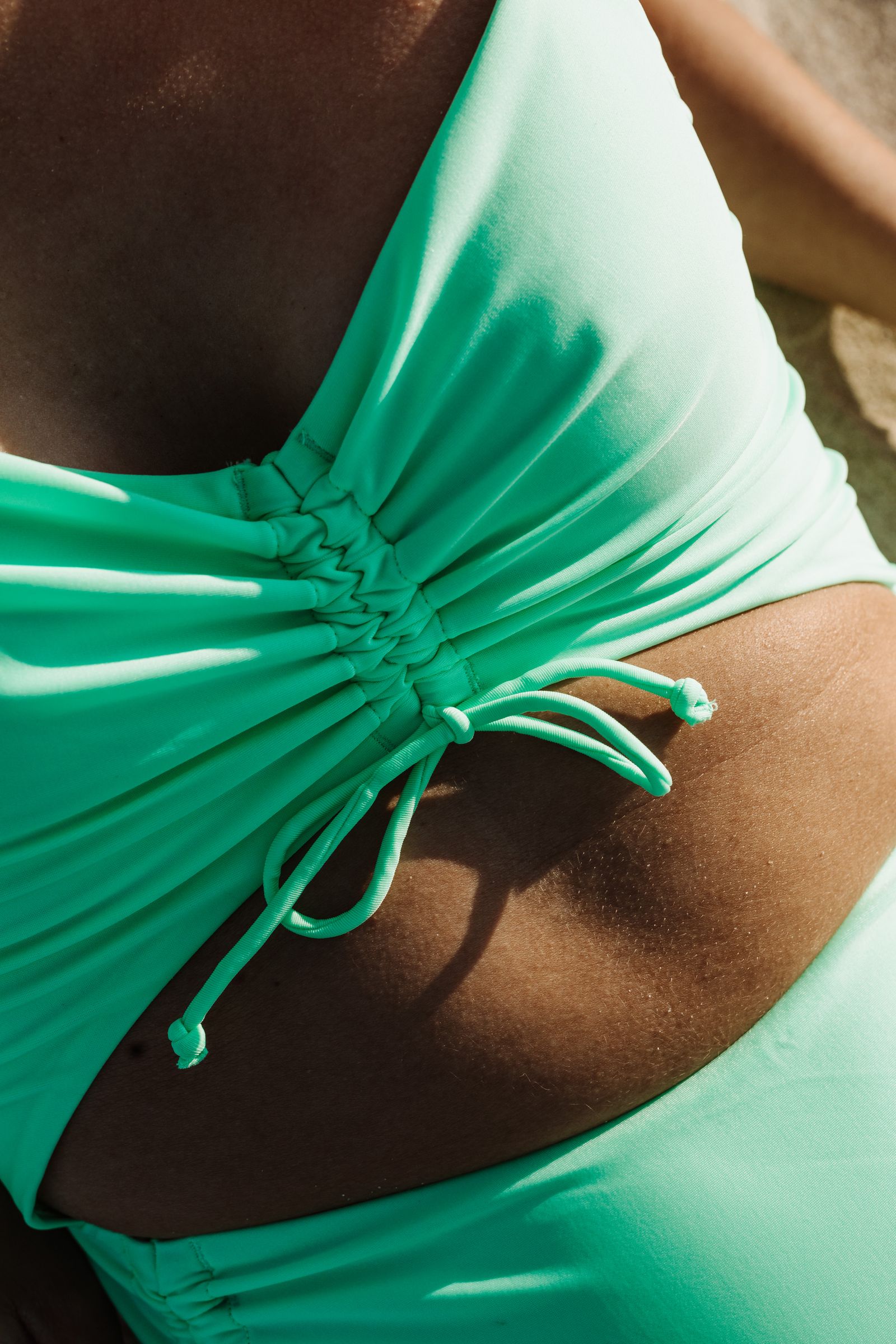
A V lengthens the torso line and suits shorter torsos, supported fuller busts, and broad shoulders. A scoop gives easy coverage for smaller to medium busts. A square neckline offers more side coverage and balances narrower shoulders. A sweetheart adds shaping at the center. Coverage is also sun coverage. The American Academy of Dermatology advises in its guide on what to wear to cover as much skin as practical and to choose clothing with a UPF number on the label, so a higher neckline does double duty for anyone who burns across the chest.
Halter, high neck, and bandeau, with their limits
A halter can lift a medium bust and adds width at the shoulder, but all its weight transfers to the neck, which a fuller bust will feel within an hour. A high neck gives the most coverage and least shifting in active water, but can bunch on a short torso. A bandeau depends entirely on a tight band, so it suits smaller busts and short, still sessions far better than swimming. Skin the suit does not cover still needs sunscreen. The Skin Cancer Foundation notes in its sun protective clothing guidance that coverage is one of the factors that makes clothing protective, alongside color, construction, and content. Our best lip plumpers guide covers low effort color between swims.
Waist, Tummy, and Torso Length
Wrap fronts, ruching, and lining
A wrap or surplice front creates a diagonal line and a defined point under the bust, suiting apple and hourglass shapes. Ruching breaks up a flat expanse of shiny fabric and hides small shifts when you sit and bend. Firm lining, often called power mesh, smooths rather than reshapes, but it makes a suit warmer and harder to remove when wet, so test that tradeoff while dry.

Miraclesuit Women's Swimwear Illusionists Palma One Piece Swimsuit, Black, 12
Offer 140.00 $
List Price
That combination gives definition under the bust, smoothing across the front, and straps set to your torso. A short torso may do better with the same wrap idea in a tankini.
Long and short torsos are sizing problems
A standard one piece on a long torso pulls at the shoulders and rides up at the leg. On a short torso, the same suit bunches at the waist. Neither problem is about weight, and sizing up or down only moves the misfit. Look for long torso or petite sizing and straps that adjust over a real range. Separates remove the fixed loop entirely. The same proportion first thinking runs through our best makeup foundations guide.
Hips, Thighs, and the Right Rise
Low, mid, and high rise, explained by where they sit
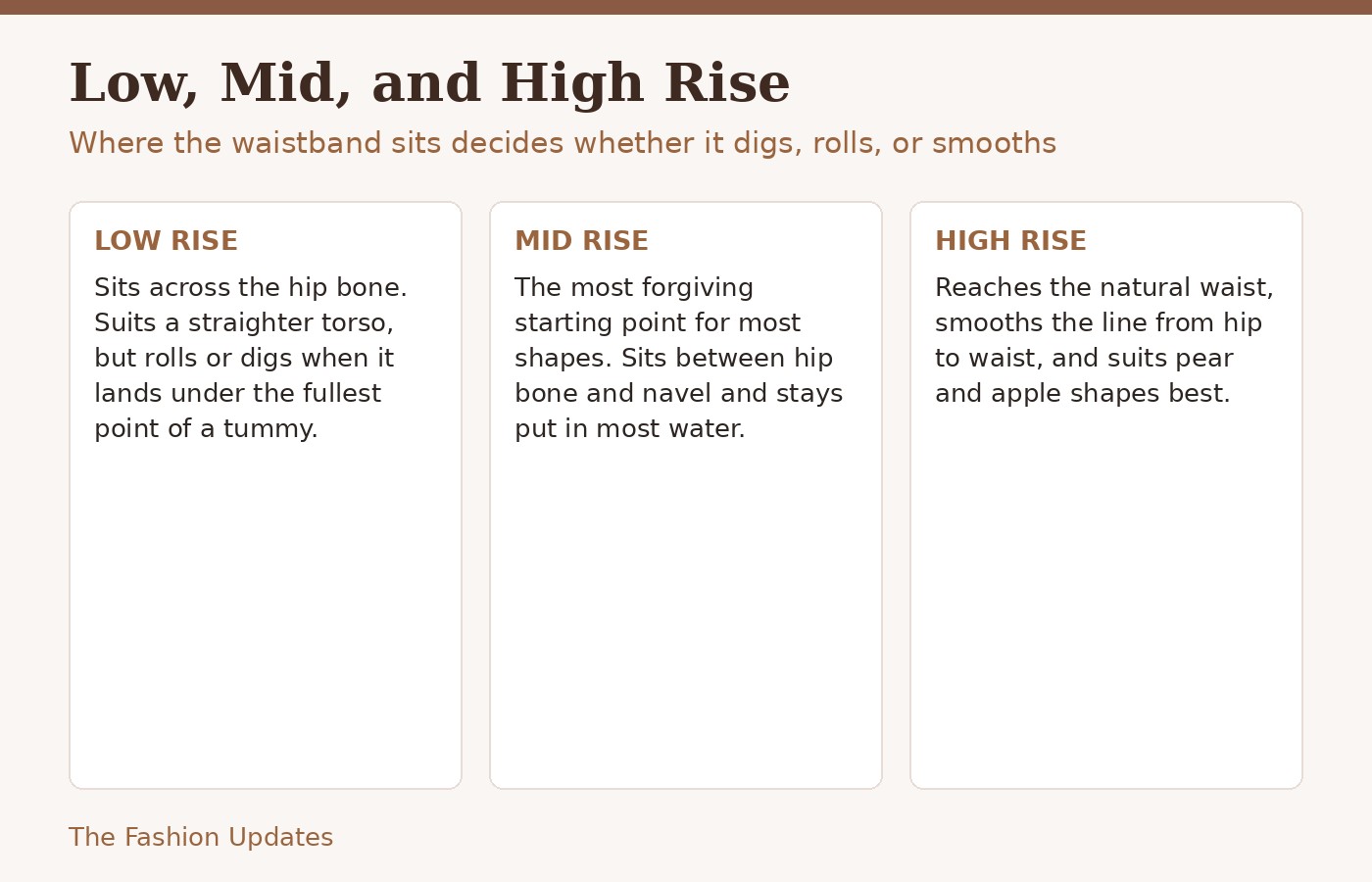
A low rise sits across the hip bone, suits a straighter torso, and fails when it lands under the fullest point of a fuller tummy, where it rolls or digs. A mid rise is the most forgiving starting point for most shapes. A high rise reaches the natural waist, smooths the line from hip to waist, and suits pear and apple shapes. A higher leg gives the thigh room to move without elastic sawing at the crease, so many fuller thighs are more comfortable in a higher cut than in a low, boyish leg. The elastic should sit in the natural crease and lie flat.
Bottom coverage and movement
Fuller coverage stays put better in surf, and skirted bottoms and swim shorts add thigh coverage and reduce chafing, at the cost of slower drying. For active days, a secure high rise bottom in a firm, opaque fabric is the workhorse recommendation.

Miraclesuit Women's Swimwear Super High Waist Pant Tummy Control Bathing Suit Bottom, Black, 14
New starting from 95.00 $
Pair it with a top chosen for your bust, in a size chosen for your hip, which is exactly why separates exist. Our nail polish colors for skin tone guide is a useful companion for finishing details once fit is settled.
Shoulders, Back, and Balance
Broad and narrow shoulders
For broad shoulders, a V or asymmetric neckline narrows the opening, while detail at the bottom restores balance. Avoid boat necklines and ruffles on the shoulder line. For narrow shoulders, do the reverse, a halter or square neckline adds width that balances a fuller hip. Back design carries support consequences too. A low, open back removes structure, because the band cannot continue firmly around the body. If you need real support, choose a clasp, a higher band, or crossed straps. A racerback is the most secure back for active swimming, but pulls straps inward.
Posture, reach, and real life tests
Try every suit with the movements of your actual day, reach overhead, bend, sit, and twist. Straps that slip during a reach test need adjustment, a different back, or a different size, and it is far better to learn that in the shop than in the sea. Our hair care tips guide covers protecting hair from chlorine and sun.
Fabric Decides Whether the Fit Lasts
Nylon, polyester, and elastane, in plain terms
Most swim fabric is a knit blend of nylon or polyester with elastane, also sold as spandex or Lycra. A textile overview of swimwear fabric and construction describes typical blends of roughly eighty to ninety percent nylon or polyester with ten to twenty percent elastane, and notes that the knit structure allows stretch and recovery. Nylon feels softer. Polyester resists chlorine and sun better, which is why many training suits are polyester based. A fabric buying guide on best fabric for swimwear makes the same distinction. Elastane percentage alone does not guarantee recovery, so stretch a handful of fabric in the shop and watch how it snaps back. The Federal Trade Commission explains in its guidance on threading your way that textile labels must list fiber content, country of origin, and the responsible business.
Opacity, lining, and chlorine
Stretch a light colored suit over your hand under bright light. If skin tone shows through a single layer, water will make it worse, especially in white and thin unlined prints. A full front lining is a minimum for light colors. Chlorine is the main enemy of elastane. A textile scientist explains in a report on rinsing swimwear that elastane is the most vulnerable component of swim fabric, that polyester resists chlorine better than polyamide, and that chlorine, sun, and saltwater degrade fibers over time. If you swim often, rotate two suits so each dries fully.
Sun Protection, Coverage, and Skin
What UPF means on a swimsuit label
UPF indicates how much UV radiation a fabric allows to reach your skin. The Skin Cancer Foundation explains in its expert answers that UPF thirty to forty nine offers very good protection, while UPF fifty and above offers excellent protection and blocks about ninety eight percent of rays. The rating applies only to skin the fabric covers, and can fall when fabric is stretched or wet. ARPANSA describes the Australian sun protective clothing standard in the same terms, from minimum protection at fifteen to excellent at fifty plus. A rated long sleeved swim top is therefore a different product from a decorative mesh cover up with no rating.
Coverage choices and exposed skin
The Centers for Disease Control and Prevention advises in its guidance on reducing risk to wear covering clothing, a wide brimmed hat, and wraparound sunglasses, and to use broad spectrum sunscreen on exposed skin. A bandeau day and a long sleeved day are not the same exposure, so the shade plan should change with the suit. The Environmental Protection Agency sets out in its UV Index descriptions that at high levels protection is needed and bright surfaces can double exposure. The National Weather Service gives the same warning in its ultraviolet index forecasts guidance for water and sand, and NHS Wales advises in its sun safety guidance to cover up and use at least factor thirty sunscreen on uncovered skin. For seasonal cover up options, see our Easter and spring fashion picks.
Fit Checks and Care That Protect the Fit
The dry checklist and the first swim
Check the band first. It should sit level and stay in place when you lift your arms. Check cups second, with no spilling or gaping when you bend, then straps, and that any clasp can be worked by you alone. Check the rise sitting down, and the leg elastic from behind. Then wear a new suit first for a short, low stakes swim and notice what changes when wet, whether the band loosens or the fabric turns sheer. Choose simple accessories, as in our cross necklaces for women guide, and leave anything precious out of chlorinated water. Photographs, including the feeds in our celebrities to follow for fashion inspiration, are useful for mood, but your movement test outranks any photograph.
Rinse, wash, dry, and retire
Rinse in cold water after every swim, hand wash with a mild detergent, avoid bleach and fabric softener, and dry flat in shade. Never use a tumble dryer, since heat makes elastane brittle. Follow the care label over any general routine. Retire a suit when the fabric feels rough or thinned, when the seat has lost its snap, or when it is no longer opaque when wet. Those are structural failures, not cosmetic ones. Our best fashion magazines guide and our how to apply nail polish guide are good companions for planning what comes next.
Our view
We believe the right swimsuit is the one you stop thinking about once you are in the water. Name the fit problem first, give a fuller bust real structure, give hips and thighs a rise that sits in the crease, respect your torso length, and read the fabric label before the color chart. Body type then becomes a short set of instructions for finding a suit that works.
— The Fashion Updates
Frequently Asked Questions
How do I know my body shape for swimwear if I am between two types?
Use the shape that predicts where suits fail on you. If they fit your bust and fail at the hip, shop as a pear for bottoms. If they fit everywhere except torso length, choose separates or long torso sizing.
Should a fuller bust always choose underwire in a swimsuit?
Not always, but a fuller bust always needs a support system, underwire with a firm band, molded cups with a wide adjustable band, or a movement tested high neck active style. Thin ties carrying the whole load do not work.
Is a high rise always more flattering than a low rise?
No. A high rise suits many pear and apple shapes and stays secure in activity, but on a short torso it can crowd the waist. Judge a rise by where its band lands, whether it digs sitting down, and whether it stays put when wet.
Why does my swimsuit go sheer when it gets wet?
Thin, light colored, unlined fabric is the usual cause, and stretching it makes it worse. Test opacity over your hand in bright light, choose lined styles in pale colors, and remember that an older suit can turn sheer as its fibers thin.
How long should a swimsuit last?
It depends mainly on chlorine exposure and care. A polyester suit rinsed after every swim and rotated with another suit lasts far longer than a nylon suit worn daily in a pool and left wet in a bag.
Can I rely on a UPF label instead of sunscreen?
Only for the skin the fabric covers, and only while the fabric is not badly stretched or degraded. Use sunscreen on all exposed skin, seek shade at the strongest hours, and treat a rated swim top as coverage, not as protection for uncovered areas.
How We Pick What We Recommend
Every guide on The Fashion Updates follows the same review process — what we compare, what we check, and what we leave out.
Sources
- American Academy of Dermatology — What to Wear to Protect Your Skin From the Sun
- Skin Cancer Foundation — Sun Protective Clothing
- Skin Cancer Foundation — Expert Answers to Your Sun Protection Questions
- CDC — Reducing Risk for Skin Cancer
- EPA — UV Index Descriptions
- ARPANSA — Australian Sun Protective Clothing and the AS/NZS Standard
- FTC — Threading Your Way Through the Labeling Requirements Under the Textile and Wool Acts
- University of Portsmouth — Wearing a Well-Fitting Sports Bra Can Improve Your Performance
- Phys.org, The Conversation — Do I Have to Rinse Out My Swimsuit After the Pool?
- TextileTuts — Swimwear Fabric and Construction
- PandaWoven — Best Fabric for Swimwear: Nylon, Polyester and GSM
- National Weather Service — Ultraviolet Index Forecasts
- NHS Wales — Sun Safety