You love the clothes, but a magazine photograph never shows you how they came to be, who argued over them, who sewed them at midnight, or who decided they mattered at all. That is the gap a good fashion film fills. The best fashion documentaries and style films take you past the finished image and into the rooms where taste is made, tested, and defended, so you come away understanding your own wardrobe in a completely new way.
The Fashion Updates
Watch the Film, Keep the Lesson
Fashion documentaries and style films, sorted by what each one teaches you about clothes, makers, and your own wardrobe.
Key Takeaways
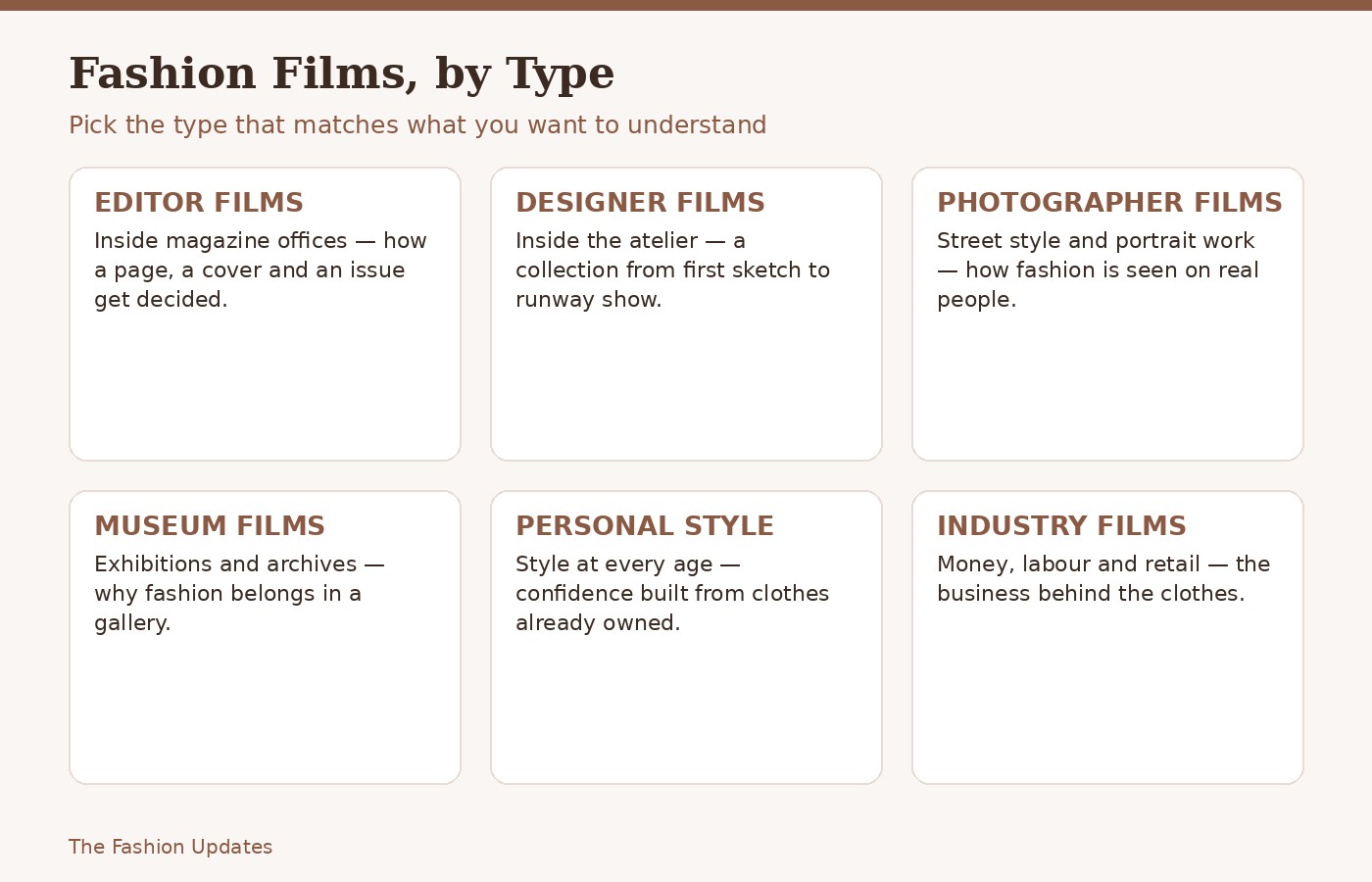
- The strongest fashion films fall into clear types, and knowing the type helps you pick the right film for your mood.
- Editor films reveal how a magazine page is built, while designer films reveal how a collection moves from sketch to runway.
- Photographer portraits teach you how to look at clothes on real streets, not only on models.
- Museum films explain why fashion belongs in a gallery and how an exhibition is put together.
- Personal style films are the most useful for your own wardrobe, because they show confidence built from what you already own.
Table of Contents
- How to Choose the Right Fashion Film for You
- Inside the Magazine: Films About Editors
- Inside the Atelier: Films About Designers
- The Photographers Who Teach You How to See
- Fashion in the Museum: Exhibitions on Screen
- Personal Style on Screen: Dressing for Yourself
- Style Films That Are Not Documentaries
- How to Watch a Fashion Film Like a Stylist
- Our view
- Frequently Asked Questions
- Sources
- Recommended
How to Choose the Right Fashion Film for You
A fashion film is not one thing. Some are patient portraits of a single person, some are tense countdowns to a runway show, and some are joyful tours through closets, studios, and city streets. Choosing well starts with naming what you want from the evening. If you want to understand why a magazine cover looks the way it does, start with an editor film. If you want the pressure of making something beautiful on a deadline, start with an atelier film. If you want practical courage for your own closet, start with a personal style film.
| Film type | What it shows you | Best for you if you |
|---|---|---|
| Editor films | How a magazine issue is chosen, shot, and edited | You read magazines closely and want to know how the pages are made |
| Designer films | How a collection is designed, fitted, and shown | You love the craft of making clothes and the drama of a runway |
| Photographer films | How style is spotted and photographed in daily life | You want to train your eye and dress with more confidence |
| Museum films | How fashion is curated, displayed, and debated as art | You enjoy exhibitions and want the story behind the show |
| Personal style films | How real people build a look from personality and habit | You want ideas you can use with clothes you already own |
| Style fiction films | How costume tells a story about ambition and identity | You want entertainment first, with fashion as the language |
Once you have a type in mind, pick one film, watch it without multitasking, and notice which moments you want to rewind. Those moments are the lesson. A film that makes you look at your own coat, shoes, or mirror differently has done its job, even if you never buy anything new. The order in this guide follows the journey of a garment itself: from the editor who commissions the photograph, to the designer who makes the clothes, to the photographer who captures them on the street, to the museum that preserves them, and finally to the person who wears them every day.
Inside the Magazine: Films About Editors
The magazine office is the most revealing setting in fashion film, because it is where private taste becomes public direction. An editor does not merely pick pretty clothes. She decides which stories deserve space, which photographs deserve a full page, and which ideas are ready for readers. Watching that process teaches you how to edit your own wardrobe with the same discipline: keep what earns its place, cut what does not, and let the strongest idea lead.
The September Issue: Editing as Decision-Making
The September Issue is the essential starting point and the clearest portrait of a modern fashion magazine at work. The film follows the editor-in-chief and her team as they assemble the largest issue of the season, and its power comes from the contrast between its two central figures. One leads with decisiveness about what the magazine must be, while the other leads with imagination and a deep feeling for the photograph itself. Their working relationship, warm and tense by turns, is the film. Harvard Magazine describes the film as a portrait of the editor and her creative director at work on that landmark issue, and that framing is exactly right: this is a film about collaboration, not a single star.
Watch for the small decisions. A coat is kept or cut in a meeting that lasts seconds. A photograph is reshot because the feeling is wrong, even though the clothes are right. Each choice is small on its own, yet together they become the issue readers hold. If you have ever wondered why one magazine feels authoritative while another feels scattered, this film gives you the answer in plain sight: authority comes from editing, and editing is a series of clear, sometimes difficult choices. If you read our guide to the best fashion magazines, you will recognise many of the titles and traditions this film depicts, and you will read them with sharper eyes afterwards.
Diana Vreeland: The Eye Has to Travel: Editing as Vision
The story of Diana Vreeland stretches from magazine columns to the museum, and her film is the most joyful portrait in this guide. Vreeland believed fashion should be bold, imaginative, and a release from the ordinary, and the film traces that belief from her early work through her time leading a major magazine and on to her later work as a curator. The Smithsonian account of her life describes how she turned museum rooms into vivid, theatrical experiences, and the film shows the same instinct in her editorial work: she did not record fashion, she staged it.
Where the first film is about process, this one is about vision. Vreeland trusted her eye completely and trusted readers to follow her somewhere new. You do not need to copy her taste. Borrow her confidence instead: the willingness to choose something because it excites you, and to let the rest of the outfit rise to meet it. Her story also connects directly to the museum films below, because her curatorial work helped establish the idea that fashion deserves the same serious attention as painting or sculpture.
Inside the Atelier: Films About Designers
If editor films show you how fashion is chosen, designer films show you how fashion is made. The atelier is a workshop, a fitting room, and a theatre at once. Fabric is cut, pinned, unpicked, and cut again. A sleeve that looked perfect on paper pulls in the wrong place on a moving body. Watching designers work through those problems is the closest most of us will come to understanding couture from the inside.
Dior and I: The Debut and the Hands That Make It
Dior and I is the most intimate atelier film on this list and the best place to start if you love craft. It follows a new creative director preparing his first haute couture collection for a historic house, and it gives generous screen time to the seamstresses and pattern makers whose hands carry the work. Film at Lincoln Center describes the film as a privileged glimpse into the inner workings of the house, and that is exactly what it delivers: fittings, toiles, late nights, and the quiet pride of people who have spent decades perfecting a single skill. The drama is not manufactured. It comes from the calendar, because a couture show cannot be postponed.
Watch the toile, the plain cotton mock-up sewn before the real fabric is cut. The toile is where mistakes are cheap and ideas are tested, and it teaches a lesson for your own wardrobe: the first version is rarely the final version, and a good fit is earned through revision. If a garment does not sit quite right, ask whether a small alteration would let it work before you discard it. Couture is built on that patience, and everyday dressing benefits from the same habit.
Valentino: The Last Emperor: The Partnership Behind the House
Valentino: The Last Emperor takes a different angle. Where the Dior film is a countdown to a debut, this film is a portrait of a closing chapter, following a legendary designer and his longtime business partner through the final stretch of a long career. It is affectionate, funny, and candid about the business of fashion: the house is also a company, with clients, costs, and a reputation to protect. A Wesleyan account of the film notes that its director was a magazine correspondent who knew this world from the inside, and that familiarity shows in the easy, unguarded access the camera enjoys. Watch the partnership as closely as the clothes. One partner creates, the other protects the conditions that let creation happen. That division appears in every creative field, including your own closet: someone has to dream, and someone has to make sure the dream can be worn and lived in.
McQueen: Tailoring, Theatre, and Legacy
McQueen is the most intense designer film here. It traces a designer who began as a tailor’s apprentice and built a house known for theatrical, deeply personal runway shows. Its power comes from the archive: sketches, fittings, and show footage showing how a single idea could grow into an entire world on the runway. The Metropolitan Museum’s account of his work describes his runway presentations as dramatic scenarios with narrative structure, and the film lets you see that storytelling in motion, from first fitting to final walk.
The lesson is not that everyday dressing should be theatrical. It is that clothes carry meaning, and one piece that tells a story about you can anchor an outfit more powerfully than five forgettable pieces. The film also shows the cost of that intensity — labour, pressure, and persistence — and it is worth watching with that in mind.
If you love shoes as much as clothes, add Manolo: The Boy Who Made Shoes for Lizards here. It follows a shoemaker from a childhood spent making things by hand to a career built on the belief that a shoe should be both beautiful and beautifully made. A Marketplace interview about the film captures its central insight, that the designer is happiest in the factory shaping a last by hand. It pairs naturally with our guide to women’s cowboy boots and with the practical advice in our guide to the healthiest heel height for your feet.
The Photographers Who Teach You How to See
Designers make clothes and editors choose them, but photographers teach us how to look at them. A good fashion photograph tells you where to look, what to notice, and how clothes move in the world. Photographer films are therefore among the most practical of all, because they train the eye you use every morning.
Bill Cunningham New York: Attention as a Skill
Bill Cunningham New York is the essential film in this group, and the most beloved, for a simple reason: its subject loved fashion without loving fame. Cunningham spent decades riding a bicycle through New York, photographing ordinary people whose outfits caught his eye alongside the society figures he covered for a newspaper. Film at Lincoln Center describes him as a photographer who captured the essence of singular personalities, and the film shows how he did it: by looking, patiently and without judgement, at how real people put clothes together.
The lesson is attention. Cunningham did not wait for a perfect outfit. He noticed a colour, a silhouette, or a coat worn with complete confidence, and photographed the detail that made it work. You can practise the same attention without a camera. On your next walk, notice one outfit that works and ask why. Is it the proportions, the colour combination, or the way the shoes relate to the bag? That kind of looking builds taste faster than any shopping trip, because it teaches principles rather than products.
Fashion in the Museum: Exhibitions on Screen
Fashion in a museum can feel surprising at first. Clothes are meant to be worn, not displayed behind glass, yet a well-curated exhibition reveals things no photograph can: the cut, the weight, the handwork, and the way light falls on fabric as you walk around a piece. Museum films capture that experience and explain why curators believe fashion belongs alongside painting and sculpture.
The First Monday in May: The Exhibition and the Gala
The First Monday in May follows both sides of the same event: the exhibition and the gala that opens it. A curator and an editor-in-chief prepare a major exhibition inspired by Chinese design and the star-filled benefit that celebrates its opening. Tribeca describes the film as an exploration of the intersection of art, fashion, and celebrity, and that captures its central tension. The gala is glamorous and widely photographed, but the exhibition is the reason the evening exists, and the film keeps returning to the curatorial work: choosing garments, arranging rooms, and placing each piece so it speaks to the next.
Watch for the context the museum creates. A garment placed beside a painting or a piece of porcelain suddenly reveals a connection you would never have noticed on a runway. That is the museum’s gift. The film also asks whether fashion is art, without settling the question for you. Listen to the different answers, notice which feels most honest, and let your answer shape how you value the clothes in your own closet.
The museum itself supplies the essential background. The Metropolitan Museum’s Costume Institute page explains that its collection spans seven centuries of fashionable dress and accessories, and that its legendary consultant Diana Vreeland created a suite of memorable exhibitions that set the standard for costume displays around the world. That history explains why the film feels so assured: the institution has been thinking about how to display fashion for generations.
A second museum story pairs well with this film. The Victoria and Albert Museum’s account of Savage Beauty describes a retrospective that brought together hundreds of ensembles and accessories, organised around the themes at the heart of the designer’s work. Its success showed that a fashion retrospective could draw crowds once reserved for blockbuster painting shows. Watch the McQueen film for the making, then read about the exhibition for the remembering. A practical tip follows from both: watch museum films before you visit an exhibition, not after, so the film gives you the vocabulary to look with when you stand in front of the real garment.
Personal Style on Screen: Dressing for Yourself
The most useful fashion films are not about the industry at all. They are about people dressing for themselves, with confidence, humour, and a clear sense of who they are. They answer the question every reader eventually asks: how do I take all this inspiration and make it mine, with the body I have, the budget I have, and the life I actually live?
Iris: Permission to Be Yourself
Iris is the warmest film in this guide and the one most readers return to. It follows a style icon in her tenth decade who built a reputation on mixing high and low, old and new, with complete freedom. Film Forum describes her as a master of bravura style, mixing valuable antiques, colourful accessories, and high-end pieces to wonderful effect, and the film shows that mixing in action: in markets, in her apartment, in fittings, and in conversation with designers who admire her eye. Her message is simple and radical: individuality is the point, and sameness is the enemy.
Watch Iris for permission. Permission to wear the bold glasses, the bright coat, the unexpected combination that makes you feel like yourself. Her outfits work not because every piece is expensive, but because every piece is chosen with conviction. A thrifted jacket worn with confidence beats a designer piece worn apologetically, every time.
Advanced Style: Seven Women, One Method
Advanced Style tells the same story through seven different women. It follows stylish older New Yorkers whose eclectic personal style has guided their approach to ageing, showing each woman’s daily life, closet, routines, and friendships. A detailed account of the film describes it as a portrait of women challenging conventional ideas about beauty and growing old, and that is exactly the right frame. These women are not dressing to look younger. They are dressing to look like themselves, more fully and joyfully than ever.
The practical borrowing from both films is a habit, not a purchase. Each morning, choose one piece that feels like you, even if it is not the safe choice, and build the outfit around it. Let the bold piece lead and let the rest support it. That habit also protects you from the most common wardrobe mistake: buying clothes that are fashionable but not yours. Confidence in clothes is easier when the rest of your routine supports it, which is why our guides to hair care tips and the best makeup foundations work from the same principle as these films: start with what suits you, learn the technique, and let the products serve the person.
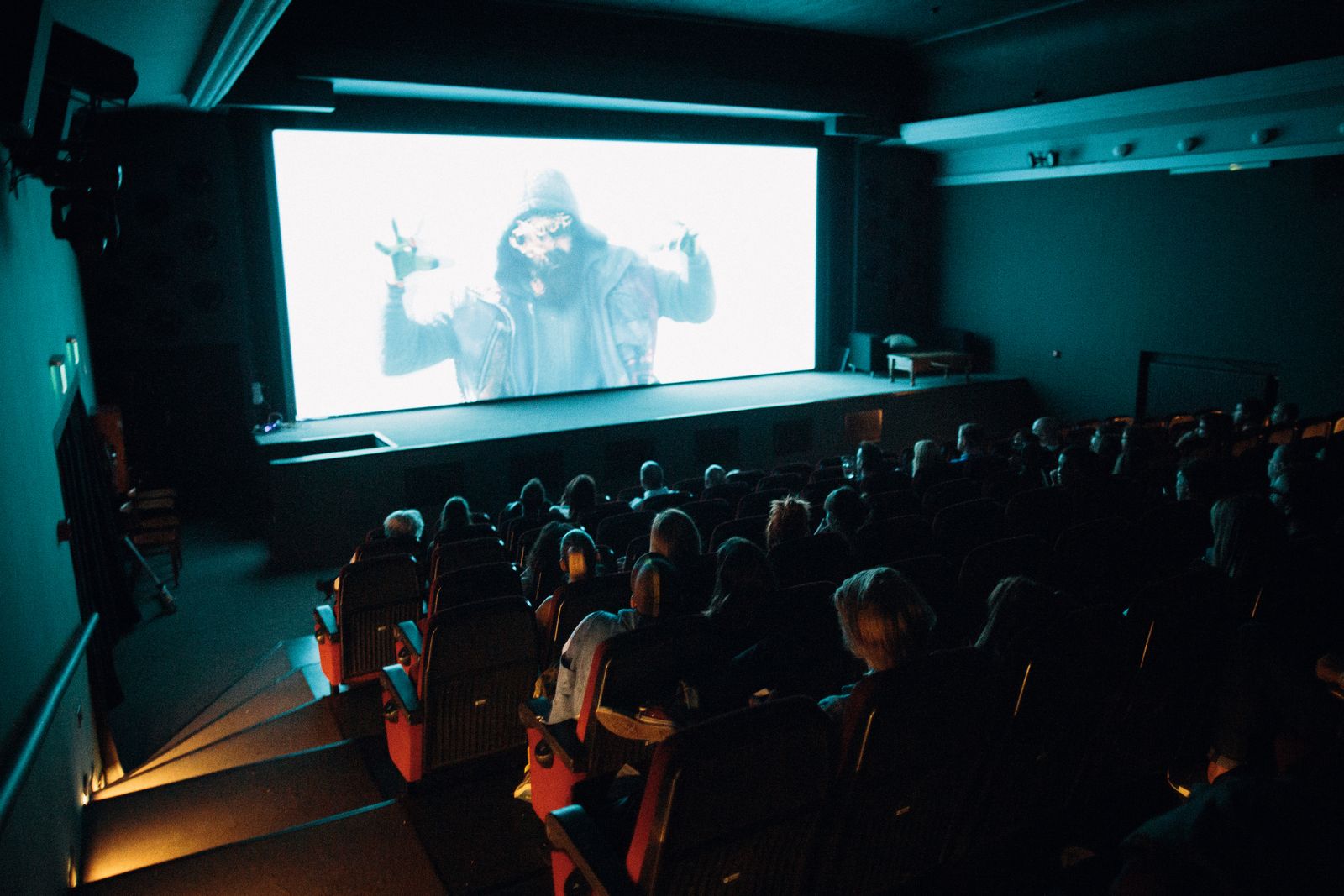
If you watch only one film from this section, watch Iris first, then Advanced Style. The first gives you a single unforgettable personality to learn from, and the second shows that the same principles work for many different personalities. Together they make a strong case that style does not belong only to the young or the wealthy. It belongs to anyone willing to pay attention, take a small risk, and enjoy the result.
Style Films That Are Not Documentaries
Not every fashion film is a documentary, and some of the most useful style lessons come from fiction. A costume designer on a narrative film has a different job: the clothes must tell you who a character is, what she wants, and how she changes, often before she speaks a word. Watching fiction with that in mind teaches you how clothes communicate, a skill you use every day.
The classic example is the story of a young assistant who arrives at a fashion magazine with no interest in fashion and gradually learns its language. At first her clothes are shapeless and indifferent, because she does not yet see herself as someone who belongs in that world. As she learns, her silhouette sharpens, her colours clarify, and her accessories become deliberate. The change is not about spending money. It is about intention, and the film shows in exaggerated form what happens when a person starts dressing with purpose.
That lesson is worth carrying into your own wardrobe. Clothes communicate before you speak, and a small change in fit, colour, or grooming can change how a room receives you. That does not mean dressing to impress strangers. It means dressing to express the version of yourself you want to bring into the room. Our guide to the best fashion books explores the same idea in print, tracing how writers and designers have thought about style as self-expression, and the two belong together: the books give you the ideas, and the films show you the ideas in motion.
How to Watch a Fashion Film Like a Stylist
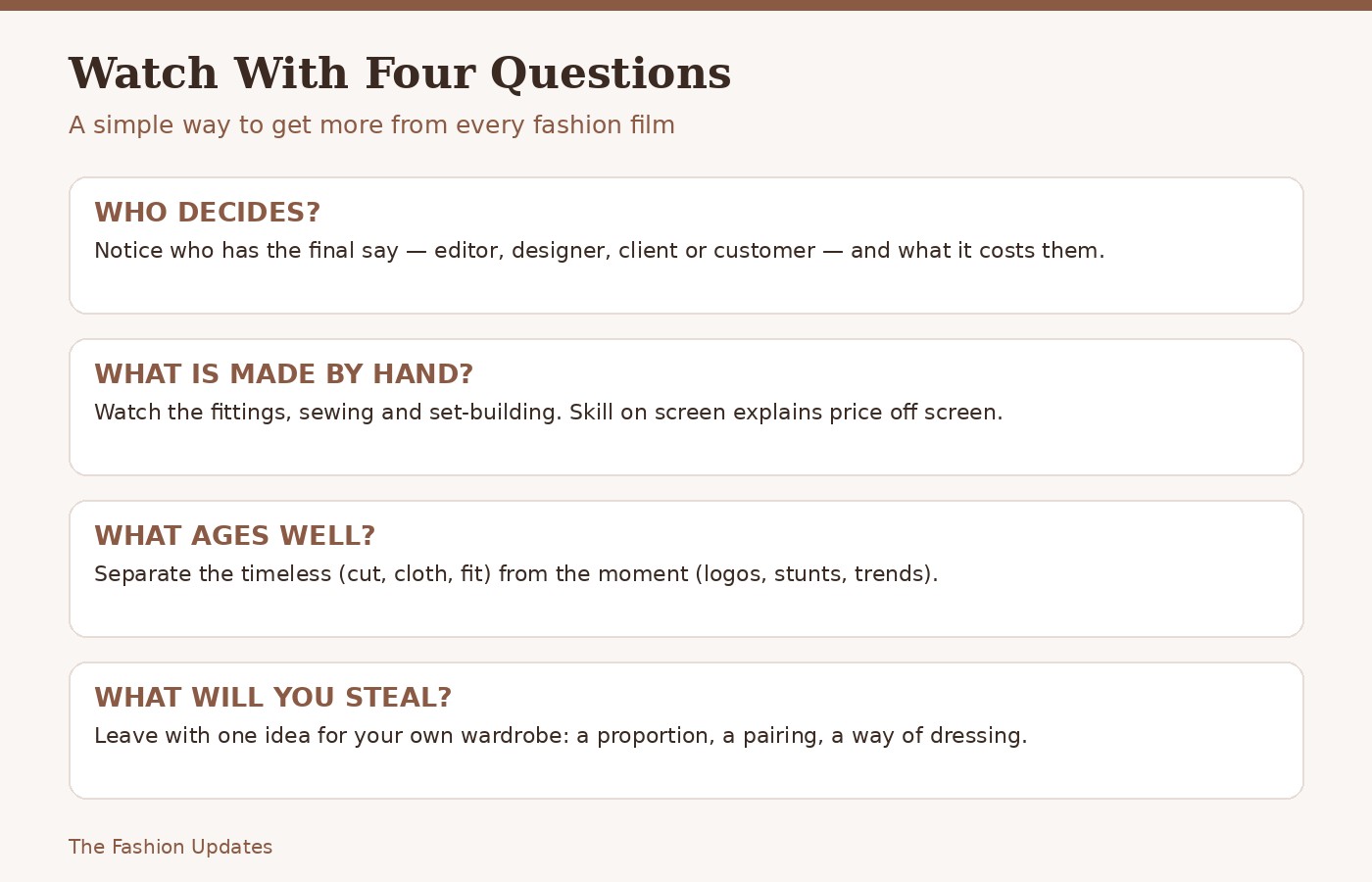
Watching passively is pleasant. Watching like a stylist is useful. The difference is small: a notebook, a pause button, and a willingness to ask what you would borrow.
Start by choosing your intention before you press play. Are you watching to understand the industry, to learn about craft, or to find ideas for your wardrobe? Your intention decides what you notice. For industry, watch the meetings. For craft, watch the hands: the pinning, cutting, and fitting. For wardrobe ideas, watch proportions and colour combinations, and ignore the price tags entirely.
Pause on the fittings. A fitting is where a garment either works or does not, and the camera lingers there for a reason. Notice what gets adjusted: a shoulder, a waist, a hem, a sleeve. When you try on clothes, ask the same questions. Would a shorter hem help? Would a different shoe change the proportions? Those are the stylist’s questions, and they cost nothing to ask.
Note one idea per film, and only one. A list of twenty ideas is a list you will never use. A single idea, written in your own words, is one you can try the next morning: a colour combination, a way of layering, a habit of editing, or a reminder to have a favourite coat altered rather than replaced. Try it once, notice whether it works, and keep it or let it go without regret. That cycle is how personal style actually develops.
The same careful looking rewards the rest of this site too, from our guide to cross necklaces for women to our guide to the best swimsuits: notice the construction, notice the fit, and notice what the piece does for the person wearing it.
Our view
Fashion films are worth your evening because they teach you to see, and seeing is the skill that makes every other style choice easier. Watch the editors for discipline, the designers for craft, the photographers for attention, and the personal style films for courage, and you will come away with a wardrobe that feels more like you. The best film on this list is not the most glamorous one. It is the one that makes you look in the mirror with fresh eyes the next morning.
— The Fashion Updates
Frequently Asked Questions
Which fashion documentary should I watch first?
Start with The September Issue to understand the industry, Dior and I if you love craft, Bill Cunningham New York to train your eye, and Iris for courage in your own wardrobe. Each is a complete introduction to its type and will help you choose the next film wisely.
Are fashion documentaries useful if I do not follow high fashion?
Yes, often more useful than a shopping guide. The best films are about decision-making, craft, and confidence, and those lessons apply at every budget. A couture fitting teaches you about fit, an editor teaches you about editing, and a personal style film teaches you about choosing with conviction.
How do I choose between a designer film and an editor film?
Choose the designer film if you love making and craft, and the editor film if you love magazines and visual storytelling. If you are unsure, watch one of each and notice which you want to discuss afterwards. The film you want to talk about is the one that taught you something.
What should I look for when watching a fashion film?
Look for the fittings, the editorial meetings, and the moments when someone changes their mind. Those are the moments when taste is being made. Notice construction, proportion, and colour, and write down one idea you want to try.
Can I learn personal style from films about older women?
Absolutely. These films show women dressing with complete freedom and deep knowledge of themselves, and that knowledge is the most valuable style lesson of all. Their specific outfits may not suit you, but their method will: choose what feels like you, wear it with conviction, and let the rest of the outfit support the boldest piece.
Do I need to know fashion history to enjoy these films?
No. Each film introduces its subject clearly. If a film sparks your interest in a designer or editor, books are a good next step for the history that films can only sketch.
How We Pick What We Recommend
Every guide on The Fashion Updates follows the same review process — what we compare, what we check, and what we leave out.
Sources
- Harvard Magazine on The September Issue
- Smithsonian on Diana Vreeland
- Film at Lincoln Center on Dior and I
- Wesleyan on Valentino: The Last Emperor
- Metropolitan Museum on Alexander McQueen
- Marketplace on Manolo Blahnik
- Film at Lincoln Center on Bill Cunningham New York
- Tribeca on The First Monday in May
- Metropolitan Museum Costume Institute
- V&A on Alexander McQueen: Savage Beauty
- Film Forum on Iris
- FSHN Magazine on Advanced Style