
As an Amazon Associate I earn from qualifying purchases.
A pair of jeans can match your usual size exactly and still fail you: the waistband gaps at the back, the hem pools over your shoes, or the knees bag out before lunch. None of those problems means your body is the wrong shape. Each one points to a specific measurement: rise, inseam, or stretch recovery. This guide shows you how to find jeans that fit by reading those three numbers properly, measuring yourself and a pair you already own, and testing stretch the way fabric laboratories do.
The Fashion Updates
Fit Is a Measurement, Not a Guess
Rise, inseam and stretch recovery decide whether jeans fit. Measure all three and any pair becomes predictable.
Key Takeaways
- Rise decides where the waistband sits and whether it gaps, digs in, or stays put when you sit, so choose rise by measurement, not by the low, mid, or high label alone.
- Inseam is the inside-leg measurement from crotch seam to hem, and the right number changes with your shoes, so measure a pair you already like before you order.
- Stretch and recovery are different qualities: stretch is how far denim extends, recovery is how completely it returns, and poor recovery is what leaves baggy knees and a loose waistband.
- Measure where the jeans will actually sit, because a high-rise waist measurement and a low-rise waist measurement are taken at different points on your body.
- Care protects fit: washing less often, in cold water, and air drying helps denim keep the shape you bought.
Table of Contents
- Key Takeaways
- Start With Rise: Where the Waistband Sits
- Measure Yourself and a Pair You Own
- Inseam: Length That Works With Your Shoes
- Stretch and Recovery: Why Some Jeans Bag Out
- Diagnose the Fit Problems You Already Have
- Hemming and Small Fixes That Save a Good Pair
- Care That Protects the Fit
- Our view
- Frequently Asked Questions
- Sources
- Recommended
Start With Rise: Where the Waistband Sits
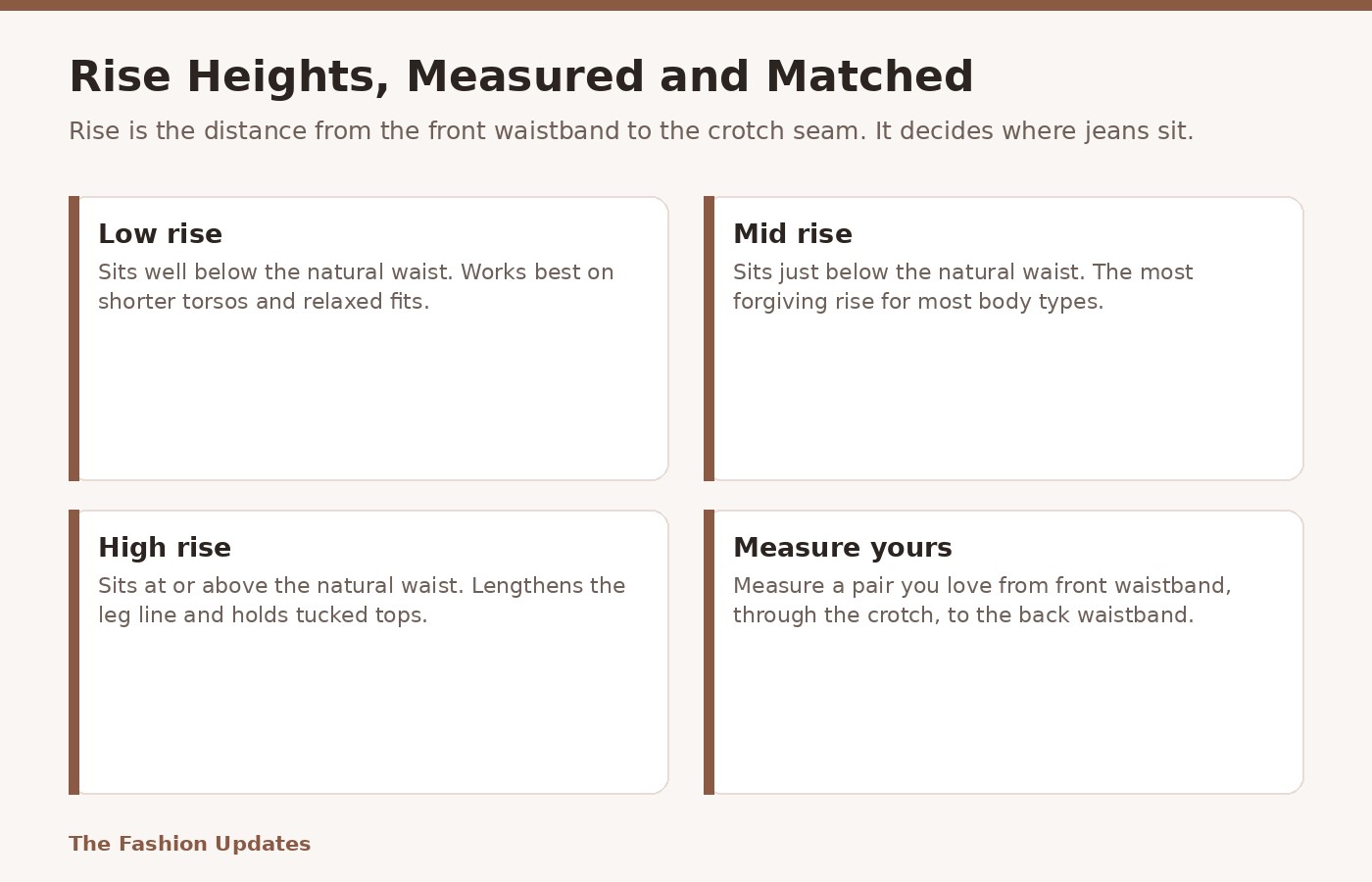
Rise is the distance from the crotch seam to the top of the waistband, and it decides where your jeans sit, how much coverage you get when you bend, and which waist measurement you should even take. Levi’s explains the measurement directly in its guide to measuring jeans: lay the jeans flat and measure the rise to find your fit, whether that is high, mid, or low rise. Because brands set their own boundaries for those labels, the number matters more than the name. The table below gives the working ranges used across most women’s and unisex ranges.
| Rise | Typical front rise | Where it sits | Who it usually suits |
|---|---|---|---|
| Low rise | Under about 8.5 inches | Low on the hips, below the belly button | Shorter torsos, anyone who dislikes fabric near the ribs, relaxed and slouchy cuts |
| Mid rise | About 8.5 to 10 inches | At or just below the belly button | Most bodies and most wardrobes: the balanced default for everyday wear |
| High rise | About 10 to 12 inches | At or above the belly button, near the natural waist | Longer torsos, a defined waist-to-hip difference, anyone who wants coverage when bending and sitting |
American Eagle sets out a similar ladder in its women’s jeans size chart, placing low rise on the hips below the belly button and high rise at or near the natural waist, with super high-rise styles sitting above it. Treat those boundaries as a starting grid, then confirm with the garment measurements on the product page, because one brand’s mid rise can match another brand’s high rise.
Front rise, back rise, and the gap test
The front rise is only half the story. The back rise is usually longer, and the difference between the two is what lets a waistband cover you when you sit without pulling the front up. If the waist fits your hips but gaps at the back, the problem is often the relationship between waist and hip, not the size itself. A curvy cut, cut with more room through the hip and thigh relative to the waist, is the standard fix, a point covered in the jeans fit guide discussion of shaped waistbands and curvy fits. A belt can settle a small gap, and our best belts for men guide covers belt sizing for unisex styles, but if you have to cinch the band until the fabric folds, the cut is wrong for you.
Rise and torso length
A high rise on a short torso can reach the ribs and dig in when you sit. A low rise on a long torso can leave you adjusting the waistband all day. Sit down in the fitting room, bend as if tying a shoe, and check both ends: the band should stay where you placed it, and the crotch seam should not pull. This seated test matters more than the standing mirror view, the same reason our men’s trousers guide treats sitting comfort as a separate check for tailored trousers.
Measure Yourself and a Pair You Own
Jeans sizing starts with two numbers, waist and inseam, and Levi’s states the convention plainly in its guide to measuring jeans: a 32×32 jean has a 32 inch waist and a 32 inch inseam, sometimes labelled 32W and 32L. Women’s sizing usually shows a single waist number, and Madewell warns in its sizing guide that the number does not always equal the body measurement, noting that a women’s size 28 refers to a 29 inch waist measurement, so the brand’s own chart always governs.
Measure your body, where the jeans will sit
Stand naturally and measure around your waist at the point where you want the waistband to rest, keeping the tape level and snug without digging in. Levi’s gives that technique in its product size guide: wrap the tape around your natural waistline for high-rise styles, measure around the fullest part of your hips for the hip figure, and measure the inseam from the top of the inner thigh to the ankle. For a mid or low rise, move the tape down to where that band will actually sit and measure there instead, because the circumference changes with height on the torso. Write all three numbers down: waist at the intended rise, fullest hip, and inseam.

Measure a pair that already fits
A favourite pair is the most honest size chart you own. Levi’s sets out the garment method in its product size guide and its measuring guide: lay the jeans flat, measure across the waistband and double it, measure the inseam from crotch seam to hem, and measure the front rise from crotch seam to the top of the waistband. Compare those three garment numbers, not the label size, against the product page of anything you plan to buy. If a brand publishes only body measurements, use your body numbers. If it publishes garment measurements, use the flat-lay numbers. Mixing the two systems is the most common reason a correct size arrives feeling wrong, a confusion our capsule wardrobe guide also warns about when building a small wardrobe where every piece has to earn its place.
Inseam: Length That Works With Your Shoes
The inseam is the length of the inside leg, from the crotch seam to the hem, and it decides whether a hem breaks cleanly over a shoe, crops above the ankle, or drags. The inseam measuring guide at Wearandi makes the key distinction: the inseam number describes the garment, not a promise about where the hem lands on your body, because rise, leg proportions, and shoe height all change the visible result. A higher rise lifts the whole garment, so two pairs with the same inseam can finish at different points on your ankle.
Match the inseam to the shoe
Decide the hem by the shoes you will actually wear. A straight or wide leg worn with flat sneakers needs a different length from the same cut worn with heeled boots. Our style white sneakers guide shows how a clean break over a low sneaker looks, while boot styles need extra length so the hem covers the top of the shaft, the same pairing logic covered in our what to wear with cowboy boots guide. Cropped and ankle styles are designed to finish above the ankle bone, so a shorter inseam there is the design, not a sizing error. If you live in loafers, the hem should clear the top of the shoe without pooling, as shown across the outfits in our best loafers for women guide.
Petite, regular, and tall lengths
Length labels are ranges, not guarantees. American Eagle’s women’s jeans size chart shows how widely inseams spread within one fit, with extra-short through extra-long options differing by two inches at each step, and different fits carrying different regular lengths. Madewell likewise separates petite, regular, and tall options in its sizing guide, and notes that fit varies by style even within one size. When you fall between lengths, buy the longer one: shortening is a simple alteration, adding length is impossible. If your current jeans only work with one pair of shoes, the fix is usually a second inseam for a second shoe height, a small duplication that pays off in a working wardrobe like the ones built in our mens wardrobe essentials guide for unisex basics.
Stretch and Recovery: Why Some Jeans Bag Out
Stretch is how far a fabric extends under force. Recovery is how completely it returns when the force is removed. Growth is what stays behind. Those three definitions come straight from laboratory testing: the ASTM D3107 explainer describes a test method that measures the elongation and recovery of woven fabrics containing elastic yarns under specified tension, and the elongation and recovery guide at FORALL sets out the same three lengths every recovery figure rests on: original, stretched, and recovered. A jean can stretch generously and still recover badly, and that second number is the one your knees and waistband report by midday.
Read the fibre label, then test the fabric
Rigid denim is 100 percent cotton. It softens and moulds gradually rather than flexing. Comfort stretch usually adds a small amount of elastane, and higher-stretch blends add more, sometimes with polyester or other fibres in the mix. Textile School describes the construction in its denim fabric guide: denim is a cotton twill with an indigo-dyed warp and an undyed weft, and stretch denim adds an elastane core to the weft yarns. The label percentage alone cannot tell you how a pair will behave, because yarn construction and finishing change the result. Cotton Incorporated proves that point with its Natural Stretch technology, a mechanical construction that gives 100 percent cotton woven fabric a typical fill stretch of 10 to 18 percent with no elastomeric yarn at all, by spacing the warp yarns wider and shrinking them in a controlled way.
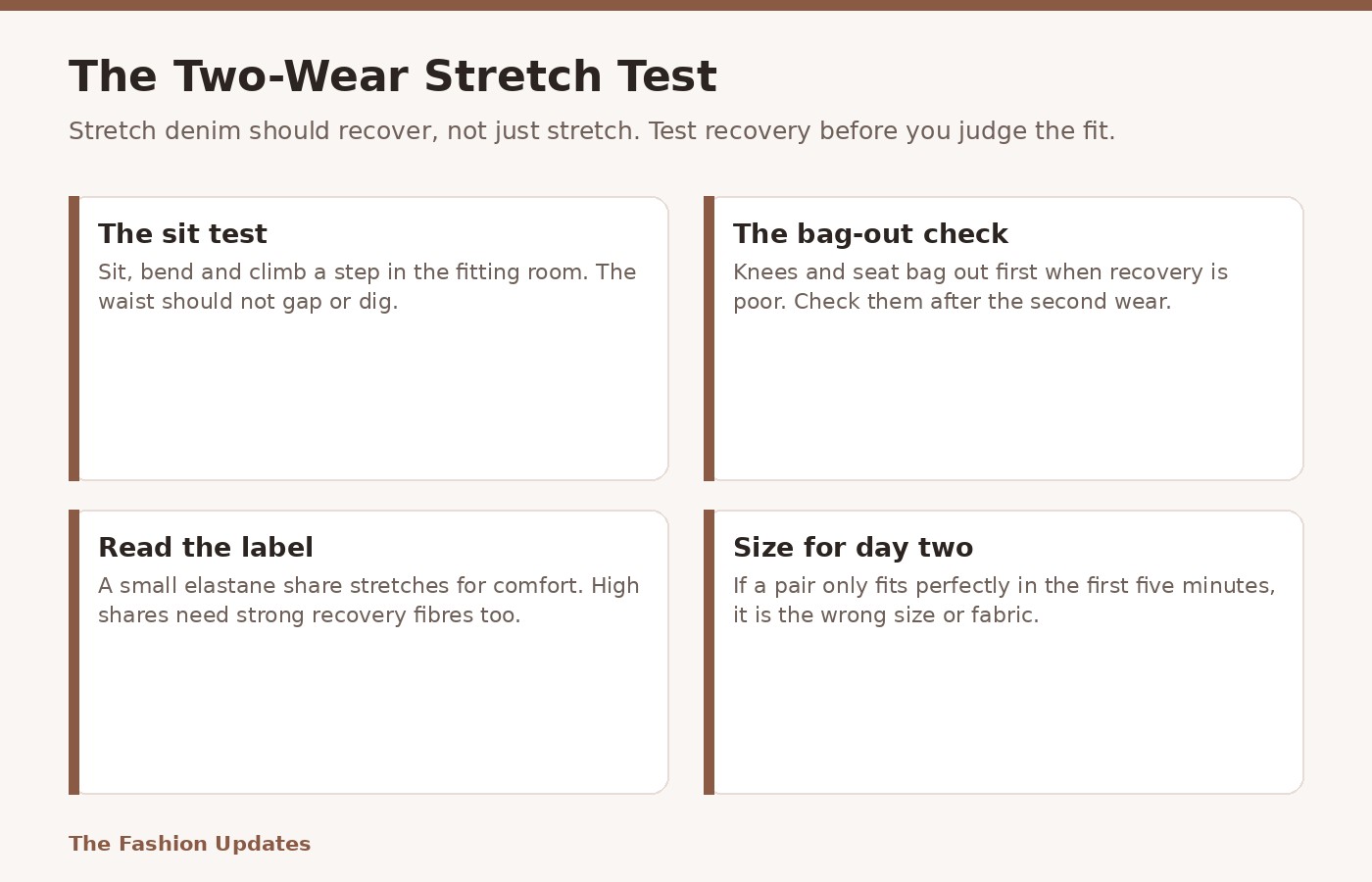
The two-minute recovery test
In the fitting room, do what the laboratory does, at hand scale. Stretch a hidden area of the thigh or waistband gently, hold it briefly, let go, and watch whether the fabric returns flat or stays rippled. Then wear the jeans for several minutes, sit down and stand up repeatedly, and check the knees, seat, and waistband for early bagging. The ASTM D3107 explainer notes that the method exists to evaluate the stretch, growth, and recovery properties garments show during wear, which is exactly what your sit test previews. The elongation and recovery guide adds the caution that a recovery figure without the elongation it was measured at is incomplete, so judge stretch and recovery together, never by how easily a pair pulls on. If a close-fitting pair needs a firm tug to do up but then sits flat and stays flat, its recovery is doing its job. If it slides on easily and loosens within the hour, size is not the problem: the fabric is.
How much stretch do you actually need
Match the stretch to the cut. Skinny and close straight fits need real stretch to move in, and they punish poor recovery fastest, because the knee bends the fabric at the same point all day. Relaxed, wide, and loose fits need little or none: the room is built into the pattern, and rigid denim holds their shape better over time. Mid-stretch straight and slim fits sit between the two and suit most daily wear. The same fit-first logic runs through our swimwear guidance, where the swimsuit body type guide matches support to shape rather than to a size label, and our best swimsuits picks favour fabrics that keep their shape in water. Denim asks the same discipline on land.
Diagnose the Fit Problems You Already Have
Work through the symptoms before you buy anything else. Each common failure maps to one measurement, and fixing the wrong one wastes a return.
Waistband gaps at the back
Your hips fit, your thighs fit, and the band stands away from your back. That is a waist-to-hip ratio problem, answered by a curvy cut or a higher back rise, as the jeans fit guide explains when it advises a shaped waistband that curves inward for exactly this case. A tailor can take in a waistband when the gap is modest. If the gap is large, exchange the cut, not the size: sizing down will strangle the hips to save the waist.
Hem pools, drags, or hides the shoe
That is inseam, and only inseam. Confirm it against the inseam measuring guide method: measure the offending pair flat, note where the hem lands with your usual shoes, and order or hem to the difference. Pooling also breaks the line of otherwise good outfits, whether the shoe is a sneaker, a loafer, or the boots in our womens cowboy boots guide, where length over the shaft is the whole point of the pairing.
Knees and seat bag out by afternoon
That is recovery, covered above. No size change fixes it, because a smaller size in the same fabric bags in the same places, just from a tighter start. Change the fabric: a lower-stretch or rigid denim in the same cut, or a brand whose stretch denim holds its shape. Textile School’s denim fabric guide notes that fabric weight also plays a part, with heavier denim generally holding structure longer than light, soft blends.
Waistband digs in when you sit
The rise is too short for your torso, or the waist is sized to a lower wearing point than the one you chose. Re-measure at the height you actually wear, using the method in Levi’s product size guide, and compare rises before you compare waist sizes. Discomfort that only appears seated is a geometry problem, and geometry is changed by rise, not by willpower. The same seated check rescues other close-fitting clothes, much as our stop heels hurting guide separates fit pain from break-in pain before suggesting any fix.
Hemming and Small Fixes That Save a Good Pair
When waist, hip, and rise are right and only the length is wrong, keep the pair and fix the hem. Levi Strauss points owners to exactly that route in its denim care guide, noting that tailors can alter, hem, repair, and customise jeans rather than replacing them. Wash and dry the jeans the way you plan to care for them before any hem is marked, so shrinkage happens before the alteration, not after.
Sewn hems and the original hem method
A tailor can shorten jeans with a fresh hem or by reattaching the original factory hem, which keeps the worn edge and its stitching. The hemming guide at Tailors and Alterations walks through that professional method: mark the new length while wearing the jeans and your intended shoes, cut, and reattach the original hem so the result looks factory finished. Marking while dressed matters, because the right length is a relationship between the hem and the shoe, not a number in isolation. Break-in time also changes how a hem sits, just as it does with the stiff leathers in our break in cowboy boots guide, so wear the jeans a few times before committing to the final cut if the fabric is rigid.

No-sew shortening for a trial length
If you are unsure about a new length, live with it temporarily first. Fold the excess inside, hold it with iron-on hemming tape, and wear the jeans through a normal day with your usual shoes. The hemming guide covers tape as the no-machine route to a clean, lasting-enough hem, and a trial day tells you more than a mirror does: whether the hem catches on the shoe, clears the ground outdoors, and still looks right seated. When the trial length proves itself, make it permanent with stitching. Proportion checks like this are the same habit our sunglasses face shape guide teaches for frames: test against your own measurements and daily use, not against a model’s photograph.
Care That Protects the Fit
Fit is not finished at the till. Washing and drying change denim’s dimensions and its recovery, so care is the last fit decision. Levi’s gives the core routine in its denim cleaning guide: wash sparingly, turn jeans inside out, close zips and buttons, use cold water on a gentle cycle with a mild detergent, skip fabric softener, and air dry rather than tumble dry. Its help pages repeat the same sequence in the denim care and washing guidance, adding that machine drying may contribute to shrinking and fading.
Wash less, wash cold, dry flat or on the line
Levi Strauss puts a number on the habit in its denim care guide: wash once every ten wears at most to maintain fit, spot cleaning small stains with a damp cloth and mild soap instead. Its companion piece on washing jeans less explains why the habit matters beyond the garment, finding in the company’s lifecycle assessment that consumer care accounted for a substantial share of a pair’s lifetime water use. Heat is the enemy of recovery in particular: elastane weakens under repeated hot washing and tumble drying, so the cold, gentle, air-dry routine protects the stretch you tested in the fitting room. Cotton Incorporated’s Natural Stretch technology page makes the contrast neatly, noting that mechanical cotton stretch keeps its elasticity even after tumble drying precisely because there is no spandex to degrade, which is one more reason rigid and mechanical-stretch denim forgives imperfect laundry habits better than high-stretch blends.

Muchfun 3Pcs Durable Honeycomb Mesh Laundry Bags for Delicates 12x16 Inches | (3 Medium)
Offer 5.94 $
List Price
Store them folded, wear them in rotation
Hanging heavy denim by the waistband for months can pull the fabric downward, and folding over a bar concentrates stress at the knee. Fold jeans and stack them, or roll them, and rotate pairs so each one rests between wears: elastane blends recover some of their shape during a rest day, which is the household version of the relaxation intervals built into the laboratory methods above. Rotation is also a wardrobe strategy, the same one our best fashion magazine reading list assumes when editors build small, hard-working closets instead of large, tired ones. Two pairs that each fit, worn in turn, will outlast three pairs bought by guesswork.
Our view
Jeans do not fit by size. They fit by three numbers you can measure in five minutes: the rise that puts the waistband where your torso wants it, the inseam that ends the leg where your shoes begin, and a recovery strong enough to return the fabric to those measurements after every sit, bend, and stride. Learn your three numbers from a pair you already love, test stretch before you trust a label, and let care protect the fit you bought. The right pair is not the one that fits in the mirror. It is the one that still fits at the end of the day.
— The Fashion Updates
Frequently Asked Questions
How do I find my jeans size if I only know my dress size?
Measure your waist where you want the band to sit and your fullest hip, then use the brand’s own size chart to convert. Dress sizes and denim sizes do not convert reliably between brands, and a single denim number can sit a full inch away from the body measurement it names, so your tape measurements are the safer starting point.
What rise is best if my waistband always gaps at the back?
Try a curvy cut, which is patterned with more room in the hip and thigh relative to the waist, or a style with a higher back rise and a shaped, contoured waistband. If the gap is small, a tailor can take the waistband in. Sizing down usually trades the gap for tight hips, so change the cut before you change the size.
How long should jeans be with sneakers?
For a straight or slim leg, the hem should meet the top of the shoe with one small break or none. For wide and relaxed legs, a hem that just clears the ground over a flat sneaker keeps the shape without dragging. Measure the inseam of a pair whose length you like with those shoes, and order or hem to that number.
Do stretch jeans always bag out?
No. Bagging is a recovery failure, not a stretch failure. A well-made stretch denim extends under force and returns close to its original dimensions, while a poor one keeps some of the extension as growth at the knees, seat, and waistband. Test recovery in the fitting room by stretching, releasing, sitting, and standing, and protect it afterward with cold washing and air drying.
Should I size down in stretch jeans?
Only if the brand advises it for that style and the pair feels loose at the waist after a few minutes of sitting and walking, not merely snug at first try-on. Rigid denim should fit correctly at purchase because it moulds rather than shrinks to you, and an overly tight stretch pair will stress its own recovery and bag sooner.
Can jeans that are too long be fixed?
Yes. A tailor can hem them, including reattaching the original factory hem so the finish looks untouched, and iron-on hemming tape works as a trial or temporary fix. Wash the jeans first so any shrinkage happens before the new length is set, and have the length marked while you wear the shoes you plan to pair with them.
How We Pick What We Recommend
Every guide on The Fashion Updates follows the same review process — what we compare, what we check, and what we leave out.
Sources
- Levi’s — Fit Guide: How to Measure Jeans
- Levi’s — Product Size Guide
- Levi’s — How to Clean, Wash, and Dry Jeans: Denim Cleaning Guide
- Levi’s — Denim Care and Washing
- Levi Strauss & Co. — The Definitive Denim Care Guide
- Levi Strauss & Co. — No, You Don’t Have to Wash Those Jeans, Really
- Cotton Incorporated, CottonWorks — Natural Stretch Technology
- Madewell — Sizing Guide: Find Your Perfect Fit
- American Eagle — Women’s Jeans Size Chart
- FYI Tester — Introduction to the ASTM D3107 Standard
- FORALL — Fabric Elongation and Recovery Test: ASTM D3107
- Textile School — What Is Denim? Fabric, Weight, Types and How It Is Made
- Tailors and Alterations — How to Hem Jeans Like a Pro
- Wearandi — How to Measure Jeans Inseam
- JeansFact — How Jeans Should Fit: Women’s Jeans Fit Guide