As an Amazon Associate I earn from qualifying purchases.
Your podcast app is full of fashion shows, and most of them sound identical in the listing: two hosts, a celebrity guest, some chat about trends, and nothing you can use the next morning in front of your own closet. The problem is not a shortage of shows. It is a shortage of sorting. Fashion podcasts teach very different things depending on who makes them: a trade journalist teaches the business, a working designer teaches craft, a historian teaches where styles come from, and a stylist teaches how to dress the body you have. This guide sorts the best fashion podcasts by what each one actually teaches, so you can pick the show that matches the lesson you want.
The Fashion Updates
Learn Style by Listening
Learn style by listening: the best fashion podcasts sorted by what each show teaches, from industry and design craft to history and personal style.
Key Takeaways
- Choose a fashion podcast by the lesson you want first, industry, craft, history, personal style, or culture, because each type of show teaches a different skill.
- Business and craft shows teach how fashion makes money and how clothes actually get made.
- History shows teach where garments and styles come from, which makes current trends easier to read and easier to resist.
- Personal style and conversation shows teach the language of dressing, why outfits work and what clothing signals.
- Listening becomes learning when you follow shows properly, keep a simple routine, and write down one usable idea per episode to test in your wardrobe.
Table of Contents
- Key Takeaways
- Start With What You Want to Learn
- Industry and Business Shows Teach How Fashion Makes Money
- Design Craft Shows Teach How Clothes Get Made
- History Shows Teach Where Style Comes From
- Personal Style Shows Teach How to Dress Yourself
- Culture and Conversation Shows Teach Fashion Fluency
- How to Listen So Episodes Download and Play
- Build a Listening Routine That Fits Your Week
- Take Notes and Turn Listening Into Wardrobe Decisions
- Our view
- Frequently Asked Questions
- Sources
- Recommended
Start With What You Want to Learn
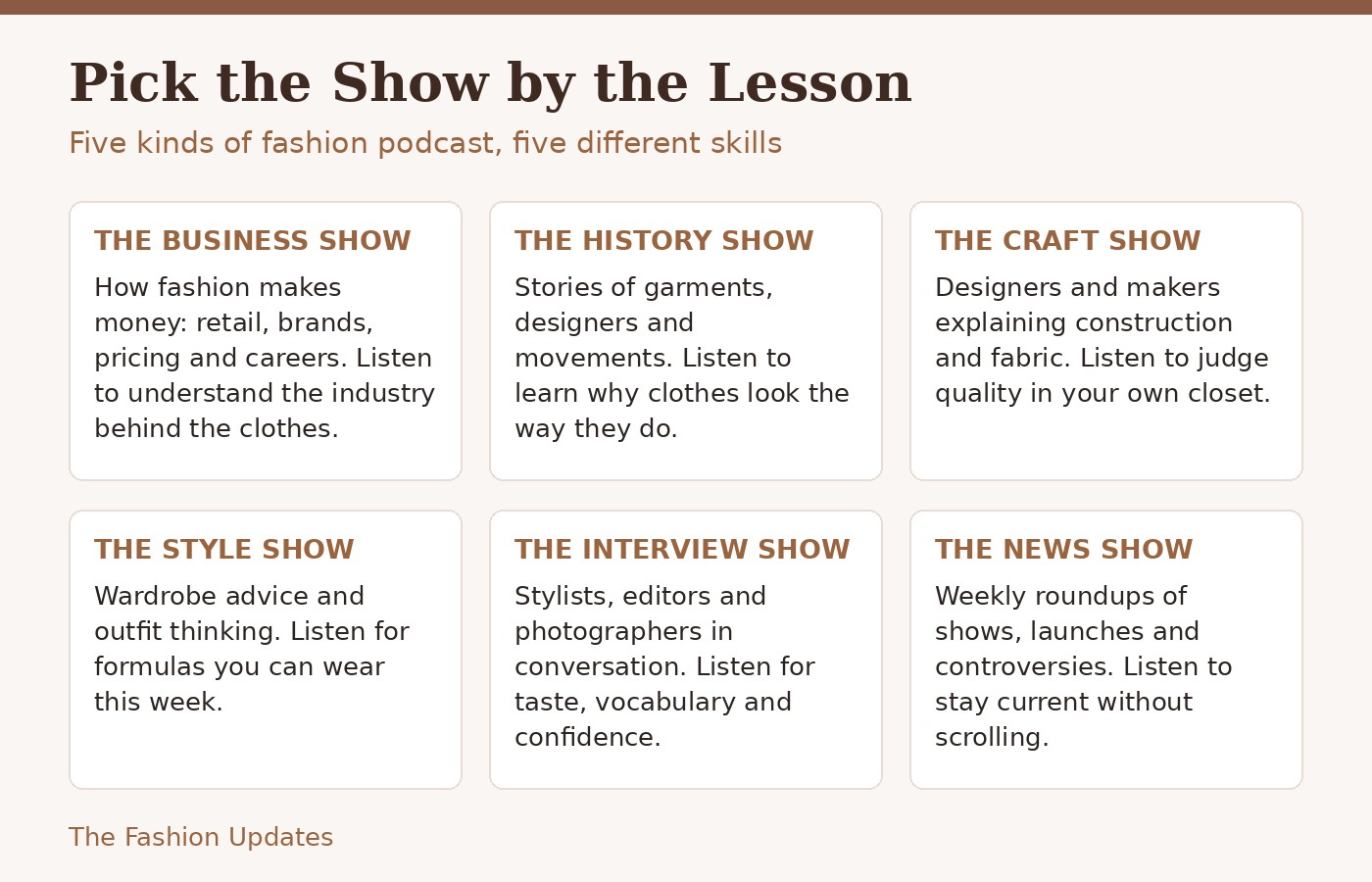
Most podcast regret comes from a mismatch, not a bad show. A listener who wants help getting dressed follows a trade business show, hears an hour on retail earnings, and concludes that fashion podcasts are boring. A listener who wants to understand the industry follows a celebrity chat show and concludes they are shallow. Both shows may be excellent at their own job. The fix is to name your lesson before you press follow.
| Show | Best for | What it teaches | Episode length style |
|—|—|—|—|
| The Business of Fashion Podcast | Industry and business | How brands, retail, and luxury actually make money, through interviews with the people running them | Long interviews, usually under an hour |
| Articles of Interest | Design and social history | Why everyday garments exist, from pockets to punk, and what clothing says about class, gender, and work | Short seasons, around half an hour an episode |
| The Cutting Room Floor | Design craft and candor | How clothes get developed and sold, in frank conversations with designers and industry insiders | Long-form interviews, often over an hour |
| Dressed: The History of Fashion | Fashion history | The social and cultural history behind what people wore, garment by garment and era by era | Deep dives, often in two parts |
| Fashion Neurosis with Bella Freud | Identity and personal style | How clothing connects to identity, memory, and self-presentation, through a designer’s couch conversations | About an hour, one guest |
| Handcut Radio | Menswear and craft | How men’s clothing is made and worn well, in interviews with makers, tailors, and brands | Around three quarters of an hour |
| The Run-Through with Vogue | Fashion news and culture | What editors are watching now, from runway news to cover stars and cultural moments | Twice weekly, under an hour |
| Every Outfit | Culture and commentary | How to talk and think about celebrity dressing, red carpets, and fashion in popular culture | About an hour, weekly |
Name your lesson before you follow
Write down, in one sentence, what you want listening to give you. Dressing better on workdays is a personal style lesson. Understanding why a handbag costs what it costs is a business and craft lesson. Knowing why a silhouette keeps returning is a history lesson. That sentence becomes your filter for every recommendation you meet afterwards, including ours.
Use more than one sense of fashion media
Podcasts are the audio layer of a wider fashion education, and they work best alongside the other layers. Our best fashion magazines guide covers the titles worth reading for photography and styling, our best fashion books guide covers the long-form reading podcasts often reference, and our best fashion documentaries guide covers the films that show garments moving on real bodies.
Follow two shows, not twelve
Start with one teaching show matched to your lesson and one lighter conversation show for pleasure. Twelve follows produce a queue you resent, and a resented queue produces no listening at all. Two shows produce a habit. When one teaching show has given you what it can, replace it rather than adding a third.
Industry and Business Shows Teach How Fashion Makes Money
Business shows will not tell you what to wear on Saturday. They teach something more durable: how the industry that sells you clothes actually works, why prices sit where they sit, and how much of what you read as taste is really distribution, marketing, and timing.
The Business of Fashion Podcast is the trade classroom
The Business of Fashion podcast feed is where the industry interviews itself. Founder-led conversations and news-led debriefs sit side by side, with guests drawn from the people who run brands, stores, and luxury groups. Listen for how guests explain decisions, a price rise, a creative director change, a store closure, and you start to hear the machinery behind the press release.
What business listening does for your wardrobe
A few months of business listening quietly rewires your shopping. You stop reading a discount as generosity and start reading it as inventory. You understand why a well-made coat costs what it costs, which supports the fit and fabric discipline in our capsule wardrobe guide. You also get better at telling a brand investing in product from a brand investing only in attention, a distinction that matters when you follow the accounts in our celebrities on Instagram roundup.
Who should skip the business shows for now
If your problem is strictly personal, nothing to wear, pieces that do not combine, mornings that start badly, a business show will feel like homework set by someone else. Start with the personal style shows below, and come back to the trade shows when curiosity about the wider system arrives. It usually does, because once your own wardrobe works, why the industry sells the way it does becomes genuinely interesting.
Design Craft Shows Teach How Clothes Get Made
Craft shows sit between the business and the body. Their hosts and guests make things, pattern cutters, designers, product developers, tailors, and they talk about clothing as an object with seams, costs, and compromises. Once you have heard how a garment is built, you cannot unsee a bad one on a rail.
The Cutting Room Floor talks like the studio, not the stage
Designer Recho Omondi hosts The Cutting Room Floor, billed as fashion’s only fashion show, and its long interviews are valued precisely because they are not polished publicity. A NYLON profile of fashion podcasters describes Omondi using the show to look under the hood of businesses and quiz professionals about how their work really happens. Episodes on product development teach that a garment is a chain of decisions, and every weak link shows up later as a twisted seam or a fabric that dies in the wash.
Articles of Interest teaches design through single garments
Avery Trufelman’s Articles of Interest began inside the design podcast 99% Invisible and became an independent production, and its method is the close study of one kind of clothing at a time: why womenswear lacks pockets, how casual wear rose, what a Hawaiian shirt carries with it. An academic review in Textile History journal treats the show as serious dress research, weaving social and design history through interviews with wearers, makers, and curators. The lesson is construction literacy: you learn to ask what a garment is for.

Handcut Radio teaches menswear craft by interview
Handcut Radio explores men’s style and luxury through conversations with the people who make and sell it: tailors, bespoke denim specialists, shirtmakers, and independent brands. Its back catalog is a craft library for anyone building the considered rotation described in our men’s wardrobe essentials guide, because guest after guest returns to the same virtues, cloth quality, honest construction, and clothes bought to be kept.
History Shows Teach Where Style Comes From
History is the most underrated style teacher on this list. Trends stop looking like commands when you know they are reruns. A silhouette that feels compulsory this season becomes a choice when you have heard where it came from and what it meant before marketing got to it. History shows give you that distance, and distance is what taste is made of.
Dressed is a fashion history course in your pocket
Dressed: The History of Fashion, hosted by fashion historians April and Cassidy, explores the social and cultural histories behind why we wear what we wear, one garment, designer, or moment at a time. Its deep archive works like a course you can enter anywhere: pick the episode nearest your current curiosity and you will come away understanding the present-day version better. Pair an episode with the object-based learning on show in the Museum at FIT collections, where garments are studied as evidence rather than as shopping.
Museums teach the same lesson with objects
Podcasts tell you the story; collections show you the seams. The Met Costume Institute essay walks through a collection spanning centuries, from Worth and Chanel to Westwood and McQueen, and reading it alongside history listening sharpens both. The same habit sharpens smaller decisions too, from reading a silhouette in our swimsuit body type guide to choosing a frame shape in our sunglasses for your face shape guide.
How history listening changes shopping
The practical payoff is patience. A listener who knows how often a shape has cycled stops panic-buying its return and starts choosing the version that suits their body and palette.
Personal Style Shows Teach How to Dress Yourself
This is the category most readers came for: shows that talk about dressing as something a person does, with a body, a budget, a history, and feelings about all three. The best of them teach by conversation rather than instruction, letting guests describe what clothes do for them until you recognize your own habits.
Fashion Neurosis puts style on the couch
Designer Bella Freud hosts Fashion Neurosis, inviting each guest to lie on a couch and explore the connection between fashion and identity. The format sounds playful and lands seriously, because a guest explaining the outfit worn at a turning point in their life is teaching you how clothing stores memory and intent. The same self-knowledge runs through our skin undertone guide, since knowing what your coloring does is the factual half of the identity work this show explores.

Soundcore by Anker Q30 Hybrid Active Noise Cancelling Headphones, Black | Over-Ear, Bluetooth, Multiple Modes, Hi-Res, Custom EQ via App, 50H ANC Playtime, Comfortable Fit, Multipoint Connection
Offer 53.19 $
List Price
What personal style listening can and cannot do
A conversation show can give you language, permission, and examples. It cannot look at your body, your rail, or your calendar, so treat its lessons as principles to test rather than rules to obey. When a guest swears by a uniform, test a uniform for a week. Principles that survive contact with your real week graduate into your system; the rest were entertainment, and entertainment is a legitimate return on an hour.
Menswear interviews double as personal style lessons
The maker interviews on Handcut Radio belong here as much as in the craft section, because guest after guest describes building a personal wardrobe slowly, around a few loved things, and that philosophy transfers to any closet. The Textile History review makes the point formally, describing how the show uses wearers’ own testimony to explore the personal motivations behind dressing. If your household is building two wardrobes at once, pair the listening with our men’s wardrobe essentials guide.
Culture and Conversation Shows Teach Fashion Fluency
Fluency is the social layer of style: being able to follow a fashion conversation, recognize a reference, and understand why a red carpet look landed or failed. Conversation shows teach it by exposure and repetition, and they are the easiest listening on this list to keep up.
The Run-Through with Vogue is the newsroom you can hear
The Run-Through with Vogue publishes twice a week, with Vogue editors and guests working through fashion news, runway talking points, and the cultural moments fashion is feeding on. Its lesson is currency: what the industry is arguing about right now, in the words of the people who will write it up. Pair it with the slower reading in our best fashion magazines guide and you get both the headline and the long view.
Every Outfit teaches the commentary habit
Every Outfit, hosted by Chelsea Fairless and Lauren Garroni, grew out of their account cataloguing the clothing in a beloved television series, and the weekly show applies that same close looking to celebrity dressing, awards seasons, and fashion in popular culture. The transferable skill is the close look itself. After a few episodes you start asking their questions of any outfit, including your own in the mirror: what is this referencing, and is the message the one the wearer intended? That habit sharpens everything from choosing a scent with our best perfumes for women guide to judging a finished look against our hair care tips guide.
Use conversation shows as your background layer
Because these shows reward attention but do not demand notes, they suit the slots where teaching shows fail: cooking, commuting in traffic, folding laundry, walking the dog. Save the business, craft, and history shows for slots where you can pause and think.
How to Listen So Episodes Download and Play
None of the above matters if the mechanics fight you. Podcast apps are simple once three actions are clear: follow the show so new episodes find you, download episodes so they play without a connection, and clear played episodes so your phone does not fill with audio you have already heard.
Following and downloads in Apple Podcasts
Apple’s own guidance on podcast download settings explains that shows you follow download automatically, that played episodes are removed automatically, and that both behaviors can be adjusted per show or across the app. Set your teaching shows to keep their recent episodes, let everything else stream, and turn off automatic downloads for any show you sample casually.

Following and downloads in Spotify
Spotify’s help pages on podcasts and shows set out the same basic moves in its own layout: follow a show to save it to your library, find the latest episodes of saved shows in one place, and download episodes for offline listening. Whichever app you use, do a two-minute setup once: follow your two chosen shows, download tomorrow’s episode over Wi-Fi, and check that played episodes clear themselves. After that, listening should cost you no decisions at all.
Choose listening gear for comfort, not fashion
You will listen more when listening is physically easy. For walks and commutes, a light pair of earbuds that stay put and let you hear traffic when you need to will serve you better than anything chosen for looks. For desk listening, longer sessions reward comfort and a seal that keeps household noise out, so a rambling interview stays intelligible at low volume. Getting ready for a listening walk is its own small ritual, and our best makeup foundations guide and our nail polish colors for skin tone guide cover that half of it.
Build a Listening Routine That Fits Your Week
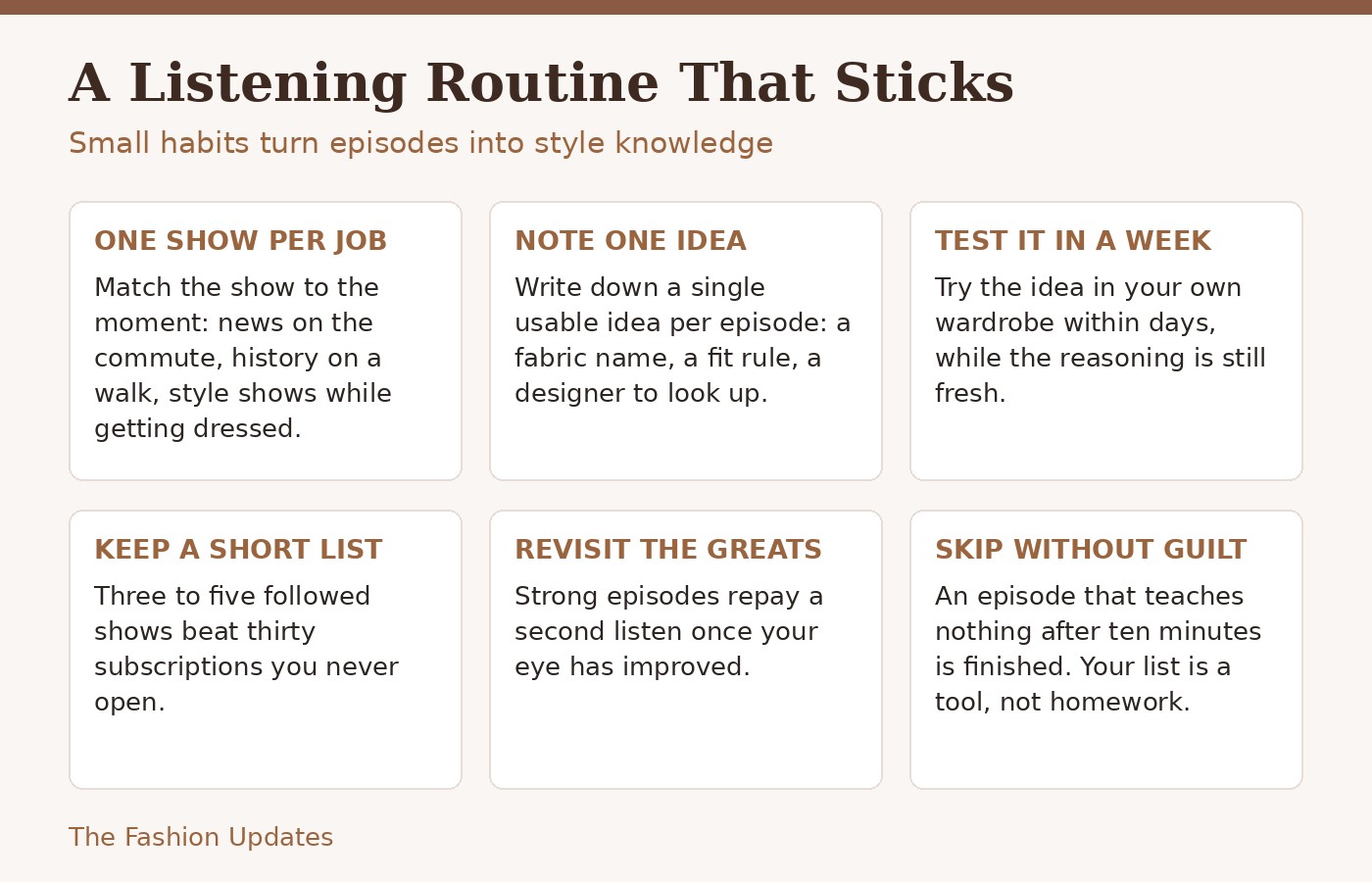
A routine is a time and a trigger, not a resolution. Attach each show to something you already do, and the habit runs itself: the teaching show with the morning walk, the conversation show with the evening tidy, the history show with the weekend cook.
Anchor episodes to existing habits
Pick anchors you never skip: a commute, a dog walk, a gym session, a Sunday reset of the wardrobe rail. Assign one show per anchor and protect the pairing for a few weeks before judging it. If an anchor collapses, move the show rather than abandoning it. Our stop heels hurting guide exists because walking plans fail on footwear, and listening walks are no different: comfortable shoes and a downloaded episode are the whole system.

Run a four-week rotation across categories
Rotate by category rather than bingeing one show dry. A workable pattern: business in week one, craft in week two, history in week three, personal style in week four, with a conversation show running underneath throughout. Rotation shows you the same fashion moment from four directions, which is where real understanding forms.
Keep the queue shorter than your week
Your follow list should hold only what your anchors can absorb. If new episodes are expiring unheard, you are following too much, and the honest fix is subtraction, not speed.
Take Notes and Turn Listening Into Wardrobe Decisions
Listening becomes learning at the moment you write something down. Not a transcript, not a summary, just the one idea from each episode that could change a decision you actually face: a fit point to check, a fabric to look for, a styling move to test, a purchase to cross off.
Keep a one-line-per-episode notebook
Use whatever you already carry, a notes app, a notebook by the kettle, the back of your wardrobe list. One line per episode, with the show name, the idea, and the decision it touches. A line like “check jacket shoulder seam against my posture before buying” is worth more than a page of summary.
Test each lesson in one outfit
Give every promising idea a single fair test. A proportion tip gets one outfit, worn for a full day, not judged in the mirror for ten seconds. A care tip gets one wash cycle. A buying rule gets one shopping trip. Lessons that pass become part of your system, alongside guides like our capsule wardrobe guide; lessons that fail get dropped without hard feelings.
Let listening feed your other fashion habits
Notes compound when they connect. A history episode explains a silhouette you then spot in a magazine; a craft interview teaches a term you then hear on a conversation show; a business episode explains why the piece you noted is suddenly everywhere.
Our view
We believe the best fashion podcast is the one matched to the lesson you actually need. Business shows teach how the industry works, craft shows teach how clothes are made, history shows teach where style comes from, and conversation shows teach the language everyone else is speaking. Follow two, write down one idea per episode, and test it in your own wardrobe. That is how listening turns into style.
— The Fashion Updates
Frequently Asked Questions
What is the best fashion podcast for a complete beginner?
Start with a personal style or conversation show, because both teach the language of dressing through real examples and need no background. Add a history show once you are curious about where styles come from, and a business show when you want to understand prices and brands.
Can podcasts really teach personal style, or do I need a stylist?
Podcasts can teach principles, vocabulary, and judgment, and for most readers that is the part of style that was missing. They cannot see your body, your wardrobe, or your calendar, so their lessons need testing against your real week. A stylist adds personal diagnosis; listening builds the knowledge that makes any advice easier to judge.
How many fashion podcasts should I follow at once?
Two is the right starting number, one teaching show matched to your goal and one lighter conversation show. Add a third only when every episode of the first two is being heard.
Are long interview episodes better than short ones?
Neither is better in itself. Long interviews carry craft and career detail that short formats cannot hold, while short, tightly made episodes suit single topics and busy slots. Match the length to the time you honestly have.
Should I listen to back catalogs or only new episodes?
Back catalogs are where the teaching value concentrates, because craft, history, and personal style lessons do not expire. Work through a teaching show’s archive by topic, and use new episodes mainly from news and conversation shows, where currency is the point.
Do I need special equipment to listen to podcasts?
No. Any phone and the earbuds or headphones you already own will do. Comfort matters more than specification, because you will listen longer in gear you forget you are wearing.
How We Pick What We Recommend
Every guide on The Fashion Updates follows the same review process — what we compare, what we check, and what we leave out.
Sources
- The Business of Fashion: Podcasts
- Apple Podcasts: The Run-Through with Vogue
- Spotify: Dressed, The History of Fashion
- 99% Invisible: Articles of Interest
- Apple Podcasts: Fashion Neurosis with Bella Freud
- iVoox: The Cutting Room Floor
- NYLON: Fashion Podcasts Giving an Inside Look Into the Industry
- Apple Podcasts: Every Outfit
- Handcut Radio: Men’s Style and Luxury Podcast
- Textile History Journal: Podcast Review of Articles of Interest and Handcut Radio
- Apple Support: Change Your Download Settings for Podcasts on iPhone
- Spotify Support: Podcasts and Shows
- The Museum at FIT: Collections
- The Metropolitan Museum of Art: Costume in The Metropolitan Museum of Art