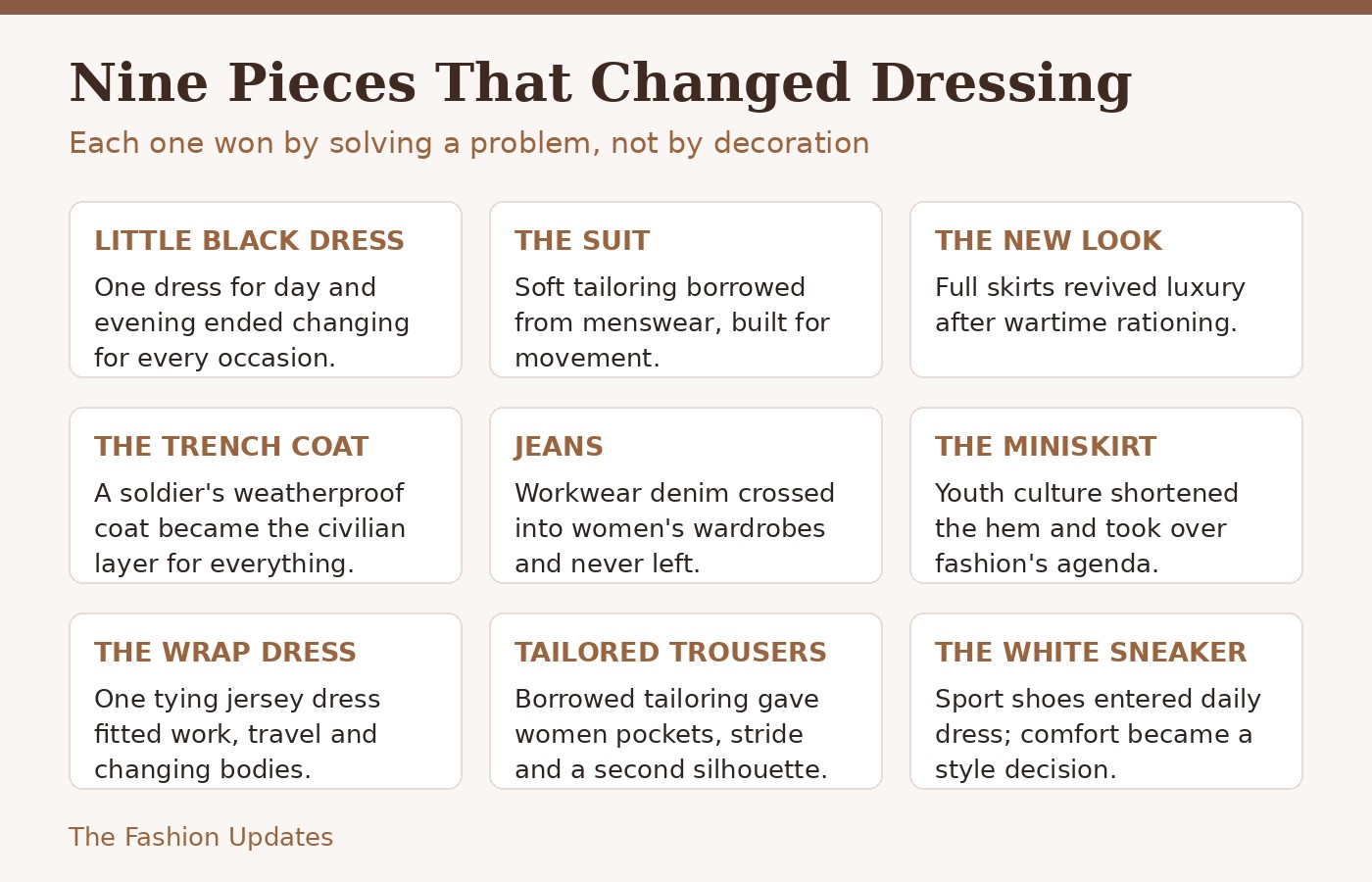
Some pieces in your closet are older than they look. The black dress, the jeans, the trench coat and the white sneaker were not always obvious choices, and each became ordinary only after it solved a problem the clothes before it could not. Fashion history basics is really the story of those solutions: a dress that ended the need to change for every occasion, a suit built for movement instead of display, trousers borrowed from work and menswear, a skirt that belonged to the young rather than to couture. Read your own wardrobe this way and the basics become evidence of how women’s lives changed, one practical problem at a time.
The Fashion Updates
Why Your Basics Look the Way They Do
Little black dress, Chanel suit, jeans, wrap dress, miniskirt, trench and white sneaker: the landmark pieces that changed how women dress, and why.
Key Takeaways
- Every landmark piece in this history won because it solved a problem, of movement, work, cost, care or time, not simply because it looked new.
- The little black dress and the Chanel suit came from Gabrielle Chanel’s guiding ideas of comfort, simplicity and wearability, and both replaced clothes that restricted the wearer.
- Dior’s New Look moved in the opposite direction, restoring full skirts and narrow waists after wartime restraint, and the argument it caused is part of its history.
- The trench coat, jeans and sneakers all entered women’s wardrobes from somewhere else, the military, the workplace and the sports field, and kept the useful details of those origins.
- The miniskirt, the wrap dress and borrowed tailoring each marked a shift in who dress was for: the young, the working woman, and women who wanted the ease long reserved for menswear.
Table of Contents
- Key Takeaways
- The Pattern Behind Every Classic
- The Little Black Dress Took Black Out of Mourning
- The Chanel Suit Put Comfort Into Tailoring
- Dior’s New Look and the Reaction Against It
- The Trench Coat Came Home From the Trenches
- Jeans Moved From Workwear Into Women’s Wardrobes
- The Miniskirt Belonged to the Young
- The Wrap Dress Solved the Working Morning
- The White Shirt and Tailored Trouser Were Borrowed on Purpose
- Sneakers Walked Out of Sport
- What to Notice in Your Own Closet
- Our view
- Frequently Asked Questions
- Sources
- Recommended
The Pattern Behind Every Classic
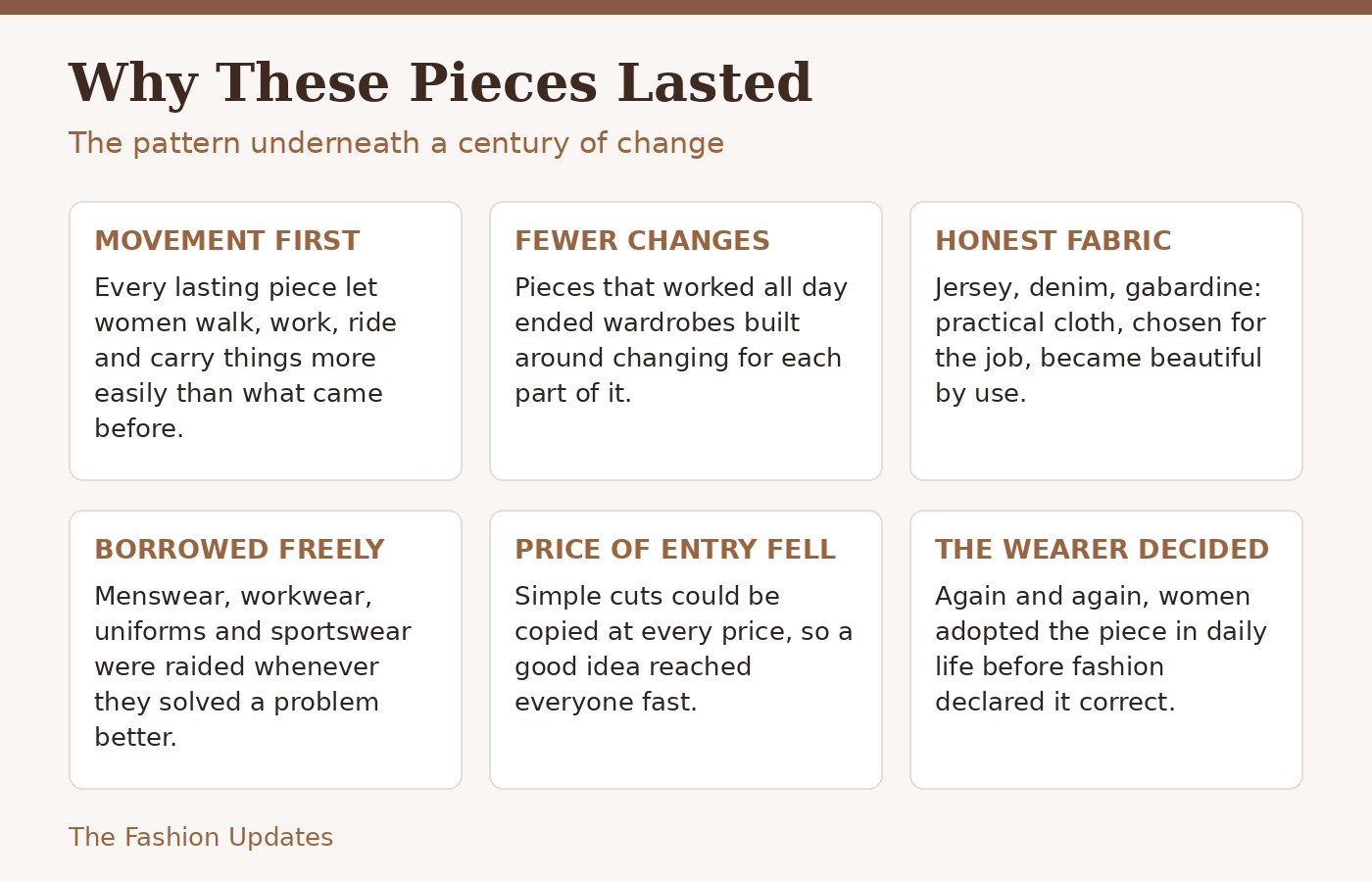
Start with the pattern, because the pattern explains the pieces better than any list of dates. Again and again, a garment lasted when it removed a difficulty: it let a woman move, work, travel, dress quickly, or use one garment for more than one part of the day. The Costume Institute collection at the Metropolitan Museum of Art spans centuries, and its survivors share that practical streak far more often than they share a silhouette. Decoration dates. Usefulness repeats.
| Piece | What changed | Why it lasted |
|---|---|---|
| Little black dress | Black became a fashion choice, and one dress could serve day and evening | It ended constant outfit changes and worked across occasions |
| Chanel suit | Tailoring became soft, collarless and easy to move in | It gave polish without a corseted structure underneath |
| Dior New Look | Full skirts and a narrow waist returned after wartime restraint | It answered a hunger for abundance, then provoked the next reaction |
| Trench coat | A military officer’s weatherproof coat entered civilian dress | Its gabardine, belt and storm details solved real weather |
| Jeans | Riveted work trousers became everyday dress for women | Denim survived hard wear and needed little ceremony |
| Miniskirt | Hemlines rose and youth, not couture, set the terms | It was simple, mobile and easy to make and copy |
| Wrap dress | A dress closed with ties, with no zips or buttons to manage | One piece dressed a working woman in minutes |
| White shirt and tailored trouser | Menswear tailoring was borrowed and recut for women | Both pieces mixed with almost everything else owned |
| White sneaker | A rubber-soled sports shoe became everyday footwear | Comfort carried it from the court and track into daily dress |
Usefulness came before symbolism
Most of these pieces acquired their meanings after they had proved useful. Jeans meant freedom only after they had meant durability; the trench meant elegance only after it had meant staying dry. For wider context on how taste gets recorded, our best fashion magazines guide and our best fashion books guide show where these stories were first argued over in print.
The Little Black Dress Took Black Out of Mourning
Black was not always a neutral. The V&A records in its account of what makes Chanel iconic that black had historically been associated with service, shop assistants and mourning dress, and that Gabrielle Chanel promoted it from the late 1910s as a chic symbol of modernity instead. The little black dress did not invent black clothing. It changed what black meant on a woman who had chosen it for herself.
The Ford comparison, and what it really claimed
In October 1926, American Vogue presented a black Chanel crêpe de chine day dress and predicted it would become a dress the whole world would wear. The V&A account notes it was dubbed the Ford of fashion, after the popular American car, because its appeal was expected to be universal. The Met’s Heilbrunn essay makes the same point, that Vogue likened the dress to the Ford as an allusion to its almost universal popularity as a fashion basic. The comparison was not about glamour: a Ford was standard, repeatable and within reach, and the claim was that a dress could be too.
One dress, fewer changes of clothes
The problem the dress solved was time and occasion. The V&A points out that at a period when women changed several times a day for different activities, a dress that could be dressed up or down and move from day to evening was a radical idea. Black made that possible because it carried no fixed message about the hour or the event. The little black dress lasted because it reduced decisions, and wardrobes still reward any piece that does that.

The Chanel Suit Put Comfort Into Tailoring
If the black dress simplified the day, the Chanel suit simplified tailoring. Chanel’s version was built from her stated principles of comfort, simplicity and wearability, which the V&A’s Chanel account describes as the consistent thread of her career. It looked composed while asking very little of the body inside it.
Jersey, and fabric borrowed from menswear
Chanel’s route into that ease began with jersey. The Met essay explains that jersey had been more commonly used for men’s underwear fabric before Chanel worked with it, that she first bought it partly for its low cost, and that she kept using it because it draped well and suited her simple, practical designs, many inspired by menswear. The V&A adds that its fluidity suited the freedom of movement she wanted. A cheap fabric, chosen under pressure, became a philosophy: the cloth should serve the wearer.
The cardigan jacket and the chain in the hem
The mature suit, codified after Chanel reopened her house in 1954, kept that philosophy in tailored form. The Met describes the classic version as a slim skirt with a collarless jacket trimmed in braid, with gold buttons, patch pockets and a gold-coloured chain sewn into the hem so the jacket hung properly from the shoulders. The V&A describes a cardigan-like cut and supple fabrics that gave far greater freedom of movement than the structured tailoring it replaced. Every famous detail was a working detail: the chain was a weight, the braid held an edge, the pockets were placed to be used. A surviving Chanel suit in the Met collection, dated 1970, shows how long that formula stayed in production, refined rather than reinvented.
Dior’s New Look and the Reaction Against It
The New Look is the great exception that proves the pattern, because it solved an emotional problem rather than a physical one. After years of wartime restriction, Christian Dior offered abundance. The V&A’s record of the Bar suit describes it as one of the most popular models in Dior’s first collection, which he called La Ligne Corolle, while the press dubbed it the New Look, its shape a round, sloping shoulder line, a narrow waist and spreading skirts.
Fifteen metres of cloth, and the outrage that followed
Abundance had a measurable cost in fabric. The V&A’s record of a New Look day dress carries the museum’s panel text noting that a typical New Look woollen day dress required about 15 metres of fabric, and a short taffeta evening gown about 25 metres, at a time when rationing was still in place, and that this caused outrage. The same text records that Dior launched his house on 12 February 1947 and became an overnight sensation, his collection the antithesis of the lean, boxy wartime fashions before it. Both reactions were true at once: the clothes were beautiful, and they were extravagant in a hungry moment.
Chanel’s answer, and why both looks survive
Chanel read the New Look as a step backwards. The Met essay records that she felt Dior’s designs were neither modern nor suitable for the liberated women who had taken on active roles during the war. Her comeback suit was that argument made in cloth. The lesson for your closet is not to pick a winner: your wardrobe holds both impulses, the structured piece that marks an occasion and the easy piece that gets you through the day.
The Trench Coat Came Home From the Trenches
Few classics announce their origin in their name. The trench coat was shaped by the First World War, and Smithsonian Magazine’s history of the trench coat explains that while the garment was not exactly invented for that war, it was during the war that it took the shape still recognised today. Its problem was weather at its worst, endured outdoors with no chance to change.
Gabardine solved the rain problem first
The enabling invention came earlier. Smithsonian records that Thomas Burberry founded his business in 1856 and in 1879 invented gabardine, a breathable yet weatherproofed twill made by coating individual strands of fibre rather than the finished cloth. The V&A’s guide to the Burberry trench tells the same story, that gabardine laid the foundation for a garment shaped by military use before it was embraced as a fashion icon. Earlier waterproofs sealed the wearer in; gabardine let the body breathe, which is why the coat could be worn all day rather than endured for an hour.
Officers’ details became civilian signatures
The V&A notes that in 1914 Burberry was commissioned by the War Office to adapt its officer’s coat for contemporary warfare, resulting in the coat that took the trenches’ name, and that after the war it became popular with civilians of both sexes and a recognised design classic. The belt, the storm flap, the shoulder straps and the deep pockets all began as equipment, and they still work as equipment on a wet platform. That double life is the trench’s secret: it never had to stop being useful to become elegant. The same test explains why the boots in our what to wear with cowboy boots guide and our women’s cowboy boots guide keep returning.
Jeans Moved From Workwear Into Women’s Wardrobes
Jeans began as an answer to trousers that tore. The Smithsonian Institution’s record of an early pair explains that Levi Strauss and tailor Jacob Davis began making worker’s trousers reinforced with copper rivets after Davis heard complaints that pants were ripping apart, and that in 1873 the partners received a patent for rivets placed at the points of strain. The first jeans came in indigo blue and in brown duck, worn first by miners and cowboys. Every rivet was a repair made permanent in advance.
From waist overalls to a wardrobe default
The Smithsonian record traces the long crossing that followed, from workwear to casual clothing for all ages, classes and lifestyles. The crossing into women’s wardrobes was deliberate as well as gradual. Levi Strauss & Co.’s own historian records that the company created the first jeans for women in the 1930s, introducing Lady Levi’s in 1934 for western women on farms and ranches and for women holidaying at dude ranches: the same tool, cut for women already doing the work in borrowed pairs.
The women’s 501, and the same denim as the men’s
The symbolic moment came later, when the company introduced a women’s 501 in 1981 in the same rigid, unwashed denim worn by working men for decades, to be shrunk in the wash until it fitted the wearer. Jeans lasted in women’s wardrobes for the oldest reason on this page: they survived hard use, forgave rough care, and went with everything else a woman owned. Compare that standard with the trouser thinking in our men’s wardrobe essentials guide: in both wardrobes, the hardest-wearing piece became the most trusted one.
The Miniskirt Belonged to the Young
The miniskirt changed who fashion was for. The V&A describes Mary Quant as the most iconic designer of her decade, who popularised super-high hemlines and other irreverent looks central to the Swinging Sixties, selling them from her King’s Road boutique, Bazaar, to young women looking for something different from the mature styles on offer elsewhere. The skirt’s problem was generational: young women were being dressed as smaller versions of their mothers.
Who invented it is the wrong question
The V&A is careful on the credit. Its account of the miniskirt myth notes there is no conclusive evidence for who first took hemlines far above the knee, names André Courrèges as another possibility, and records that Quant herself acknowledged the influence of an emerging London street style. The museum’s telling is gradual: above-the-knee skirts developed alongside rock and roll and youth dance crazes from the late 1950s, and it took until 1966 for skirts to become really short. The miniskirt was not handed down by a genius. It rose, hem by hem, from the street, the dance floor and the boutique together.
Cheap, simple and easy to copy on purpose
Quant’s real contribution was distribution and attitude. Her designs were simple, wearable and easy to mass-produce, and the V&A notes that dresses like hers were instrumental in bringing the miniskirt to the mass market, with young owners shortening hems further themselves. A short skirt used little fabric, needed no structure, and freed the legs for dancing, cycling and running for a bus. Notice, in a short skirt of your own, the absence of apparatus: no boning, no layers, no assistance required. After centuries of clothes that needed help to put on, that absence was the statement. The faces that carried the look into popular memory fill our celebrities on Instagram guide in its modern form.
The Wrap Dress Solved the Working Morning
The wrap dress is the youngest classic on this page and the most openly practical. The Metropolitan Museum of Art records that Diane von Furstenberg founded her brand in 1970 and four years later created the wrap dress, which came to symbolise power and independence for a generation of women, and that an example entered the Costume Institute’s collection. A museum does not collect a dress for symbolism alone. It collects the mechanism behind it, and here the mechanism was a dress that wrapped, tied and fitted itself.
No zip, no buttons, no assistance
Think about what the wrap removed. There was no zip to reach, no row of buttons, no fixed waist that either fitted or did not. The wearer crossed the front over and tied the dress to her own body that morning, so the same dress could follow a body that changed over months and years. Made in printed jersey that travelled and resisted creasing, it answered the working morning for women entering offices in large numbers: one piece, on in minutes, appropriate all day. Earlier classics freed women to move. This one freed them to get ready.
Why a single dress could carry a career
The Met’s decision to hold the dress in its Costume Institute collection, noted in the same Met announcement, places it in the same record as the Chanel suit and the New Look: each is a complete system in a single garment, and the wrap dress aimed its system at a new setting, the office. Notice how many of your most trusted pieces share its traits: adjustable, forgiving, complete on their own. Our best swimsuits guide shows the same preference for pieces that fit the body a woman has, rather than demanding another one.
The White Shirt and Tailored Trouser Were Borrowed on Purpose
Two staples of women’s dress were not designed for women at all. They were borrowed, first by reformers, then by workers, then by anyone who wanted their ease. The white shirt carried the authority of menswear, a clean front, a collar, cuffs that could be rolled. The tailored trouser carried its freedom. Their history is older and more argumentative than their quiet looks suggest.
Bloomers, and the first public argument for trousers
The argument began in the 1850s. Smithsonian Magazine’s account of Amelia Bloomer and trousers describes how women’s rights activists briefly adopted loose trousers worn under a shorter skirt as an escape from corsets and six to eight petticoats, how the outfit took the name of Bloomer, the editor who publicised it in her newspaper The Lily, and how letters poured in from women asking for patterns. The style faded under ridicule, but the need it named did not. Every later trouser for women is that request written again in a more acceptable cut.
The shirt stayed borrowed, and that was its strength
The white shirt followed a slower path, moving from men’s wardrobes into women’s without losing its borrowed character, which is precisely why it works with everything. The V&A holds a woman’s white cotton shirt by Vivienne Westwood whose lace jabot the museum notes was a decorative device worn by men in the seventeenth century that became fashionable for women in the 1870s and 1880s. One garment, three centuries of borrowing. Chanel, whose designs the Met describes as often inspired by menswear, understood the principle: a borrowed piece arrives with its usefulness already proven. Our cross necklaces for women guide and our best belts for men guide deal in the finishing pieces such a shirt takes, and our men’s trousers guide sets out the tailoring terms, rise, break and taper, that women’s tailored trousers inherited along with the garment itself.
Sneakers Walked Out of Sport
The sneaker is the most recent arrival and the fastest crossing of all. Smithsonian Magazine’s account of the Brooklyn Museum’s exhibition The Rise of Sneaker Culture describes a running shoe from the early 1860s with spikes in its sole, and a Converse high-top from 1917 that looks strikingly similar to pairs worn today.
The women’s sneaker had to argue its way in
Smithsonian’s account also preserves the resistance. A pair of women’s sneakers from the 1920s, shown in the exhibition, were built as high-heeled shoes with rubber soles, a compromise for a moment when women were first widely allowed into athletics but were still expected not to lose their femininity in the process. The flat white sneaker is the end of that argument: it assumes she will walk, stand, commute and live in her shoes, and it now finishes outfits that once demanded a heel. The proportion questions that follow are the same ones our sunglasses face shape guide answers for accessories: the classic works when its proportions suit the wearer.

What to Notice in Your Own Closet
History is only useful here if it changes how you see the rail in front of you. Read your own classics with the pattern from the first section in mind, and ask of each piece which problem it solved when it arrived, and whether it still solves it for you. The trench that still keeps you dry, the jeans that still survive everything, the black dress that still ends the what-to-wear question: those are working tools with long service records. The audit habit in our capsule wardrobe guide applies the same test piece by piece, and our best fashion documentaries guide shows several of these pieces in motion, in the decades that made them.
Look for the working details
The details tell you whether a classic is genuine in spirit. A chain-weighted hem, a storm flap, a rivet at a pocket corner, a tie that lets a dress fit itself: the originals carried their usefulness on the surface. Look for that honesty in your own pieces. Pieces that pass that test tend to be the ones you keep for a decade. The Met’s Costume Institute preserves garments because they were kept and valued long enough to become evidence.
Our view
We believe the classic wardrobe is not a list to memorise but a set of solutions to remember. The black dress ended the daily costume change, the Chanel suit made tailoring comfortable, jeans and the trench brought working clothes home, the miniskirt handed fashion to the young, the wrap dress fitted itself to the wearer, and the sneaker put comfort first. Learn what each piece was for, and your closet becomes much harder to fill with clothes that solve nothing.
— The Fashion Updates
Frequently Asked Questions
Did Chanel invent the little black dress?
No single designer invented black dresses, and the V&A is clear that Chanel was not the only designer to promote black. Her role was to cement its acceptance: the 1926 Vogue presentation of her black crêpe de chine dress, dubbed the Ford of fashion, turned black into a chosen, modern basic for day and evening.
Why did Dior’s New Look cause arguments?
Because of its timing and its fabric. Shown in February 1947 while rationing was still in place, the New Look used roughly 15 metres of cloth in a woollen day dress, after years of lean wartime dress. Many welcomed the abundance; others, Chanel among them, saw a step away from the active lives women had lived during the war.
Who invented the miniskirt?
No one person, on the museum evidence. The V&A records that hemlines rose gradually from the late 1950s, influenced by street style and youth dance culture, that André Courrèges is another candidate for the credit, and that Mary Quant’s achievement was to popularise the look and bring it to the mass market.
When did women start wearing jeans?
As workwear first, and by design in the 1930s, when Levi Strauss & Co. introduced Lady Levi’s in 1934 for women on farms and ranches. The women’s 501 of 1981, cut in the same rigid denim as the men’s original, marks the moment the work garment and the fashion garment became the same pair.
What makes a piece a classic rather than a trend?
On the evidence of this history, a classic solved a problem of movement, work, cost, care or time, and kept solving it after its first moment passed. Trends answer a mood. Classics answer a difficulty, which is why they return in every generation’s wardrobe.
How can I use this history in my own wardrobe?
Read your pieces by their working details and their original jobs. Keep the ones that still do their job, and be suspicious of any piece that solves nothing and only decorates.
How We Pick What We Recommend
Every guide on The Fashion Updates follows the same review process — what we compare, what we check, and what we leave out.
Sources
- V&A — What Makes CHANEL So Iconic?
- The Metropolitan Museum of Art — Gabrielle “Coco” Chanel (1883–1971) and the House of Chanel
- The Metropolitan Museum of Art — House of Chanel, Suit
- V&A — “Bar” Skirt Suit, Christian Dior
- V&A — “Green” Day Dress, Christian Dior
- Smithsonian Magazine — The Classy Rise of the Trench Coat
- V&A — The Burberry Trench: Crafting an Icon
- Smithsonian Institution — Levi Strauss Jeans
- Levi Strauss & Co. — Celebrating 40 Years of the Women’s 501 Jean
- V&A — Introducing Mary Quant
- V&A — The Miniskirt Myth
- The Metropolitan Museum of Art — The Atelier With Alina Cho Launches New Season With Diane von Furstenberg
- Smithsonian Magazine — Amelia Bloomer Didn’t Mean to Start a Fashion Revolution, But Her Name Became Synonymous With Trousers
- Smithsonian Magazine — Running Shoes Date Back to the 1860s, and Other Revelations From the Brooklyn Museum’s Sneaker Show
- V&A — Shirt, Vivienne Westwood
- The Metropolitan Museum of Art — Costume in The Metropolitan Museum of Art