
As an Amazon Associate I earn from qualifying purchases.
You already own the shoe. That is the point of this guide, and why it contains no ranking of pairs to buy. A clean white sneaker is the most forgiving shoe in a wardrobe, but forgiving is not automatic: the same pair that sharpens a tailored trouser can make a slip dress look unfinished, and the difference is rarely the shoe itself. It is the formula around it: the hem, the sock, the proportion, whether the shoe still reads white. This guide works through the formulas garment by garment.
The Fashion Updates
One Shoe, Every Outfit
Learn how to style white sneakers with dresses, tailoring, denim, skirts and athleisure, plus sock rules and care that keeps them white for good.
Key Takeaways
- Style by formula: match the sneaker’s profile to the garment, slim and low with tailoring and dresses, fuller with denim and relaxed pieces.
- The hem does most of the work: trousers and jeans end just above the shoe, and dresses and skirts need a visible gap of leg above it.
- Socks are a styling decision: no-show for polished looks, a deliberate crew sock for casual looks, never an accidental athletic sock.
- Clean is a styling requirement: a grey or yellowed pair reads as careless under anything smarter than gym clothes.
- Sneakers have limits: formal dress codes, evening fabrics, and damaged or heavily athletic pairs call for another shoe.
Table of Contents
- Key Takeaways
- The Formula First: Match the Shoe’s Profile to the Garment
- Dresses: Let the Hem Do the Work
- Tailoring and Trousers: Keep Everything Above the Ankle Sharp
- Denim: The Easiest Formula Still Has Rules
- Skirts: Balance the Shape, Watch the Length
- Athleisure and Casual Sets: One Sporty Signal at a Time
- Proportion and Sock Rules That Decide the Whole Look
- Keeping Them White: Clean by Material, Protect Before Wear
- When Sneakers Do Not Work
- Our view
- Frequently Asked Questions
- Sources
- Recommended
The Formula First: Match the Shoe’s Profile to the Garment
Every formula in this guide rests on one match: the bulk of the shoe against the structure of the clothes. A slim, low-profile pair, the court-style silhouette descended from the tennis shoe, sits quietly under tailored and flowing garments. A fuller, cushioned pair carries visual weight, so it needs weight above it, denim, wide legs, or relaxed layers, to look balanced rather than accidental. Who What Wear makes the same point in its shoes that go with anything guide, treating the plain white sneaker as a shoe that works across dresses, skirts, and trousers because the pared-back shape stays out of the way. Start from the table.
| Outfit base | Sneaker formula | Sock choice | What makes it work |
|---|---|---|---|
| Midi or shirt dress | Slim low-top, minimal detailing | No-show sock | A visible gap of leg keeps the dress light and the shoe deliberate |
| Tailored trousers or suit | Slim leather low-top, clean and polished | No-show or trouser-matched sock | Sharp clothes above the ankle make the casual shoe read as a choice |
| Straight or wide-leg denim | Low-top or fuller retro profile | No-show, or crew sock with wide legs | Denim’s weight balances either shoe, as long as the hem ends cleanly |
| Pleated or slip skirt | Slim low-top | No-show sock | The low shoe grounds the skirt’s movement without adding bulk |
| Mini skirt or shorts | Low-top or classic high-top | Crew sock is optional and deliberate | Bare leg plus a clean shoe keeps the proportion young, not unfinished |
| Leggings and athleisure set | Fuller cushioned or retro profile | Crew sock | Matching sport weight top and bottom keeps the look intentional |
| Maxi dress or maxi skirt | Slim low-top, not a chunky sole | No-show sock | A low shoe disappears under the length instead of fighting it |
Why the white low-top became the default
The silhouette is not an accident of taste. As Smithsonian Magazine traces in its history of sneakers, rubber-soled shoes began as sports shoes for croquet and then tennis, and the white court shoe became the template later sneakers borrowed from. GREATS tells the same story in its history of the white tennis shoe, following the low-top from canvas plimsolls to the leather court shoe. That is why the slim pair reads as neat rather than sporty, and why our fashion history basics guide counts it among the pieces that changed how women dress.
Read your own pair before you build outfits
Hold your pair up and name three things: how high the sole sits, how much padding the upper carries, and how bright the white still is. A flat sole and plain upper put your pair in the slim column, ready for dresses and tailoring. A thick sole, mesh panels, or strong logos put it in the fuller column, ready for denim and casual sets. A greyed pair sits in neither column until cleaned. This is the capsule wardrobe guide logic: one well-kept pair replaces several single-outfit pairs.
Dresses: Let the Hem Do the Work
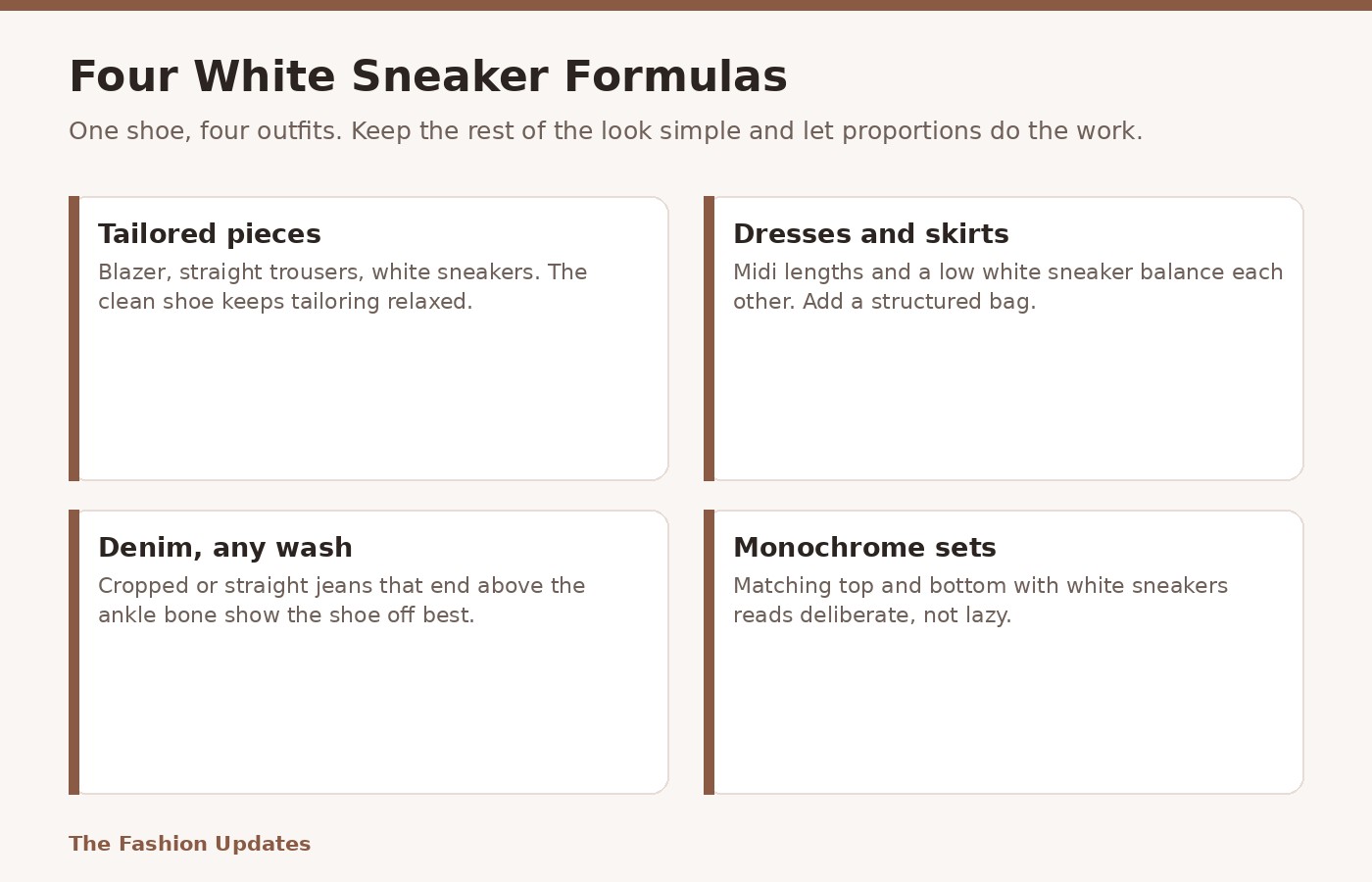
A dress and white sneakers succeed or fail at the hem. The formula is a slim low-top, a dress ending well above the ankle or above the knee, and a visible stretch of leg between the two. When a hem falls to the ankle bone and meets a bulky shoe, the leg line disappears. Who What Wear’s editors return to this pairing in their white sneaker outfits, putting slip dresses over sneakers rather than reserving them for jeans. Refinery29 tested the idea across a week of outfits in its white sneakers with dresses piece.
Midi, shirt, and slip dresses
The midi dress is the easiest starting point. A shirt dress, slip dress, or fitted knit midi carries enough line to hold its own above a low shoe, and the sneaker lowers the formality by one notch, usually the notch that makes a dress wearable on an ordinary day. Keep the shoe slim and let the dress stay the outfit. If the dress is floaty, add one structured piece, a jacket, blazer, or belt. A fuller sneaker under a floaty midi is the combination to avoid: two soft shapes stacked together read as shapeless. Finish a daytime dress outfit with the choices in our sunglasses face shape guide.
Mini and maxi dresses
Mini dresses take the opposite handling. The leg is already exposed, so the shoe can carry more presence: a high-top or retro low-top both work, and a deliberate crew sock can look right here. Maxi dresses need the slim shoe again: the fabric reaches the ankle, so a low, quiet shoe slips under the hem. In both cases, look at the full silhouette. If your eye lands on the sneaker first, the shoe is too big for the dress. That matches our swimsuit body type guide: fit the dominant garment first.

Tailoring and Trousers: Keep Everything Above the Ankle Sharp
Tailoring is where white sneakers earn their reputation, and where they are judged most harshly. The formula is strict: a slim leather low-top in genuinely clean condition, trousers ending at or just above the shoe, everything else pressed and deliberate. Because everything above the ankle is sharp, the soft shoe reads as a considered softening; let the tailoring go rumpled and it reads as giving up. InStyle’s fashion editor makes the workplace case in her guide to sneakers to work, noting that sleek sneakers sit close enough to a loafer’s silhouette to pass at work. Who What Wear builds the same formula in its spring and summer white sneaker outfits, pairing a matching vest and trouser set with white sneakers.
The trouser hem is the whole trick
A trouser that pools over a low sneaker hides the shoe and shortens the leg. Aim for the hem to kiss the top of the shoe or stop a finger’s width above it. Cropped wide-leg trousers can take a slightly fuller shoe, because the fabric’s weight balances it. Tapered trousers cannot; they need the slim shoe. If a trouser only works with a heel, that is information about the trouser, not the sneaker, and our stop heels hurting guide covers the days when the heel is the right tool.
Suits, blazers, and the dress-code line
A full suit works when the cut is relaxed, the top underneath is simple, and the shoe is the plainest pair you own. A blazer over straight trousers or dark denim is the more forgiving version, and the one to try first. A written formal dress code or a courtroom is not a styling problem but a rule to follow, and the final section returns to it. Our best fashion magazine guide points to titles that treat tailoring as a craft.
Denim: The Easiest Formula Still Has Rules
Denim is the pairing nobody needs to be sold on, which is why it goes wrong quietly. The formula changes with the cut. Straight-leg jeans take almost any white sneaker. Skinny jeans need a low shoe, since a bulky sole under a narrow ankle exaggerates both. Wide-leg jeans can carry the fuller shoe, and often need it. Who What Wear’s editors make the same point in their best white sneakers reviews, noting how the same styles move between jeans, dresses, and skirts: the jean is the constant, the shoe adjusts. Their white sneaker outfit formulas include the blazer, tank, and straight-leg jean uniform.
Cuffs, crops, and the ankle gap
With denim, the ankle gap is a tool you control. A single neat cuff on a straight or relaxed jean, ending just above the shoe, creates it deliberately. A full-length jean that stacks over the shoe hides it. Cropped jeans arrive with the gap built in, the easiest denim for sneakers of any profile. Dark, clean denim with a slim shoe and tucked top is the closest denim gets to tailoring, and it borrows the tailoring rules: pressed, deliberate, nothing accidental. Our mens wardrobe essentials guide builds the same base for the other side of the closet.
Skirts: Balance the Shape, Watch the Length
Skirts follow the dress rules with one extra variable: the top can change the proportion. The base formula is a slim low-top and a no-show sock, with the hem above the knee or in the midi zone with leg visible below it. Who What Wear’s shoes that go with anything guide lists the slip, maxi, and miniskirts among its pairings, the three lengths that work. Refinery29 makes the pleated case in its sneakers with dresses and skirts outfits, balancing a pleated midi against the shoe’s plainness.
Pleated, slip, and A-line skirts
A pleated midi skirt moves, so the shoe under it should not: slim, low, and plain, letting the pleats hold the eye. A slip skirt in a silky finish is the high-low pairing at its clearest, a dressed fabric grounded by a plain shoe, with a simple knit or tee tucked in to define the waist. An A-line skirt above the knee is the most forgiving, taking a low-top or a high-top. In every case, tuck the top. Our cross necklaces for women guide covers pendant lengths for these necklines.
Pencil and maxi skirts, the two hard cases
The pencil skirt is the skirt most likely to reject a sneaker, because its line is formal and narrow. It can work with the slimmest leather low-top and a relaxed top, a tee or soft knit rather than a blouse, moving the outfit into smart-casual territory. If the top stays formal, keep the heel. The maxi skirt is the opposite problem, length rather than formality: treat it like the maxi dress, with a low shoe under the hem. For boot-based skirt styling, see our what to wear with cowboy boots formulas.

Athleisure and Casual Sets: One Sporty Signal at a Time
Athleisure is the sneaker’s home ground, and the risk is sameness: leggings, a sports top, a fuller sneaker, and a gym bag together make a workout kit, not an outfit. Let the sneaker be one sporty signal among non-sporty pieces: leggings with an oversized blazer, a matching set with a structured bag, joggers with a clean knit. Who What Wear’s fresh white sneaker outfits include the matching set lifted by a coat: one tailored layer converts exercise clothes into a street outfit. InStyle’s sneakers at work coverage makes the adjacent point that intentionality separates a styled shoe from a commute shoe.
Leggings, joggers, and matching sets
With leggings, proportion runs the outfit: a longer top, a fuller shoe to balance the narrow leg, a crew sock if cropped. Joggers are easier: the cuffed ankle creates the gap automatically. A matching set needs a plain sneaker and a real bag rather than a gym bag. Comfort has a foot-health side: the APMA advises in its how to choose the right shoe guidance that a shoe should fit comfortably on the first try and be replaced when tread and midsole show uneven wear.
Shorts, casual dresses, and weekend formulas
Shorts take the mini-skirt formula: a low-top, bare leg or a deliberate crew sock, a shaped top. The weekend test: if you could walk straight into a workout unchanged, swap one non-sporty piece in. Our best fashion books guide includes the references that develop this eye.
Proportion and Sock Rules That Decide the Whole Look
Most white sneaker outfits that feel wrong are failing on proportion or socks, not on the main pieces. A white shoe is a bright block at the end of the leg: it draws the eye down and shortens the leg line unless something counters it, an ankle gap, a clean hem, a structured top half. The fuller the shoe, the more weight the outfit needs; the slimmer the shoe, the more delicate the garment it can sit under. That is the balance Who What Wear describes when it pairs baggy jeans with retro sneakers with slimmer shoes for tailored sets.
The three sock choices, and when each is right
There are only three sock decisions. The no-show sock, leaving the ankle bare, is the polished default: dresses, skirts, tailoring, and cropped trousers all take it, because bare ankle is part of their line. The crew sock, worn visibly and deliberately, belongs to casual formulas: minis, shorts, leggings, wide-leg denim, retro shoes. The trouser-matched sock is the quiet option for longer tailored trousers. The one choice that is never right is the accidental athletic sock under a dress or trousers, signaling the gym in an outfit claiming something else.

Fit and comfort are part of the proportion
A sneaker outfit also fails when the shoe does not fit: a slipping heel changes how you walk and how the outfit moves. The APMA’s shoe choice guidance is practical here: feet are seldom the same size, a shoe should fit the larger foot, be stiff through the middle, and not need a break-in period. That separates sneakers from boots: where our break in cowboy boots guide manages a planned break-in, a sneaker that hurts on day one is the wrong size. When a heel is the right shoe, our whats healthiest heel height for feet guide covers the favored heights.
Keeping Them White: Clean by Material, Protect Before Wear
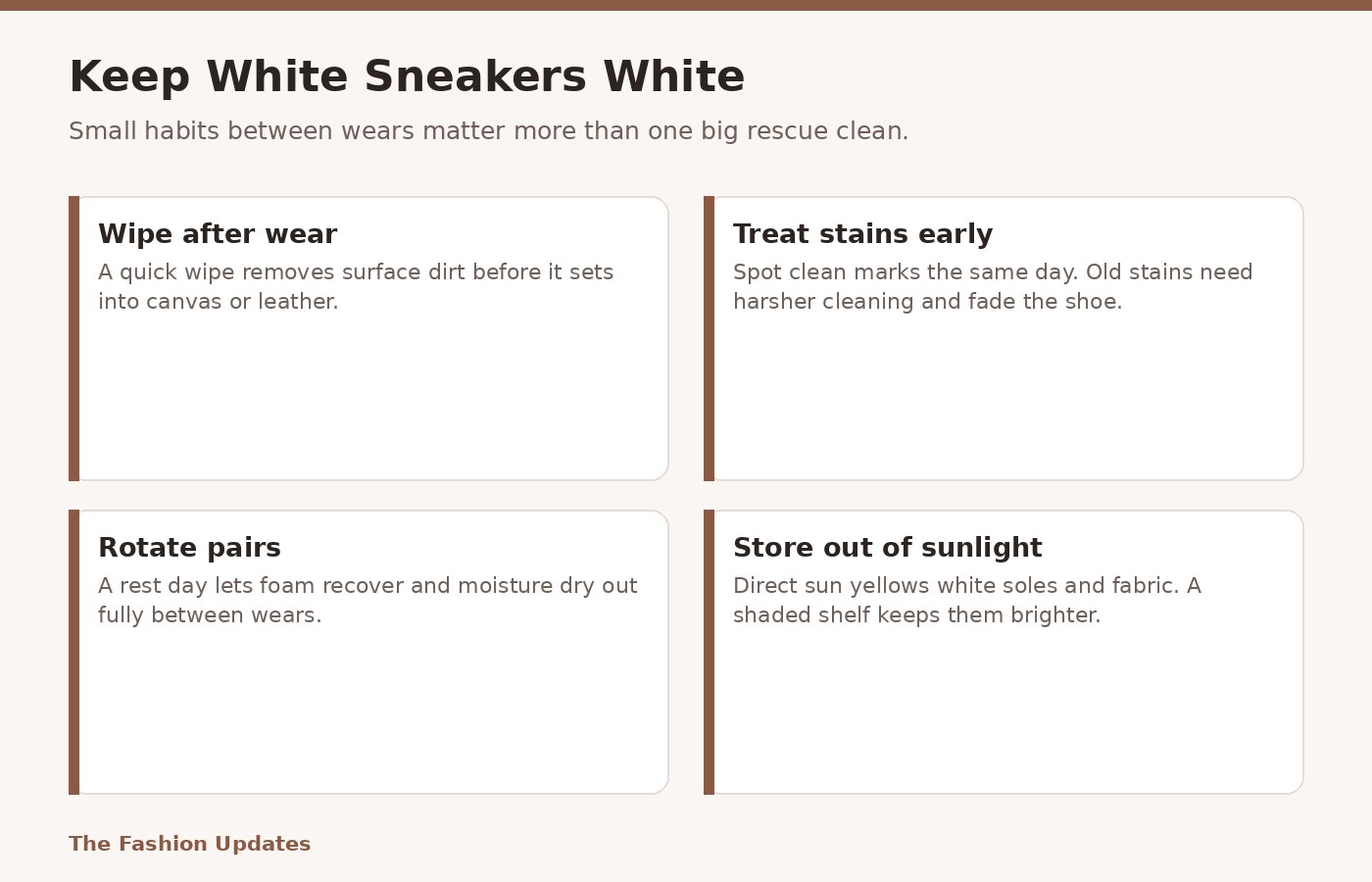
None of the formulas above survive a dirty shoe. White is the sneaker’s whole contribution, so a greyed pair removes the contrast the outfit was built on. The care routine is short, and the sources agree on its shape. Nike sets out the core method in its how to clean your shoes guide: dry-brush loose dirt first, use a mild solution of warm water and a little detergent or dish soap, hand-wash the laces separately, clean the soles, blot the uppers rather than rubbing them, and air dry at room temperature. Adidas gives the same sequence in its cleaning canvas and leather sneakers guide, adding that canvas should not be scrubbed hard, because hard scrubbing can fray or fade it.
Leather, canvas, and knit each get a different touch
Leather is the easiest upper to keep white: it wipes clean, and Nike notes that a cleaning eraser or leather conditioner can lift stains from it, if you do not scrub hard enough to damage the surface. Clarks works through the same materials in its how to clean white shoes guide, wiping leather with a damp cloth rather than soaking it, and using a baking soda paste on canvas. Canvas needs the paste and a thorough rinse, since leftover detergent can yellow it. Knit and mesh need the gentlest handling, brushed in the direction of the knit, no bleach. Gear Patrol’s ultimate guide to cleaning sneakers warns that you cannot judge a white shoe until it has dried.

Soles, laces, drying, and protection
Soles and laces are where a cleaned shoe is betrayed. Reader’s Digest recommends in its how to clean white sneakers guide that a wetted melamine pad is the fastest way to bring rubber soles back to white, and that laces should soak in hot water with detergent. Family Handyman gives the same pad the maintenance role in its how to clean white shoes tips, alongside spot-cleaning scuffs as they appear. Air dry at room temperature, away from heat, for at least eight hours, stuffed with white paper towels to hold the shape.
A maintenance rhythm that keeps the formulas available
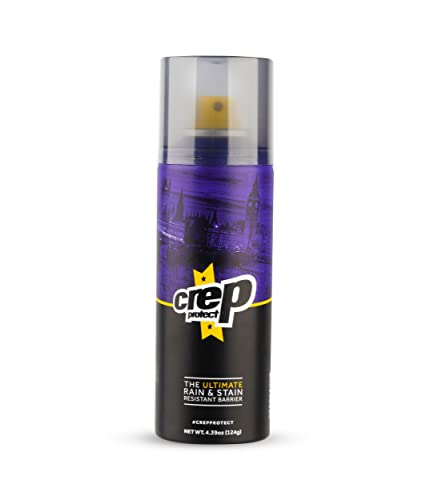
Protection turns cleaning from a rescue into a rhythm. A protector spray on a clean, dry pair, renewed after cleaning, makes the next marks wipe off instead of soaking in, a step Reader’s Digest also puts first in its white sneaker cleaning guide. Between deep cleans, a two-minute habit covers most wear: brush off dry dirt and wipe any new scuff the day it happens. Nike suggests cleaning every two weeks or whenever the shoes look dirty. Keep the kit where the shoes live: a routine that requires a search gets skipped.
When Sneakers Do Not Work
A guide that claims a shoe works with everything is not being honest: forcing a sneaker into the exceptions makes an outfit look like a compromise. The first exception is a genuine dress code: formal evening events, workplaces with written footwear rules, courtrooms, ceremonies where the standard is the point. The second is fabric: a delicate evening dress needs a shoe with the same level of occasion, and a sneaker’s plainness reads as disregard there. InStyle’s work sneaker guide draws the same boundary, qualifying its case with dress codes that set stringent guidelines.
Condition and type can disqualify a pair
The third exception is the shoe itself. A heavily athletic runner, with technical mesh and bright accents, does not become a styling sneaker because it is white; it belongs in athleisure, nowhere near tailoring. A worn-out pair fails differently: the APMA advises in its shoe guidance that uneven tread or midsole wear is the sign a shoe should be replaced. Weather counts too: white sneakers in heavy rain or mud are a cleaning bill, not a styling choice, and a boot is the practical answer, where the cowboy boots outfit formulas on this site take over.
The honest test before you leave
Stand in the full outfit and ask three questions. Is there a rule this shoe breaks? Does its condition match the rest of the outfit? Would it look chosen or defaulted on someone else? If the answers are no, yes, and chosen, wear them. If any answer fails, change the shoe, not the outfit.
Our view
We believe the white sneaker is not a trend but a tool, and most women already own a pair good enough for the job. Learn the one match that governs everything, slim shoe under structured or flowing clothes, fuller shoe under weighty casual clothes, then work the hem, choose the sock on purpose, and keep the pair white. Do that, and one shoe covers dresses, tailoring, denim, skirts, and athleisure without a new purchase. Push it past its honest limits and it stops being versatile and starts being careless.
— The Fashion Updates
Frequently Asked Questions
Can you wear white sneakers with a dress and still look dressed up?
Yes, within limits. A slim, clean low-top under a midi, shirt, or slip dress lowers formality by one notch, keeping day dresses and smart-casual occasions intact. Evening dresses and dress-coded events are the limits.
What socks should you wear with white sneakers and trousers?
Choose a no-show sock so the ankle stays bare, or a sock matched to the trouser color under a longer hem. Avoid a white athletic sock against tailoring.
Do chunky white sneakers work with skirts and dresses?
Rarely as well as a slim pair. A chunky sole adds visual weight at the end of a bare leg, fighting the lightness of most skirts and dresses. Chunky pairs work better with denim, wide legs, and athleisure, which carry enough weight to balance them.
How do you stop white sneakers from making your legs look shorter?
Show ankle between hem and shoe, end trousers and jeans just above the shoe rather than pooling over it, and match the shoe’s bulk to the outfit.
How often should white sneakers be cleaned if you wear them daily?
Little and often. Wipe scuffs as they happen, hand wash about every two weeks with the mild, blot-don’t-rub, air-dry method, and spray the clean pair with protector.
When should you choose heels or boots instead of white sneakers?
Choose the other shoe when a dress code requires it, when the outfit is formal, when weather would ruin a white shoe, or when your only pair is a technical runner or too worn.
How We Pick What We Recommend
Every guide on The Fashion Updates follows the same review process — what we compare, what we check, and what we leave out.
Sources
- Who What Wear — 7 Fresh Ways Fashion Girls Are Wearing White Sneakers
- Who What Wear — 5 Ways to Wear White Sneakers in Spring and Summer
- Who What Wear — The 15 Best Editor-Reviewed White Sneakers for Women
- Who What Wear — Shoes That Go With Anything: 4 Styles That Work Every Time
- InStyle — Here’s How to Wear Sneakers to Work Without Looking Overly Casual
- Refinery29 — Outfit Ideas: Wear White Sneakers With Dresses & More
- Nike — How to Clean Your Shoes in 6 Easy Steps
- adidas — How to Clean Your Canvas and Leather Sneakers
- Clarks — How to Clean White Shoes: A Guide to Restoring Sneakers & Boots
- Reader’s Digest — This Is How to Clean White Sneakers
- Family Handyman — 8 Tips on How to Clean White Shoes
- Gear Patrol — The Ultimate Guide to Cleaning Your Sneakers
- Smithsonian Magazine — A Brief History of America’s Obsession With Sneakers
- GREATS — The History of the White Tennis Shoe
- American Podiatric Medical Association — How to Choose the Right Shoe