
As an Amazon Associate I earn from qualifying purchases.
Most handbags fail quietly. They look right on the shelf, then the strap slips all morning, the opening is too narrow for your wallet, the interior swallows your keys, and within a month the bag sits in the closet while an older, uglier one does the daily work. The problem is rarely taste. It is fit: size, structure, strap and material were never matched to your actual day. This guide on how to choose a handbag works through those four decisions in order, so the bag you buy is the bag you reach for.
The Fashion Updates
Carry What the Day Actually Needs
A daily bag earns its place by fitting your real day: the right size, structure, strap and material, checked before you buy.
Key Takeaways
- Size the bag to what you carry on a normal day, measured against your largest everyday item, not to a label such as small, medium or large.
- Structure is a trade: a firm base and some shape help you find things and protect them, while a fully rigid bag adds weight and fights your body as you walk.
- Strap drop, strap width and empty weight decide comfort more than style does, so test all three with the bag loaded, not empty.
- Choose the material by the care you will honestly do: grained leather, canvas and nylon forgive daily use in different ways, and suede asks the most of you.
- A short in-store or at-home test, packing and carrying your real contents for a few minutes, predicts daily use better than any photograph.
Table of Contents
- Key Takeaways
- Start With What You Actually Carry
- Choose the Size by Your Real Day
- Structure: How Much Shape Helps, and How Much Hurts
- Straps, Handles and Drop: The Comfort Decision
- Weight and Your Shoulders
- Closures, Pockets and Finding Things Fast
- Material: Leather, Canvas, Nylon and Suede Compared
- Construction Details That Predict Daily Wear
- Test the Bag Before You Commit
- Care and Storage That Keep an Everyday Bag in Use
- Our view
- Frequently Asked Questions
- Sources
- Recommended
Start With What You Actually Carry
Every sound handbag decision starts on a table, not in a store. Empty your current bag and sort the contents into three piles: things you carry every day, things you carry a few times a week, and things that migrated in and never left. The first pile is your real capacity requirement. The second is a pouch problem, solved by a small pouch you move between bags. The third is weight you have been paying for in shoulder comfort. This sorting habit is the same one behind our capsule wardrobe guide, where what you actually use sets the plan.
Measure the largest item, not the pile
A pile of soft items compresses. Your largest rigid item does not. Measure the longest and widest thing in your daily pile, whether that is a wallet, a sunglasses case, a paperback, a tablet or a water bottle, and treat those numbers as the minimum clear opening and interior length the bag must offer. A zip opening shorter than your largest item forces a daily angle-and-wiggle ritual that wears the zip and scratches the item. Readers who carry a hard case will recognise the same fit logic from our sunglasses for your face shape guide, where the case, not the frames alone, decides what fits.
The comparison table to shop with
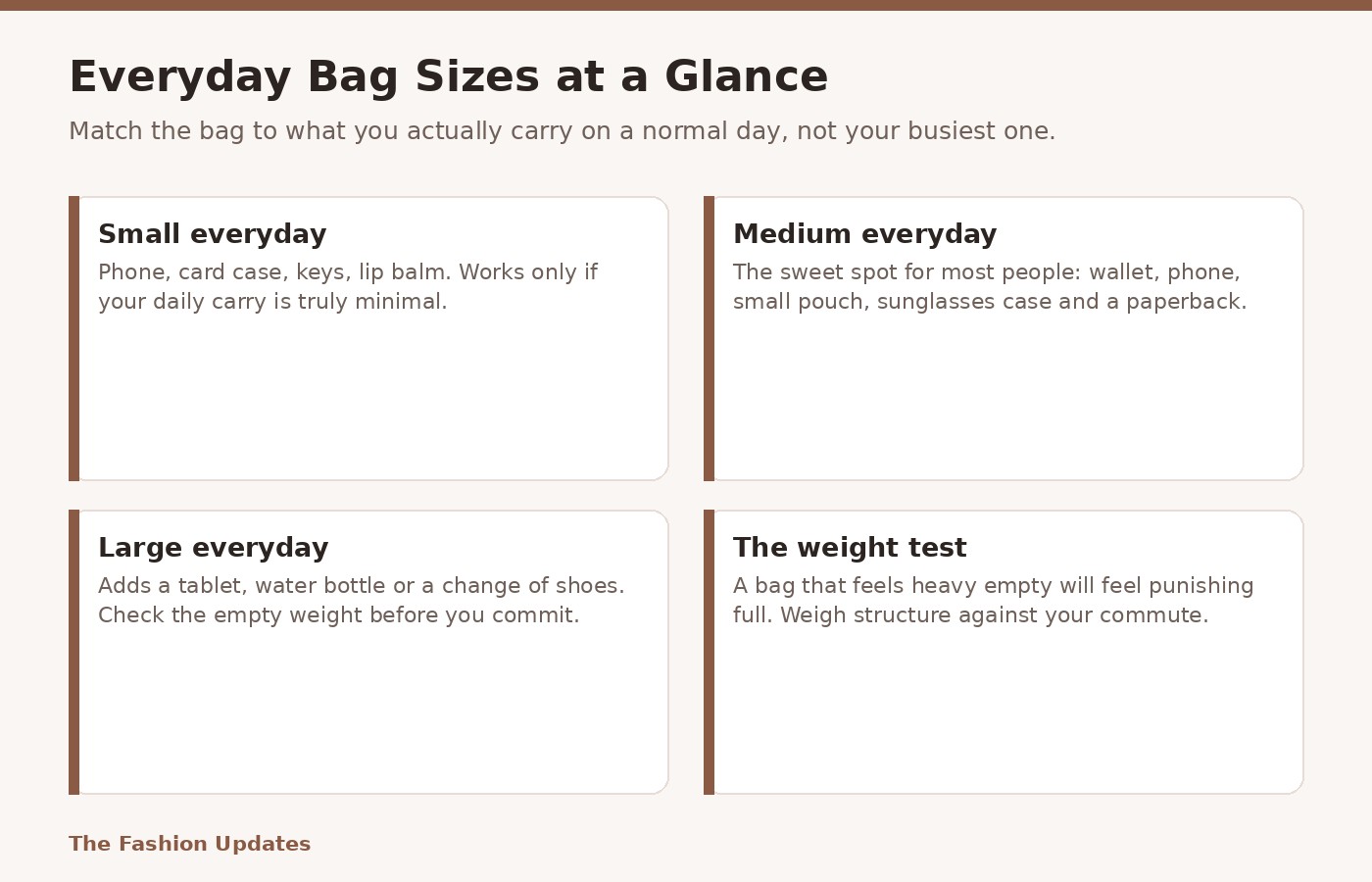
Sizes are not standardised between brands, so use function, not labels. The table below translates what you carry into the bag that usually serves it.
| What your normal day includes | Bag size that usually fits | Structure that suits it | Carry that works best |
|---|---|---|---|
| Phone, card case, keys, lip balm only | Small crossbody or mini shoulder bag | Light structure, so the small shape holds | Crossbody, hands free |
| Full wallet, sunglasses case, small cosmetics pouch, phone, keys | Medium shoulder bag or small tote | Some structure with a firm base | Shoulder or crossbody |
| The medium list plus a notebook, charger and a small umbrella | Large shoulder bag or medium tote | Structured base, softer top | Shoulder, with a crossbody option |
| The large list plus a laptop or tablet in a sleeve | Large tote or work bag with a padded section | Most structure of the group, flat base | Two top handles plus a long strap |
| Essentials split across pockets, nothing bulky | Organised satchel or multi-pocket bag | Medium structure, divided interior | The carry you already prefer |
Read the table by your busiest normal day, not your busiest day ever. A bag bought for the exceptional day is oversized and heavy for the other six days of the week.
Choose the Size by Your Real Day
With your largest item measured, size becomes a short, honest conversation. A bag is big enough when your daily pile goes in without forcing, comes out without excavating, and leaves the closure closing the way it was designed to close. If the zip strains or the flap sits lifted, the bag is too small for your life regardless of its size label, and every strained closure is a repair waiting to happen.
Width, depth and height do different jobs
Width is the number listings lead with, but depth decides whether a bag feels roomy or mean. A wide, shallow bag spreads items in a single layer you can see. A narrower, deeper bag stacks items, which holds more but hides the bottom layer. Height matters for anything tall: a bottle that pokes above the closure line will work the opening open and spill in a car footwell. Check all three dimensions against your pile, and be suspicious of any listing that gives only one. The same three-dimension thinking helps with footwear fit, as our best loafers for women guide shows when it separates length from width and depth.
Buy for the normal day, borrow for the big day
On the occasional big day, a foldable tote carried alongside your everyday bag beats a permanently oversized handbag, because the tote goes back in a drawer when the day ends. This is the accessories version of the principle in our men’s wardrobe essentials guide: pieces that each do one job well outperform one piece straining to do every job.
Structure: How Much Shape Helps, and How Much Hurts
Structure is how much of its shape a bag keeps when empty and when set down. A structured bag stands up, holds its opening open while you load it, and keeps a notebook from curling. A soft bag collapses against your body, weighs less for the same capacity, and fits into awkward spaces such as a crowded footwell. The right amount is what your contents and carry style actually need.
The base decides more than the walls
If you test one structural feature, test the base. A flat, reasonably firm base lets the bag sit upright instead of tipping its contents into a heap, and it spreads the load so heavy items rest low and central. That packing principle, heavier items low and toward the centre, is exactly what the American Academy of Orthopaedic Surgeons recommends in its backpack safety guidance, and it applies inside a handbag for the same reason: a low, centred load moves less and pulls less as you walk. Squeeze the base before you buy. If it folds in half under light pressure, the bag will slump around its contents within weeks.
Where soft bags win
A softer bag is the honest choice when your day involves crowds, long carries, or wearing it crossbody, where a rigid corner digs into your hip with every step. Soft bags also forgive irregular contents, a rolled cardigan or a child’s spare layer, that a rigid frame refuses. Many readers pair a softer bag with more structured outfits, a balance our how to style white sneakers guide also strikes. Choose softness deliberately, though: a completely unstructured bag with one open compartment loses keys and patience most reliably.
Straps, Handles and Drop: The Comfort Decision
More everyday bags are abandoned over straps than over any other feature. The strap decides where the weight sits, how the bag moves as you walk, and whether your hands stay free. Judge it loaded, over the coat you actually wear, because a strap that behaves on a bare shoulder may slide constantly on a winter coat.
Drop length: where the bag lands on your body
Strap drop, the distance from the top of the strap to the top of the bag, decides where the bag body rests. A short drop tucks it under your arm, secure but crowded with a thick coat. A longer drop rests it at the hip, easier to reach into but more likely to swing. Crossbody straps solve the swing by anchoring the bag diagonally, and they free both hands. Whatever the style, the bag should sit where you can rest a hand on it without hunching a shoulder up to keep it there. That raised-shoulder habit is what a physiotherapist warns against in this handbag ergonomics interview, which recommends wide, adjustable, padded straps and a strap long enough to wear across the body.
Width, padding and attachment points
A wider strap spreads pressure over more of the shoulder; a thin strap concentrates the same weight into a cutting line. Padding helps on heavier bags and matters little on light ones. Then look at where the strap attaches. Attachments sewn into a reinforced panel, or clipped to sturdy rings set into the bag body, survive daily use. Attachments stitched to a thin decorative tab are the first failure point on many bags, because every lift pulls on exactly those stitches. Tug each attachment firmly in the store: any give or stitch strain is the bag telling you its lifespan. The same rule holds in our best belts for men guide: the load-bearing parts decide how long the piece serves.
Two ways to carry beats one
A bag with both top handles and a detachable longer strap covers more of a real week than either alone. Handles suit short carries and a polished look; the long strap takes over for the commute and any moment you need both hands. Check that the strap clips on and off without a fight, and that the handles sit flat when it is in use. Versatility of this kind is what makes a piece a genuine gift rather than a guess, a point our Mother’s Day gifts guide makes about accessories.
Weight and Your Shoulders
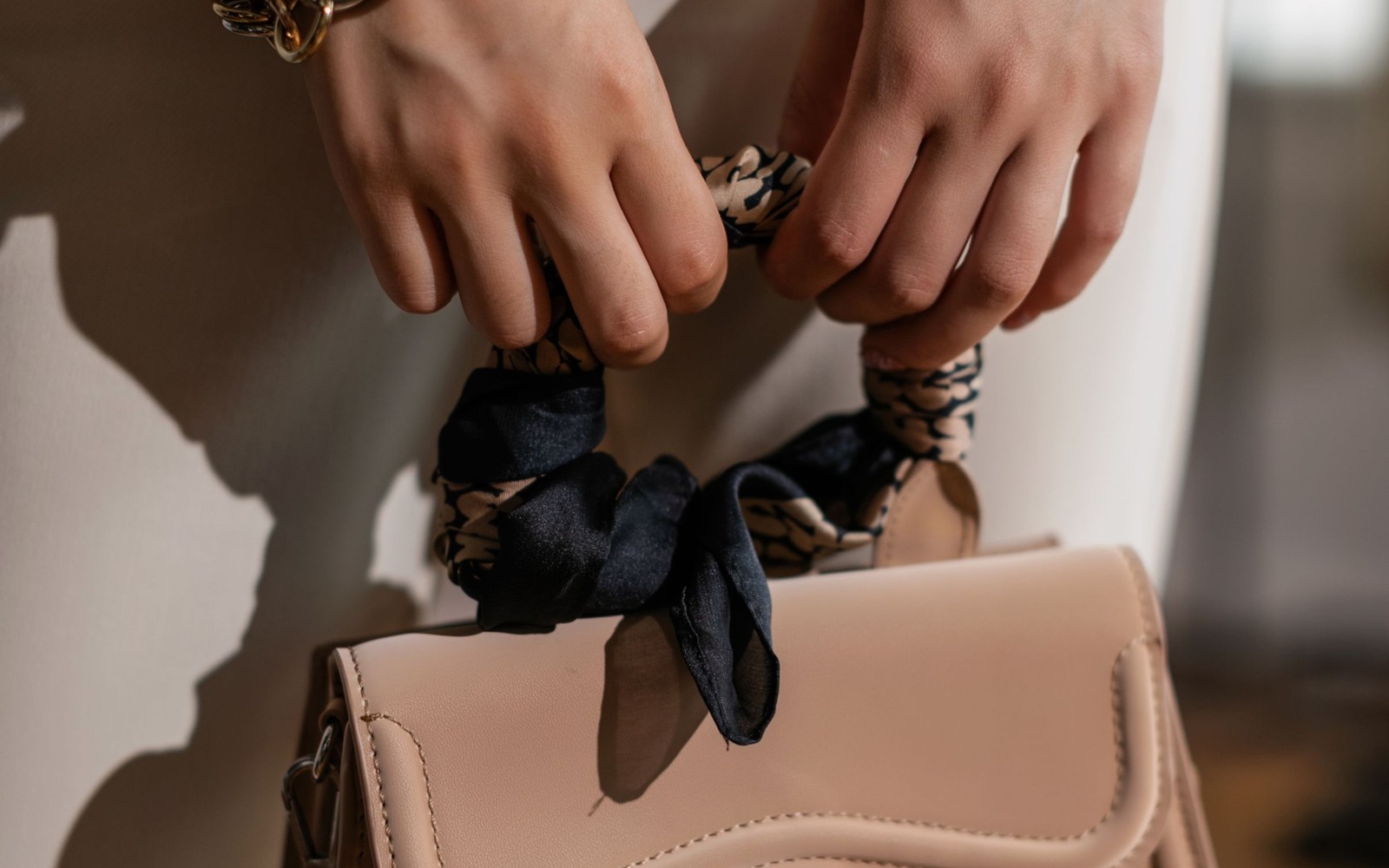
Weigh the empty bag before anything goes into it. Heavy leather, chunky hardware and layered lining can make a medium bag surprisingly heavy while still empty, and every gram of empty weight is a gram your shoulder carries all day on top of your contents. If a bag feels noticeably heavy empty in your hand, it will feel punishing loaded by mid-afternoon. Lightweight construction is not a compromise here. It is the feature that keeps a good bag in daily use.
What the health guidance actually says
The medical sources are consistent about one-sided loads. Cleveland Clinic advises people with thoracic outlet symptoms to avoid carrying heavy bags on the shoulder, and the American Academy of Orthopaedic Surgeons gives the same instruction in its thoracic outlet syndrome guidance, explaining that a heavy bag pushes down on the collarbone and increases pressure on the nerves and blood vessels beneath it. The physiotherapist in the handbag ergonomics interview adds the practical version: keep a frequently carried bag light, and switch sides often. If your neck aches on the bag side by evening, the fix is a lighter bag, a wider or crossbody strap, or fewer contents.
The two-minute weight test
Load the bag with your real daily pile, plus a full water bottle if you ever carry one, and carry it for two minutes, including stairs if you can. A deep strap groove or an urge to keep shifting the bag are warnings that read clearly at two minutes and become aches at two hours. This loaded test is the handbag equivalent of the wear test in our stop heels hurting guide: brief, honest, and far cheaper than learning the same lesson over a full day.
Closures, Pockets and Finding Things Fast
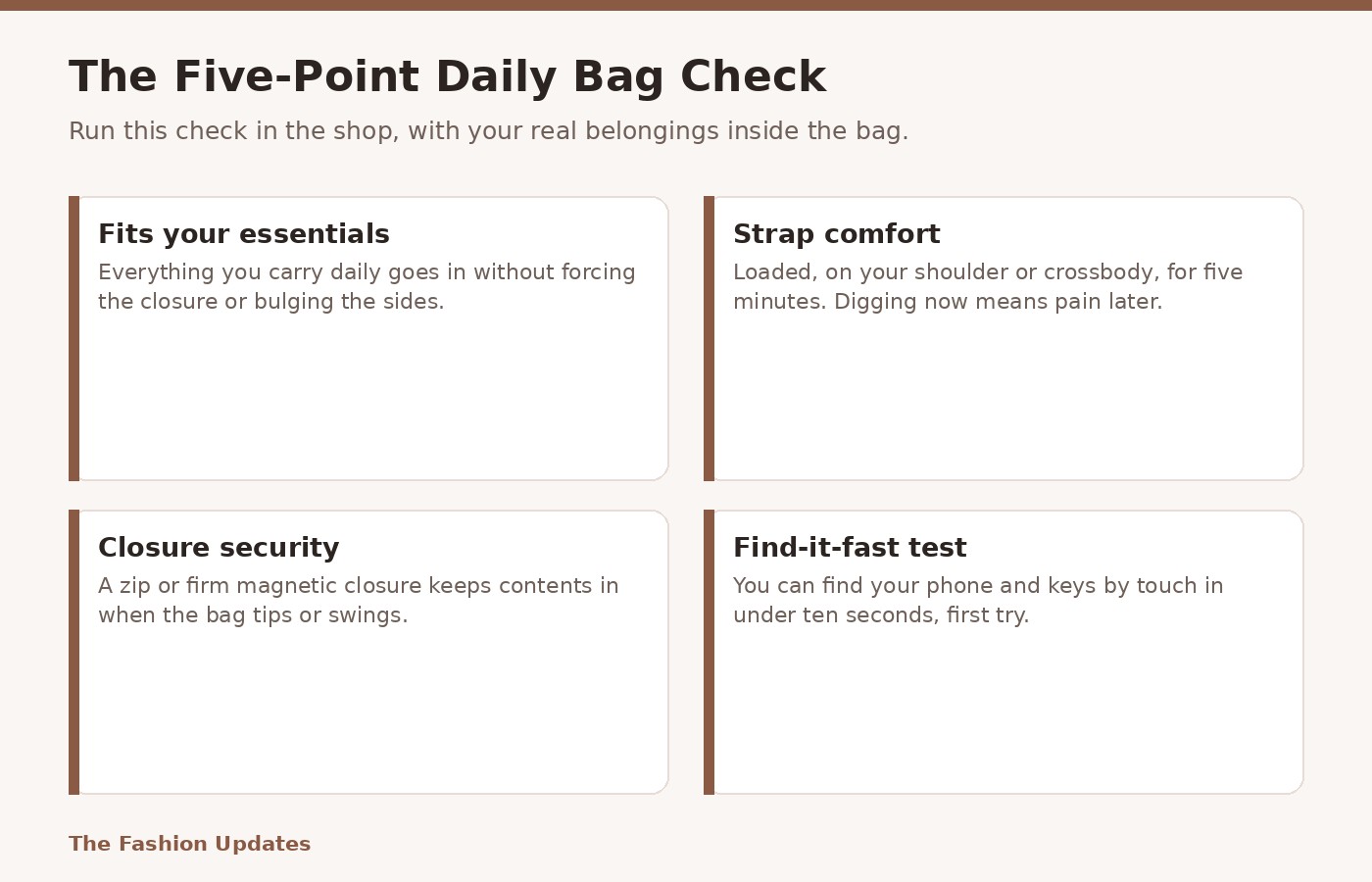
An everyday bag is opened dozens of times a day, so its closure and interior layout are daily experiences, not details. A full zip top is the secure default for commuting and crowded places, and it keeps contents in when the bag tips over. A flap adds weather cover but slows one-handed access. A magnetic snap is fast, quiet, and the least secure of the three. The more public and crowded your day, the stronger the case for a zip that closes the whole opening rather than a snap that closes the middle of it.
Pockets: enough, in the right places
The useful minimum is one zipped interior pocket for valuables, one open pocket sized for your phone, and a place for keys that is not the bottom of the main compartment. Several pockets also spread contents so the load sits more evenly, a benefit the physiotherapist notes in the handbag ergonomics interview when recommending several pockets instead of one large compartment. Too many fixed compartments, though, and each oddly shaped item fits none of them. A light-coloured lining is an underrated feature: finding a black key fob inside a black-lined bag, in a dim car park, is a small daily tax you can decline to pay. Readers who organise a routine around small daily items will recognise the thinking from our skincare routine order guide, where everything has a set place.
When an insert earns its place
If you love a bag whose interior is one open space, or you swap bags often, a removable insert gives it the pockets it lacks and lifts out, contents and all, when you change bags. Choose one slightly smaller than the interior so it does not fight the closure, with a firm enough base to keep the shape the bag itself does not provide.
Material: Leather, Canvas, Nylon and Suede Compared
Material decides weight, weather behaviour, how the bag ages and how much care it demands. There is no best material, only the material whose demands match the care you will genuinely give. Be honest at this step, because a beautiful material with the wrong care routine becomes the bag you stop using.
Leather: know which leather you are holding
Leather terms are defined more precisely than most labels suggest. The Leather Working Group’s list of leather definitions defines full grain as leather that has kept its entire grain, with none of the surface removed by corrective treatment, and corrected grain as leather whose grain has been partially removed by buffing and then refinished. Full grain shows its natural surface and develops patina; corrected finishes look more uniform and shrug off marks more easily. Coach makes the same practical point in its beginner’s guide to leather, describing crossgrain leather as lightweight and durable and pebbled leather as a textured surface that resists scratches and scuffs. For daily use, a grained finish is usually the forgiving choice, and smooth, pale leather the demanding one.
Labels deserve a sceptical read. The Federal Trade Commission’s leather guides for handbags state that it is deceptive to use the unqualified term leather unless a product is composed in all substantial parts of leather, and that bonded leather, made from shredded fibres, should not be represented simply as leather. Pair that label literacy with the material checks in our cross necklaces for women guide, another accessory where wording often outruns substance.
Leather care in daily service is simpler than museum care, and the museum sources still mark the limits. The Canadian Conservation Institute warns in its care of tanned leather note that very dry conditions make leather brittle, while high humidity encourages mould, and its broader caring for leather guidance explains how tanning and finishing change a skin’s strength and water resistance. Coach’s routine in its beginner’s guide to leather is the working version: clean regularly, condition periodically, store in a breathable cloth bag away from sunlight, and test any product on a hidden area first.

Canvas, nylon and coated fabrics: the light, forgiving route
Fabric bags trade leather’s structure and patina for low weight and easy cleaning, a trade many daily routines should take. A textile overview of which fabrics are most durable notes that nylon, also called polyamide, is valued for fibre strength and often excellent abrasion resistance, while canvas is a firm, closely woven fabric whose durability depends on yarn strength, weave density and fabric weight. Longchamp’s bag care guidance shows the daily-care side: clean canvas with a damp cloth and a little pH-neutral soap, do not soak it, keep leather trim dry, and never use leather cream on textiles. Waxed or coated canvas adds rain resistance while keeping most of that lightness, and suits the relaxed outfits in our what to wear with cowboy boots guide.
Suede: beautiful, and the highest maintenance
Suede’s nap is what makes it lovely and what makes it vulnerable: the raised fibres hold dust, mark with water and darken where hands touch. The Leather Working Group’s list of leather definitions describes suede as leather or split leather mechanically finished to produce a velvet-like nap. Deadly Ponies sets out the routine in its suede care instructions: brush in the direction of the nap, lift marks with a cleaning eraser, then apply protector spray in light coats from a distance, letting each coat dry, and reapply regularly for daily pieces and after rain. If that sounds like a chore you will skip, choose suede for a second bag, not the daily one.
Construction Details That Predict Daily Wear
Two bags in the same material at the same size can have very different lifespans, and the difference is visible before you buy. Stitching should be even, close and unbroken, with no loose ends at stress points. Corners, the highest-wear area on any bag, should be reinforced or cleanly finished, because a fraying corner opens the whole seam line. Zips should run smoothly in both directions, and the zip pull should feel substantial, since it is the part you will grip thousands of times.
Hardware, lining and feet
Hardware should feel solid rather than hollow, clasps should close with a positive action, and the lining should be stitched in, not glued and floating. Small feet on the base keep the bottom off wet pavements. These checks mirror the binding checks in our best fashion books recommendations: the parts that flex and bear load decide longevity.
Edges and handles take the strain
Edge finishing on handles should be smooth and complete, with no cracks or peeling at the bend, because handles flex at exactly that bend on every carry. Squeeze and bend one in the store: the surface should move without creasing white or crackling. Handles are also where hand cream and rain concentrate, so a finish that already looks fragile on the shelf has no chance in service. Fragrance wearers should note the contact point our best perfumes for women guide raises: spray goes on skin and dries before the bag goes over the arm, not onto the handle itself.
Test the Bag Before You Commit
Bring your daily pile, or a faithful stand-in, and run the full test wherever you buy. Pack the bag. Close it. Carry it on each shoulder and crossbody if it allows. Walk, sit down with it, set it on the floor and pick it up by each handle and strap. Open it one-handed while it hangs on your shoulder, take your phone out, and put your keys away. Every awkward moment in that sequence is one you would repeat daily, so let awkwardness disqualify a bag here rather than at home.
The outfit check
Try the bag with the clothes it must serve: your work coat, your usual shoes, the colours you wear most. A bag that only works with one outfit is an occasion bag wearing an everyday label. Neutral colours earn their reputation because they disappear into most wardrobes, the same reasoning our swimsuit by body type guide uses when it puts fit ahead of the loudest print. The editorials in our best fashion magazine guide are a good reminder of the gap between how a bag photographs and how it behaves on a bus.
The return-window rule
If you buy online, run the same test at home the day the bag arrives, tags still on, and use the return window without sentimentality if it fails. A bag that is nearly right is wrong: a strap that slips a little will slip a lot under a winter coat. Daily use magnifies small frictions, which is the whole lesson of this guide.
Care and Storage That Keep an Everyday Bag in Use
An everyday bag does not need a spa routine. It needs small, regular habits that stop dirt, moisture and distortion building up. Empty it fully once in a while, shake out crumbs, and wipe the exterior with a soft cloth suited to its material. Longchamp’s bag care guidance gives storage basics that apply across materials: keep bags in their cover, away from prolonged light, heat and humidity, test any solution on a hidden part first, and do not overfill a bag whose shape you want to keep. Pens, perfume and lipstick belong in an inside pouch, so a leak marks a lining rather than the bag itself.
Storage that holds the shape
Louis Vuitton’s bag storage guidance advises storing a bag in a breathable dust bag, lightly filled to support its structure, in a cool, dry, ventilated space, and warns against hanging bags by their handles, storing them overfilled or compressed, and using non-breathable containers that trap moisture. Coach gives the same advice in its beginner’s guide to leather: stuff with tissue, use a breathable cloth bag rather than plastic, and keep it out of direct sunlight. For a daily bag, storage mostly means the overnight version: set it down upright, not slumped under a coat.
Damp, mould and when to stop and dry
A rain-wet bag should be emptied, blotted and dried naturally at room temperature, away from direct heat, before it goes back into a closed space. The National WWII Museum’s preservation guidance makes the underlying point for leather: store it at medium humidity and moderate temperature, out of direct sunlight, and support its shape while it is pliable. If you ever find mould, treat it as a health issue first. The Canadian Conservation Institute’s removing mould from leather note explains that warmth, poor air circulation and high humidity promote mould growth, and that an affected item should be isolated and dried with better air circulation.
Our view
Choose the bag your ordinary Tuesday needs, not the bag your best outfit wants. Measure your largest daily item, insist on a firm base, a strap that stays put and an empty weight your shoulder forgets, and pick the material whose care you will actually do on a tired evening. Test it loaded, with your own things, before the return window closes. A handbag earns everyday status in the carrying, not the buying, and the right one disappears into your routine so completely that you only notice it on the rare day you leave it behind.
— The Fashion Updates
Frequently Asked Questions
How do I know what size handbag I need for every day?
Empty your current bag, keep only what you carry daily, and measure the largest rigid item in that pile. The bag’s clear opening and interior length must beat those measurements with room to spare, and the closure must close easily over the full pile. If you have to force, angle or stack to fit, go one size up.
Is a structured or a soft handbag better for daily use?
Neither is better for everyone. A structured bag with a firm base stands upright, protects a laptop or notebook and makes contents easy to see, but it weighs more and can dig in when worn crossbody. A soft bag is lighter and more comfortable against the body but needs pockets or an insert to stay organised. Match the structure to your contents and your carry style.
How heavy is too heavy for an everyday handbag?
Start with the empty bag: if it feels noticeably heavy in your hand before anything goes in, it will feel far heavier on your shoulder by afternoon. Medical guidance advises against carrying heavy bags on one shoulder, and physiotherapy guidance recommends keeping a frequently carried bag, contents included, light, and switching sides often. Neck or shoulder ache on the bag side is your signal to lighten the bag or its contents.
Which handbag material is easiest to maintain?
Nylon and coated canvas are usually the easiest: they are light, tolerate damp weather and wipe clean, though leather trim still needs to stay dry. Grained or pebbled leather is the most forgiving leather, since its texture hides scuffs. Smooth pale leather and suede ask the most, with suede needing regular brushing and protector spray to stay presentable.
Crossbody, shoulder bag or tote: which carry is best?
Crossbody is best for hands-free commuting and for spreading weight across the body. A shoulder bag suits shorter carries and easy access. A tote suits days when you carry a laptop, files or extras, provided it also has a longer strap for when it gets heavy. Many people do best with one bag that offers both top handles and a detachable long strap.
How should I store an everyday handbag at home?
Set it down upright, lightly filled if it tends to slump, in a breathable dust bag or cover, in a cool, dry place out of direct sunlight. Do not hang it by its handles for long periods, store it overfilled or compressed, or seal it in plastic, which can trap moisture. Dry a rain-wet bag naturally at room temperature before putting it away.
How We Pick What We Recommend
Every guide on The Fashion Updates follows the same review process — what we compare, what we check, and what we leave out.
Sources
- Canadian Conservation Institute — Care of Alum, Vegetable and Mineral-tanned Leather
- Canadian Conservation Institute — Caring for Leather, Skin and Fur
- Canadian Conservation Institute — Removing Mould from Leather
- Leather Working Group — 74 Need-to-Know Leather Industry Terms
- Federal Trade Commission — Guides for Select Leather and Imitation Leather Products, 16 CFR Part 24
- Coach — Ask an Expert: Beginner’s Guide to Leather
- Cleveland Clinic — Thoracic Outlet Syndrome
- American Academy of Orthopaedic Surgeons, OrthoInfo — Backpack Safety
- American Academy of Orthopaedic Surgeons, OrthoInfo — Thoracic Outlet Syndrome
- Louis Vuitton — How Do You Store a Designer Bag to Maintain Its Shape?
- Longchamp — Fixing and Care
- Deadly Ponies — Care Instructions
- National WWII Museum — Preservation of Artifacts
- Core Concepts Physiotherapy — Handbag Ergonomics, Part 1
- Nooteboom Textiles — Which Fabrics Are the Most Durable?