As an Amazon Associate I earn from qualifying purchases.
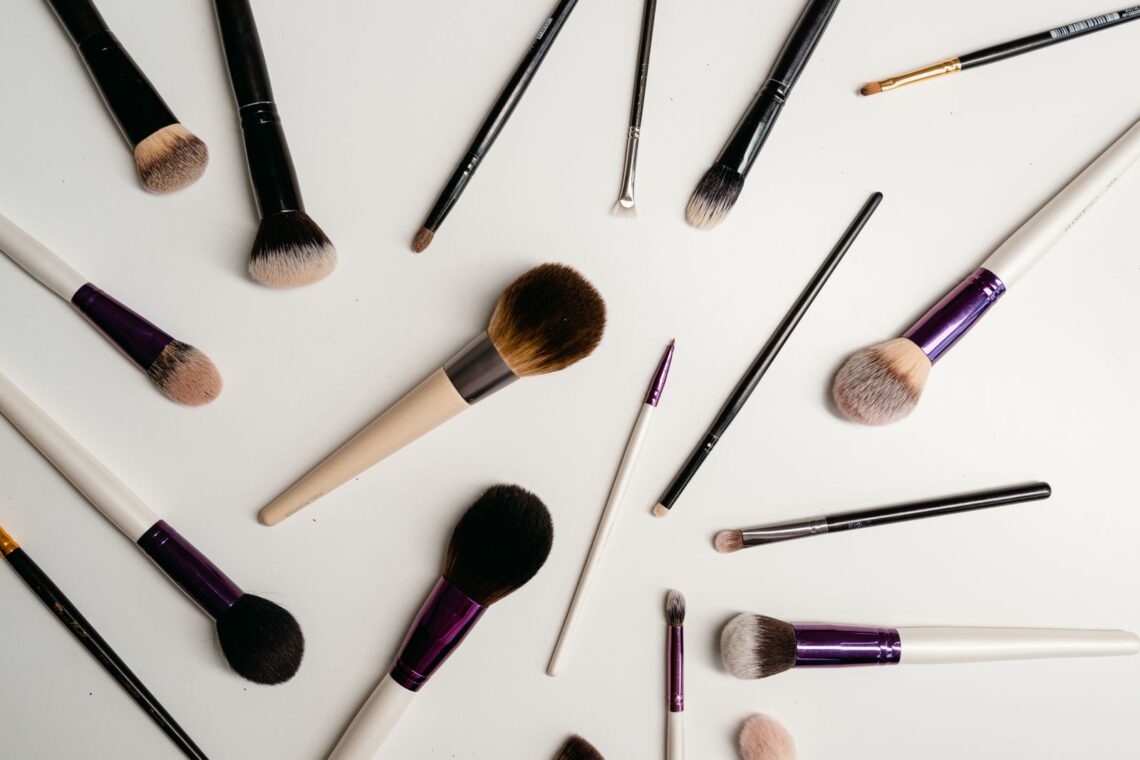
A brush roll can look like a cutlery drawer, a dozen handles with no obvious logic to which one does what. The logic is simpler than the marketing suggests. Every brush can be identified by three things you can see and feel: its shape, how densely its fibers are packed, and what those fibers are made of. Once you can read those clues, the name on the handle stops mattering. This guide works through makeup brushes explained in that order, what each brush is, how to recognize it, what product it applies, and the sequence in which brushes are used in a full routine, then how to clean and store them.
The Fashion Updates
Every Brush, Named and Placed
Learn makeup brushes explained: identify each brush by shape and fiber, what it applies, the order to use them, and how to clean and store them.
Key Takeaways
- Identify any brush by shape, density, and fiber: loose and fluffy means a soft, diffused finish, while dense and firm means more coverage and more control.
- Synthetic fibers suit liquids and creams because they do not absorb product, while softer, more flexible fibers diffuse powders without depositing too much at once.
- Face brushes follow the product order: base first, then powder, blush, bronzer, and contour, with the fan and stippling brushes as light, finishing tools.
- Eye brushes work in pairs, a flat shader to place color and a fluffy blending brush to soften it, supported by a pencil brush, an angled liner or brow brush, and a spoolie.
- Wash brushes every 7 to 10 days following dermatologist guidance, rinse the tips only, use gentle shampoo, and dry them flat with the tips hanging over the edge of the counter.
Table of Contents
- Key Takeaways
- How to Identify a Brush by Shape, Density, and Fiber
- The Anatomy of a Brush: Handle, Ferrule, and Fibers
- Face Brushes: Powder, Blush, Bronzer, and Contour
- Foundation Brushes Named by Shape
- Eye Brushes: Shader, Blending, Pencil, and Liner
- Lip and Detail Brushes That Finish a Look
- The Order to Use Brushes in a Full Routine
- Common Mistakes With Density, Pressure, and One-Brush Routines
- How to Clean Brushes the Dermatologist Way
- Storage, Replacement, and Keeping Brushes in Shape
- Our view
- Frequently Asked Questions
- Sources
- Recommended
How to Identify a Brush by Shape, Density, and Fiber
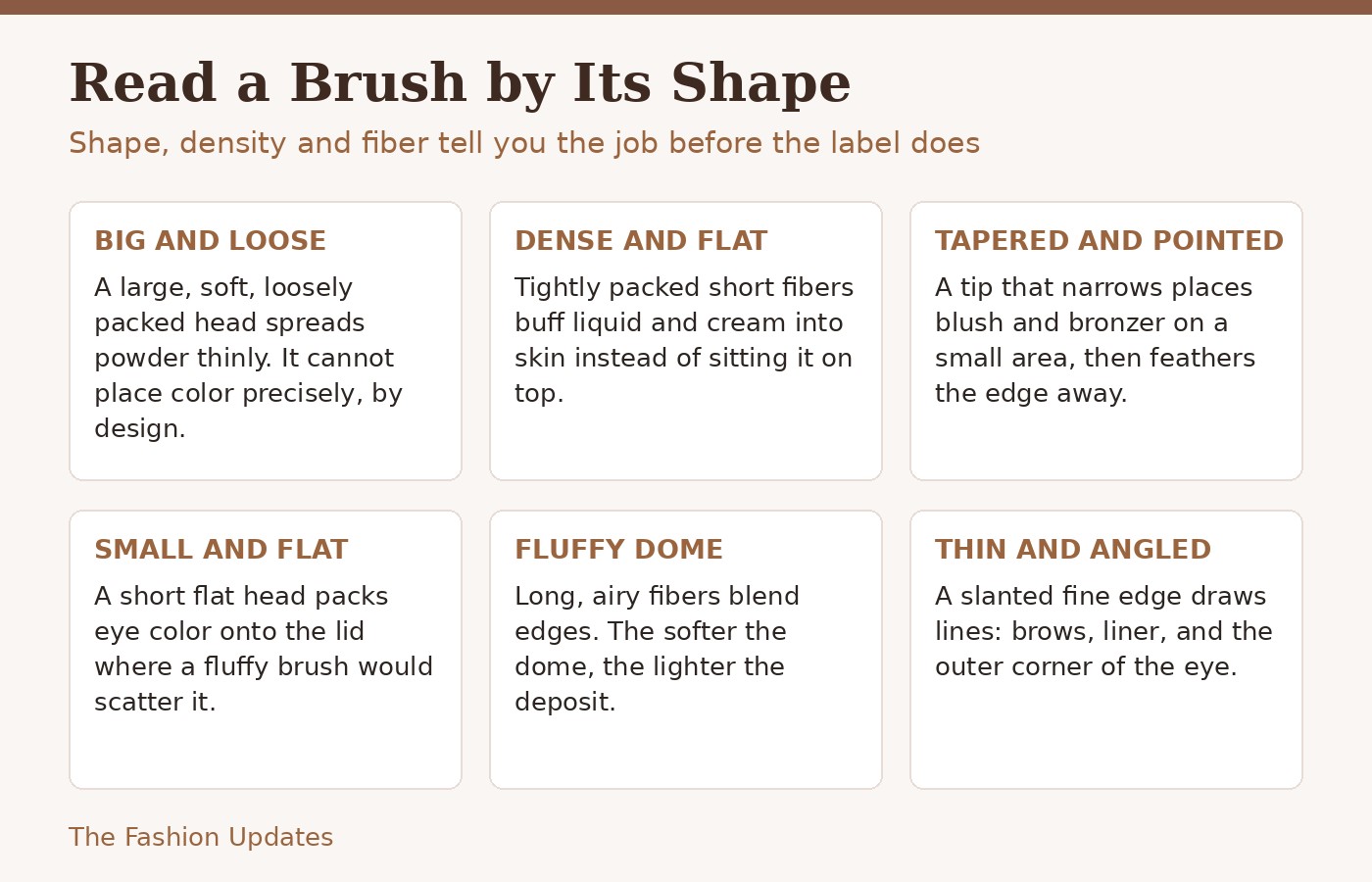
Start with the table below, because it is the whole guide in miniature. Shape decides where product lands, density decides how much of it lands, and fiber decides which formulas the brush handles well. The Sephora brush guide organizes brushes the same way, by face and eye families, and Sigma makes the related point in its cakey makeup guide that the brush you choose determines how much product is picked up, where it is placed, and how evenly it blends.
| Brush | Recognize it by | What it applies |
|---|---|---|
| Powder brush | Largest head in the set, loose, domed, very fluffy | Loose or pressed setting powder |
| Foundation brush, flat paddle | Flat, smooth, tongue-shaped, firm fibers | Liquid foundation, painted on in strokes |
| Foundation brush, flat-top kabuki | Short, dense, flat cut across the top | Liquid or cream foundation, buffed in circles |
| Stippling brush | Two lengths of fiber, pale tips over a darker base, airy feel | Light layers of foundation, blush, or bronzer |
| Blush brush | Medium, tapered or domed, soft and moderately loose | Powder or cream blush on the cheeks |
| Bronzer brush | Large, rounded, fuller than a blush brush | Bronzer across forehead, cheeks, and nose |
| Contour brush | Angled cut or small, dense, tapered head | Contour powder or cream under the cheekbones |
| Fan brush | Fibers spread in a thin, flat fan | Highlighter, plus sweeping away fallout |
| Flat shader brush | Small, flat, firm, packs color when pressed | Eyeshadow across the eyelid |
| Fluffy blending brush | Long, tapered, loose dome, very soft | Blended eyeshadow through the crease |
| Pencil brush | Tiny, pointed, pencil-shaped tip | Shadow along the lash line and inner corner |
| Angled liner or brow brush | Small, stiff, cut on a diagonal | Gel liner, brow powder, or pomade |
| Spoolie | Spiral bristles like a mascara wand | Grooming brows and separating lashes |
| Lip brush | Small, flat, firm, often retractable or capped | Lipstick and gloss with a defined edge |
Shape tells you where the product goes
A domed brush diffuses as it moves, which is why powder and blush brushes are domed. A flat brush places product exactly where it touches, an angled brush follows a line the face already has, and a pointed brush concentrates color in a small area. Bobbi Brown uses the same language on its brushes page, where a sloped brush is for concealer and a slim brush is for lining. If you own a base from our best makeup foundations guide, matching its brush by shape is the next step.
Density tells you how much product lands
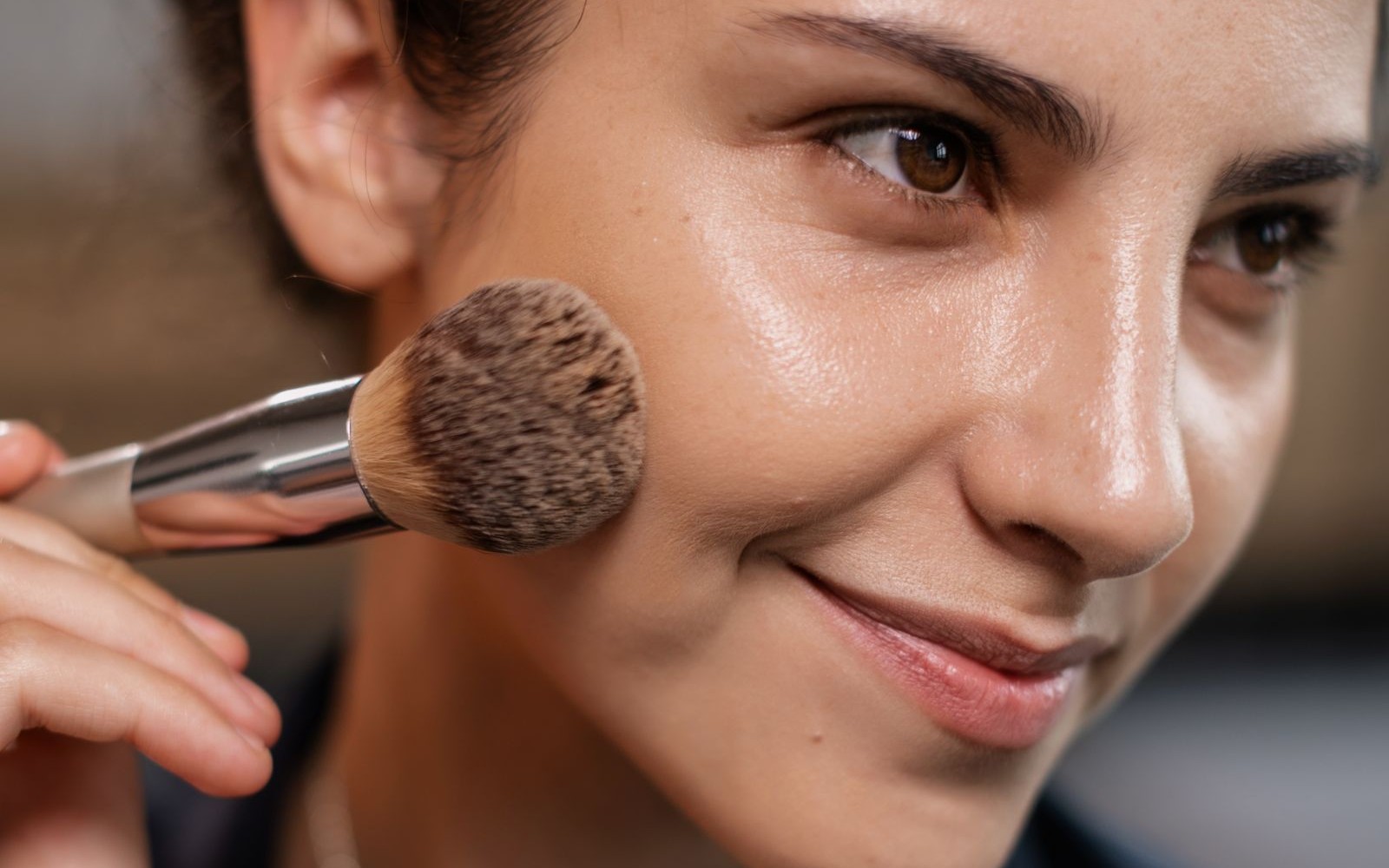
Squeeze the head gently. Fibers that barely move belong to a brush built to buff and build coverage. Fibers that splay easily belong to a brush built to dust and diffuse. Using a dense brush for powder blush is the most common beginner error, because it deposits a concentrated patch that then has to be blended away. Density, more than price or brand, separates a finishing brush from a coverage brush, so check it before any brush touches your face or your skin undertone guide test shades.
The Anatomy of a Brush: Handle, Ferrule, and Fibers
Every brush has the same three parts, and almost every way a brush dies starts in one of them. EcoTools describes its construction in its Core Five set: bamboo handles, synthetic hairs, and ferrules of recycled aluminum. The parts, not the branding, are what you are buying.
The handle and the ferrule
The handle sets length and weight, and length is leverage. Longer handles suit soft, sweeping work held lightly at the end, such as powder and blending. Shorter handles, including the stubby kabuki style, suit firm buffing held close to the head. The ferrule is the metal band connecting handle to fibers, and inside it the fibers are glued. That glue is the weak point of the whole tool: water inside the ferrule loosens it, which is why every cleaning method here keeps water on the tips only. Real Techniques notes in its brush cleaning guide that soaking loosens that glue, and a ferrule that spins or sheds from the base means the brush is at the end of its life. The same care applies to the applicators in our how to apply nail polish guide.
Natural and synthetic fibers suit different products
Natural fibers, traditionally animal hair, have a scaly surface that grabs powder well and releases it gradually, so they have long been favored for powder, blush, and blending brushes. Synthetic fibers are smooth, uniform, and non-porous: they do not soak up liquid or cream product, and they rinse clean more completely. Sigma states in its sensitive skin brush guide that its synthetic fibers are non-porous, easier to clean, and less likely to trap oils. The practical rule: liquids and creams go with synthetic, powders work with either, and a single all-synthetic set is easiest to wash, much like the gentle routines in our hair care tips guide.

Face Brushes: Powder, Blush, Bronzer, and Contour
Face brushes divide by the size of the area they cover: powder for the whole face, bronzer for the high points, blush for the cheeks, contour for a narrow line. Sephora groups its face brushes in its makeup brush guide in the same order, as does the e.l.f. team in its makeup artist brush guide.
Powder and blush brushes
The powder brush is the largest, loosest brush you own. Its job is to set base makeup with the thinnest possible layer, so it should feel almost too soft to do anything. Load it, tap off the excess, and press or sweep lightly where shine appears first. The blush brush is its smaller relative, medium-sized, tapered or domed, and slightly firmer, because blush needs placement as well as diffusion. EcoTools pairs the two in its Core Five kit, describing a tapered powder brush for a matte base and a rounded cheek brush that blends cream or powder blush, a pairing that also suits the balanced glow in our best lip plumpers guide.
Bronzer, contour, fan, and stippling brushes
The bronzer brush is large and rounded, fuller than a blush brush, because bronzer belongs across the forehead, temples, cheekbones, and lightly over the nose. Sigma sets out that placement in its bronzer application guide and recommends a soft, fluffy brush so powder distributes evenly. The contour brush is the opposite: angled or small and tapered, firm enough to lay a shadow under the cheekbone, then soften its edges. The fan brush, a thin spread of fibers, kisses highlighter onto the cheekbones and sweeps away fallout. The stippling brush, with two fiber lengths and feathery tips, dots product on in fine layers for the sheerest finish. These shaping steps sit alongside color choices like those in our nail polish colors for skin tone guide, where placement does most of the work.
Foundation Brushes Named by Shape
This guide names foundation brushes by shape only, because shape is what you can verify in a shop or a photograph. Choosing a formula, shade, or finish belongs to our best makeup foundations guide and our skin undertone guide. Here the question is only which head shape moves liquid or cream product in which way, and Bobbi Brown shows the same split on its brushes and tools page, where full-coverage and soft-focus brushes differ in the density and cut of the head.
Flat paddle, flat-top kabuki, and rounded buffing shapes
The flat paddle brush looks like a small paintbrush, flat, smooth, and tapered to a soft point. It paints foundation on in strokes, giving control around the nose and under the eyes but sometimes leaving stroke lines. The flat-top kabuki is short and very dense with a level cut, and it buffs product in small circles, erasing stroke lines as it goes. Sigma describes that role in its cakey makeup guide, noting that flat kabukis allow smooth application, rounded brushes are better for buffing, and dense synthetic brushes match liquid and cream formulas. The rounded buffing brush sits between the two, dense but curved on top.
The sponge question, and where a brush still wins
A blending sponge competes for the same job: used damp, it presses liquid product in and absorbs the excess, while a synthetic brush keeps more coverage and reaches edges with its shaped head. Match the tool to the finish you want, much as you would match a scent from our best perfumes for women guide to the occasion.

BEAKEY Makeup Sponge Set, 5 Pack Foundation Beauty Sponges & Soft Blenders | Micro Porous Low Absorption, for Liquid Cream & Powder Application, Latex Free Vegan & Cruelty-Free, Reusable & Durable
Offer 5.69 $
List Price
Eye Brushes: Shader, Blending, Pencil, and Liner
Eye brushes are small because the territory is small, and there are only four jobs: place color, blend color, concentrate color, and draw a line. One brush for each job, plus a spoolie, covers almost every look. The e.l.f. team lays out the same shapes in its beginner brush guide, and Sephora separates eye brushes as their own family in its brush guide.
Flat shader and fluffy blending brushes work as a pair
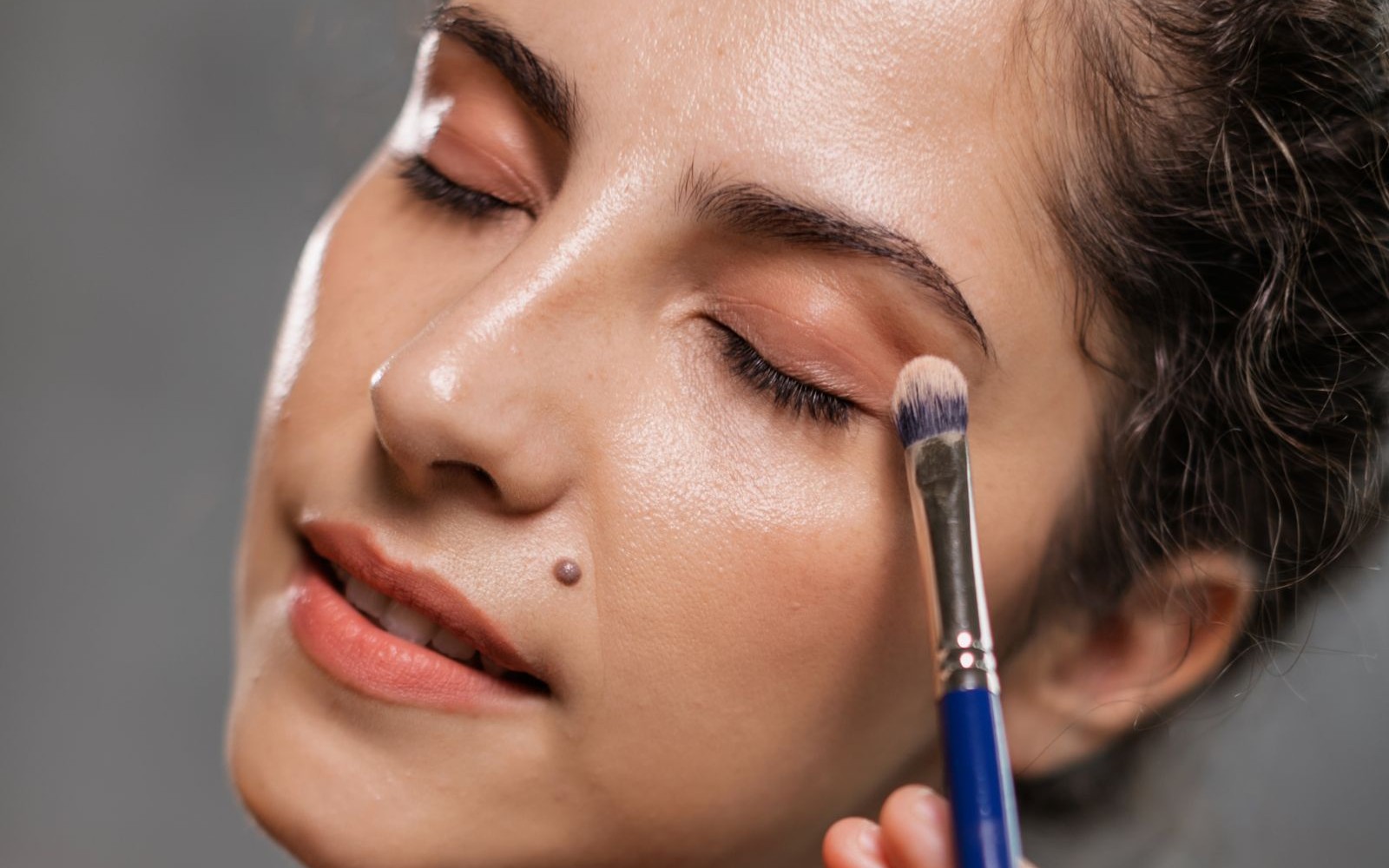
The flat shader is small, flat, and firm. Pat it into eyeshadow and press it onto the lid, and the color lands at full strength where you placed it. Dragging weakens the payoff, so press and lift instead. The fluffy blending brush is its partner: long, tapered, loose fibers that move color without depositing much. Work it in small arcs through the crease until the border disappears. The Dermstore Sigma guide describes that blending brush as soft and fluffy, good for softening harsh lines. Using only one of this pair is why eye makeup looks patchy or muddy, a precision point that also runs through our revlon nail polish guide.
Pencil, angled liner and brow brushes, and the spoolie
The pencil brush has a tiny, pointed tip. It concentrates shadow along the lower lash line, at the outer corner, or in the inner corner, anywhere a larger brush would spill color. The angled liner brush is small, stiff, and cut on a diagonal: that edge draws a line with gel or powder liner and, with brow product, stamps short strokes that read as hairs. EcoTools includes a flat liner brush for this job in its Core Five set. The spoolie has spiral bristles like a clean mascara wand, for grooming brows and separating lashes. Eye tools deserve extra hygiene care, because the FDA warns in its eye cosmetic safety guidance not to share eye cosmetics, since another person’s germs may be hazardous to you.
Lip and Detail Brushes That Finish a Look
A lip brush is small, flat, and firm, often capped or retractable so it can travel cleanly. It picks up lipstick from the bullet and lays it down with an edge a bullet cannot draw, which matters most with strong colors that show every wobble, and it can reach the last of the product left in the tube.
Detail brushes for concealer and correction
Detail brushes are the in-between sizes: a small flat brush for placing concealer precisely on a spot, a tiny tapered brush for softening its edge, and a clean small shader kept spare for corrections. Bobbi Brown describes a tapered, multipurpose brush for smaller, hard-to-reach areas on its brushes page, and the e.l.f. artist team treats these shapes as part of a working kit in its makeup artist brush guide. Detail work rewards the same light, precise hand as the finishing steps in our best women’s deodorant guide and our hair removal creams guide.
The Order to Use Brushes in a Full Routine
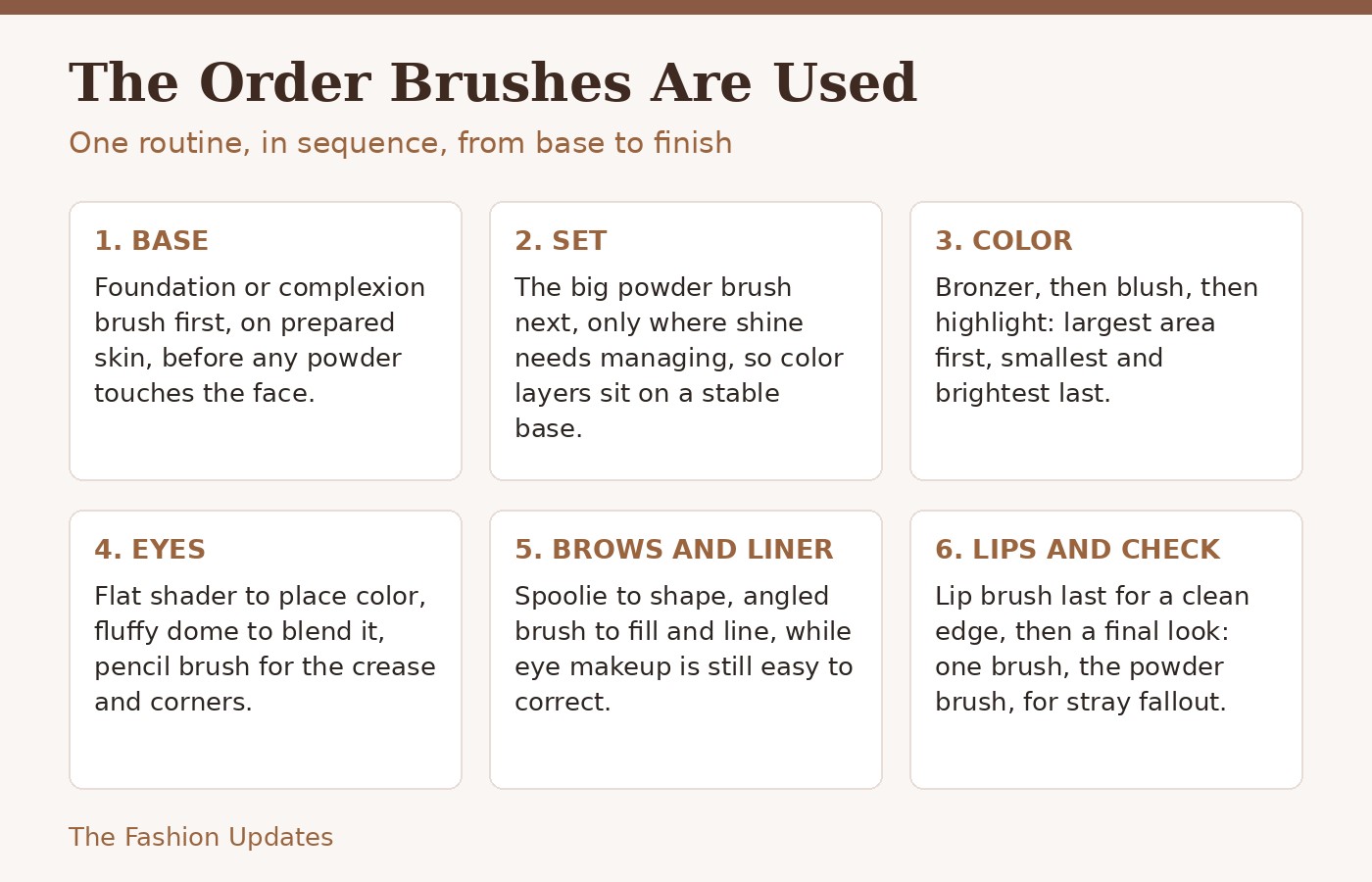
Brushes are used in the order products are layered: wet products go down before dry ones, and each layer needs the previous one settled first. The e.l.f. team sequences its starter routine the same way in its beginner brush guide, moving from base tools to eye tools to finishing tools.
Base, set, then shape
First, the foundation brush or sponge applies the base, and the detail brush places concealer. Second, the powder brush sets the base, concentrating on the center of the face. Third come the shaping powders: bronzer, contour, blush, and highlighter last with the fan brush, so the most reflective product sits on top. Sigma follows that logic in its bronzer guide, applying bronzer to the high points where light lands. A capsule approach works the same way, as our capsule wardrobe guide shows.
Eyes, brows, then lips
Eyes usually come after the base is set, or before it if you expect heavy fallout, which the fan brush then sweeps away. Within the eye step: shader first, blending brush second, pencil brush third for depth, angled brush fourth for liner. Brows follow: spoolie, angled brush, spoolie again. Lips are last, because a finished lip is the step most easily ruined by a stray sleeve. Cleveland Clinic notes in its brush cleaning guidance that eye brushes should be washed every two weeks. For wider reading on routines as a system, our best fashion magazine guide points to titles that treat beauty and dressing as one practice.
Common Mistakes With Density, Pressure, and One-Brush Routines
Most brush problems are matching and handling problems, not buying problems, and fixing them costs nothing. L’Oréal Paris makes a related point in its brush and sponge cleaning guide, treating proper brush work as a technique question, not an equipment question.
Wrong density for the product
A dense brush loaded with blush or bronzer deposits a stripe. A loose brush asked to buff foundation leaves streaks and takes forever. The test is the squeeze test from the first section: match the firmness of the brush to the coverage the step needs. Sigma states the pairing directly in its cakey makeup guide: dense synthetic brushes for liquid and cream foundations, a diffused brush for powder, and a smaller brush for concealer. If a step keeps failing, swap the brush’s density before you swap the product, and check the product itself against our best makeup foundations guide only after the tool match has been ruled out.
Pressing too hard and using one brush for everything
Pressure flattens a brush head, and a flattened head paints instead of blends. Hold the handle further from the head for soft work, and build color in two light passes rather than one heavy one. The one-brush routine creates a different problem: a single brush carrying foundation residue into powder, powder into blush, and dark eyeshadow into a light one muddies every color it touches. Cleveland Clinic explains in its cleaning guidance that an unwashed brush applies old makeup, dirt, and oil with every use. Keep face and eye brushes separate, and keep one clean blending brush reserved for softening only. CVS gives matching advice in its brush cleaning guide, recommending a liquid cleanser for day-to-day cleaning alongside periodic shampooing.
How to Clean Brushes the Dermatologist Way
Cleaning is where dermatology guidance is unusually specific. The American Academy of Dermatology recommends in its how to clean your makeup brushes guidance that brushes be washed every 7 to 10 days, because dirty brushes collect residue, dirt, and oil and can irritate skin. Cleveland Clinic gives a product-based version in its cleaning makeup brushes guidance: wet-product brushes weekly, eye brushes every two weeks, dry-product brushes monthly. Pick the schedule you will actually keep.
The wash itself, step by step
Rinse the tips only under lukewarm running water, because submerging the whole head can dissolve the glue connecting head to handle. Fill a bowl with lukewarm water and a tablespoon of gentle or clarifying shampoo, swirl each tip in the bowl, and massage the tips in your palm for a better lather. Rinse, and repeat shampooing and rinsing until the water runs clear. Squeeze out moisture with a clean, dry paper towel, reshape the head, and lay the brushes flat on a towel with the tips hanging off the edge of the counter. That is the AAD method from its brush cleaning page, and Real Techniques gives the same core steps in its step-by-step cleaning guide. Never dry brushes upright, because water runs into the ferrule and loosens the glue.

What to clean with, and what to avoid
Gentle shampoo is the dermatologist default, and a dedicated brush cleanser, liquid or solid, is the convenient alternative. A textured cleaning mat helps work lather through dense foundation brushes, which hold the most product. L’Oréal Paris describes that mat step in its cleaning guide, rubbing the bristles on a textured pad to remove debris. Avoid soaking handles, very hot water, and harsh detergents. Sponges need the same wash more often.
Storage, Replacement, and Keeping Brushes in Shape
A clean brush stored badly does not stay clean. The FDA advises in its using cosmetics safely guidance not to let cosmetics become covered with dust or dirt, and open-stored brushes collect exactly that. Cleveland Clinic agrees in its brush cleaning guidance, noting that brushes in a counter cup pick up dust and bacteria from the air.
Store dry, covered, and uncrushed
Store brushes fully dry, never sealed into a bag while still damp. At home, a covered holder or drawer keeps dust off; in a bag, a brush roll or guards keep heads from being crushed. Keep the everyday set separate from spares, so each brush can dry completely between uses, the same habit that protects the products in our hair care tips guide and a fragrance from our best perfumes for women guide.
When to replace a brush
Replace a brush when it sheds, when the head splays and will not reshape after washing, when the ferrule loosens, or when fibers stay rough or carry a smell washing does not remove. Cleveland Clinic states the rule plainly in its cleaning guidance: when a brush becomes frayed or worn, or loses its shape, it is time to replace it. The e.l.f. team gives a general lifespan in its beginner brush guide of about one to three years, with condition, not the calendar, as the deciding test. Replace the single failed shape rather than the whole set, using the table above to name what you need.
Our view
We believe most brush confusion is a naming problem, not a talent problem. Read a brush by its shape, its density, and its fiber, and its job becomes obvious: fluffy to diffuse, dense to cover, flat to place, angled to follow a line, pointed to concentrate. Learn the four face territories and the four eye jobs, use the brushes in the order the products layer, and wash them on the dermatologist schedule with the tips-only, dry-flat method. A small set understood properly will outperform a large set used at random every time.
— The Fashion Updates
Frequently Asked Questions
How many makeup brushes does a beginner actually need?
Seven shapes cover a full routine: a foundation brush or sponge, a powder brush, a blush or bronzer brush, a flat shader, a fluffy blending brush, an angled liner or brow brush, and a spoolie. Add contour, pencil, and lip brushes only when your routine uses those steps.
Can I use one brush for both liquid and powder products?
You can if the fibers are synthetic, but clean it between jobs. Liquid residue makes powder clump, and powder in the head weakens a liquid’s coverage. Two dedicated base brushes, one wet and one dry, are simpler.
Are natural fiber brushes better than synthetic ones?
Not as a general rule. Natural fibers handle powders well because their surface grabs and releases powder gradually. Synthetic fibers are non-porous, easier to wash, and suit liquids and creams better because they do not absorb them. For one set that does everything, synthetic is the practical choice.
How do I stop a foundation brush leaving streaks?
Check density first, then pressure. Finish a paddle brush’s strokes with light buffing circles, or switch to a dense flat-top shape. Work in thin layers outward, and keep the brush clean, because dried residue in the head is a common hidden cause.
Why should brushes dry flat instead of upright in a pot?
Because water runs into the ferrule, where it loosens the glue holding the fibers. Drying flat with the tips over the edge of the counter keeps water out of the joint and helps the brush keep its shape.
How can I tell a blush brush from a bronzer brush?
By size and fullness. A bronzer brush is larger and rounder, for broad sweeps across forehead, temples, and cheeks. A blush brush is medium-sized and more tapered, for placing color on the cheek. If you keep only one, keep the blush brush and use a lighter hand for bronzer.
How We Pick What We Recommend
Every guide on The Fashion Updates follows the same review process — what we compare, what we check, and what we leave out.
Sources
- American Academy of Dermatology — How to Clean Your Makeup Brushes
- Cleveland Clinic — How To Clean Makeup Brushes and Why You Need To
- Sephora — Makeup Brush Guide for Beginners
- Real Techniques — How to Clean Your Makeup Brushes: Step-by-Step Guide
- EcoTools — Core Five Makeup Brush and Sponge Kit
- Sigma Beauty — How to Fix Cakey Makeup and Why Your Brushes Might Be the Issue
- Sigma Beauty — How to Apply Bronzer for a Natural Glow
- Sigma Beauty — Best Makeup Brushes for Sensitive Skin
- Bobbi Brown Cosmetics — Brushes for Makeup and Makeup Brush Sets
- e.l.f. Cosmetics — Beginner’s Guide to Makeup Brushes
- e.l.f. Cosmetics — Makeup Artists Guide to Brushes and Tools
- FDA — Eye Cosmetic Safety
- FDA — Using Cosmetics Safely
- L’Oréal Paris — How To Clean Makeup Sponges, Brushes, and Other Tools
- Dermstore — 7 Sigma Makeup Brushes Every Girl Needs
- CVS — How to Clean Makeup Brushes and Makeup Blenders