
Your fashion reading is probably a pile, not a system: a dozen saved tabs, three newsletters you never open, and a feed that shows you whatever an algorithm picked. The fix is not more sources. It is sorting the ones worth keeping by the job each one does. This guide separates blogs from newsletters, shows you what each format is genuinely good at, and gives you a five-minute check for deciding whether any new fashion voice deserves a place in your week.
The Fashion Updates
Read Smarter, Dress Better
Blogs for reference, newsletters for rhythm: a sorted shelf of fashion reading, vetted in five minutes and kept deliberately small.
Key Takeaways
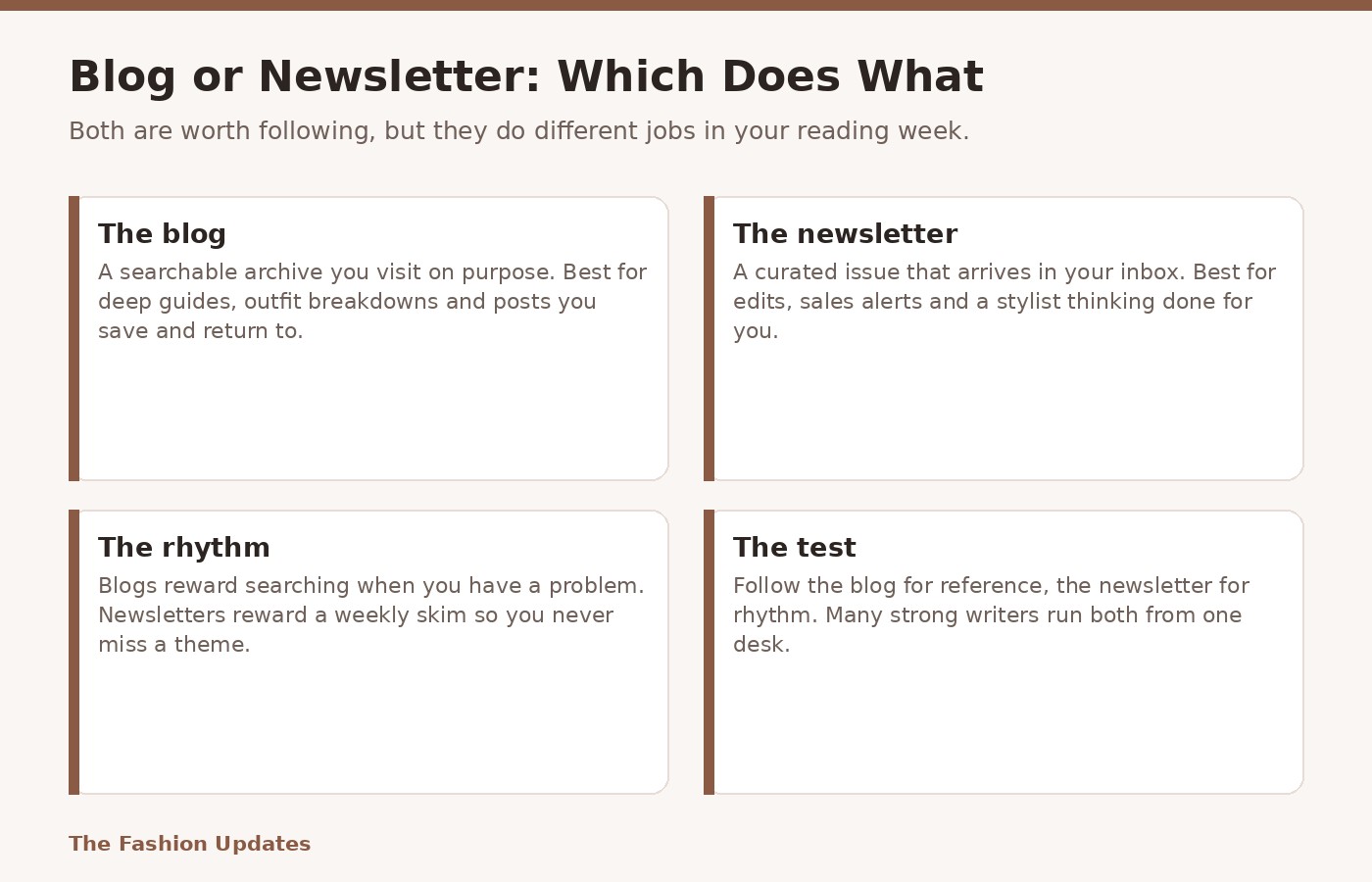
- Follow blogs for reference and newsletters for rhythm: a blog is a searchable archive you visit with a problem, a newsletter is a curated issue that arrives before you know you need it.
- Judge every fashion voice by its last three pieces on one theme, not by one viral post, because a track record is what you are actually subscribing to.
- A trustworthy blog or newsletter links its claims to sources you can open, states prices and dates plainly, and discloses affiliate links before you click them.
- Keep the total small on purpose: two or three blogs and two newsletters, well chosen, teach more than twenty follows skimmed in a hurry.
- Use an aggregator or reader app to hold your blog list in one place, so following a blog never depends on remembering to visit it.
Table of Contents
- Key Takeaways
- Start With the Job: Reference or Rhythm
- The Blog Shelf: What a Good Fashion Blog Does
- The Newsletter Shelf: What a Good Fashion Newsletter Does
- How to Vet a Blog in Five Minutes
- How to Vet a Newsletter Before You Subscribe
- Build a Reading System That Stays Small
- Blogs and Newsletters for Shopping Decisions
- A Starter Mix Worth Following
- Our view
- Frequently Asked Questions
- Sources
- Recommended
Start With the Job: Reference or Rhythm
Most reading piles fail because two different formats get judged by one standard. A blog and a newsletter are not rivals. They are different tools, and the Pew Research Center’s social media and news fact sheet shows how fragmented the average reader’s intake has become, with audiences split across many platforms and formats at once. Sorting starts with naming the job you want done.
| Format | How it reaches you | What it does best | What it does badly |
|---|---|---|---|
| Blog | You visit, search, or follow it in a reader | Deep guides, outfit breakdowns, archives you can search months later | Easy to forget; nothing arrives to remind you |
| Newsletter | It arrives in your inbox on a schedule | A finished edit: the week’s pieces, sales and stories, chosen for you | Only as good as its last issue; piles up unread if it is weak |
| Magazine site | You visit or follow its channels | Runway coverage, photography, industry authority | Print titles own this ground; see our magazines guide |
That last row matters. Print and legacy magazine titles are a separate shelf with a separate standard, and our best fashion magazines guide owns it. This post covers the independent digital shelf only: blogs you bookmark and newsletters you subscribe to. Celebrity accounts are a different shelf again, covered by our celebrities to follow on Instagram guide.
The reference test
Ask of any blog: if I had a specific problem tonight, a fit question, a shoe decision, a wardrobe gap, would this site answer it from its archive? A blog that passes the reference test earns a bookmark. Our own archive is built that way, from the capsule wardrobe guide to the jeans fit guide, because reference value is what makes a blog worth keeping.
The rhythm test
Ask of any newsletter: would I miss it if it skipped a week? A newsletter that passes the rhythm test has a voice and a selection you cannot get by opening an app. If the honest answer is that you delete it unread twice in a row, it fails, whatever its reputation. Unsubscribe without guilt and let the slot go to a stronger voice.
The Blog Shelf: What a Good Fashion Blog Does
A good fashion blog has a point of view it returns to. Discovery tools make the landscape visible: the Feedly fashion blog rankings list fashion blogs by readership, which is a useful map of the territory, though popularity alone never tells you whether a blog’s taste matches yours. Read the map, then judge the blogs yourself.
Personal style blogs: one wardrobe, documented
The personal style blog is the oldest form on this shelf: one person, one wardrobe, photographed and explained over time. Its value is continuity. You watch the same body and the same closet solve real weeks, which teaches more than a feed of one-off outfits. The strongest personal blogs explain decisions, what was altered, what failed, what a piece cost per wear. That explanatory habit is the same one our best fashion books picks reward in print: the reasoning outlasts the outfit.
Shopping and edit blogs: the shortlist done for you
A second kind of blog exists to narrow the field: gift edits, sale roundups, category shortlists. Done well, it is a research service. Done badly, it is a wall of affiliate links. The tell is whether the writer states how picks were chosen and what was left out. Who What Wear’s about page describes an editorial team built around exactly that promise, shopping guidance from working fashion editors, which is the standard to hold every edit blog to.
Coverage blogs: runway and industry, explained
The third kind covers the industry itself: shows, collections, business moves. Vogue Runway’s show coverage is the reference archive for collection photography and reviews, and independent coverage blogs earn their place by explaining what the runway means for real wardrobes. Our best fashion documentaries guide sits on this shelf too, for readers who want the industry’s stories in depth, and our fashion history basics explainer covers the background that makes coverage legible.

The Newsletter Shelf: What a Good Fashion Newsletter Does
The newsletter is the blog’s mirror image: instead of an archive you search, you get a selection someone else made, delivered on a rhythm. The format’s modern infrastructure is visible on Substack’s about page, which describes a subscription network built around individual writers, and the same writer-first model now runs across most fashion newsletters worth reading, whatever platform sends them.
What a strong issue looks like
A strong fashion newsletter issue has a shape: one lead idea, a small number of links with a sentence each on why they matter, and a short personal note that could only come from that writer. Length is a virtue signal in reverse. The issues readers finish are the ones that respect the skim. Publishers watch the same discipline from the other side: Mailchimp’s email marketing benchmarks publish open and click rates by industry, and the gap between average and top performers is mostly selection and restraint, not volume.
Free, paid, and what paying actually buys
Free newsletters monetize through advertising and affiliate links. Paid newsletters sell the selection itself. Neither model is automatically more honest, but they answer to different pressures, and it is worth knowing which one you are reading. HubSpot’s email marketing statistics roundup collects the research on how readers respond to email, and the consistent finding is that relevance, not frequency or price, drives whether an issue gets opened. Pay when a writer’s taste has repeatedly saved you time or money. Stay free while you are still testing the fit.
The fashion-specific jobs newsletters do best
Three jobs suit the format especially well. First, the weekly edit: five pieces worth your attention, pre-filtered. Second, the sale and restock alert, which is only useful from a writer whose full-price judgment you already trust. Third, the slow essay, a single argument about how dressing works, closer to our best fashion podcasts shelf in spirit: a voice teaching one thing well. A newsletter trying to do all three every week usually does none of them well.
How to Vet a Blog in Five Minutes
Reputation is a lagging indicator. Vet any blog yourself, in this order, before it earns a bookmark. The Reuters Institute Digital News Report documents how low general trust in media runs and how readers increasingly rely on their own checks of individual sources, which is exactly the habit this section builds.
Read the about page, then the last three posts
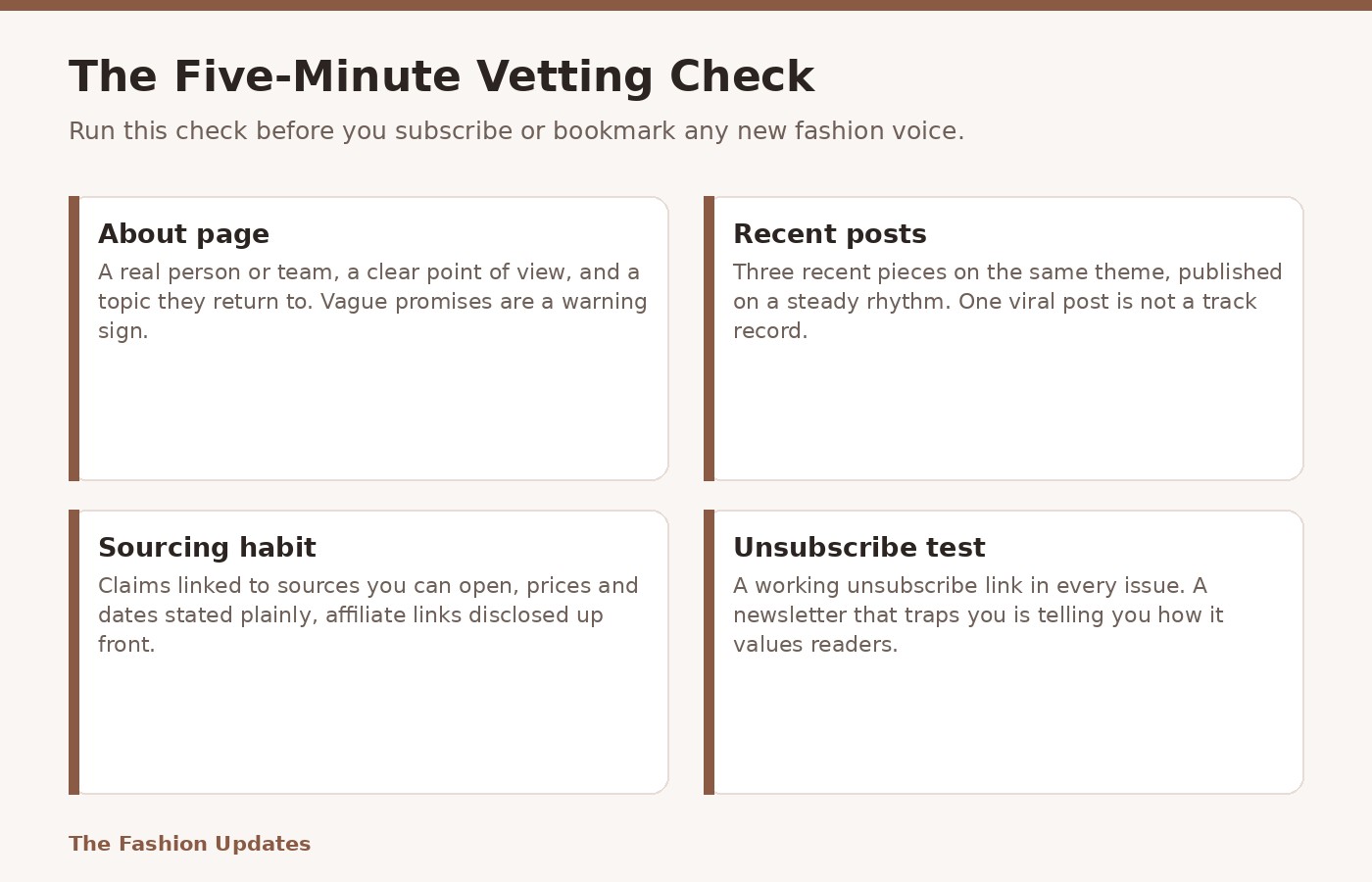
An about page should name a person or a team, a point of view, and a subject the site returns to. Then read the three most recent posts on one theme. You are checking for a track record, not a highlight. A site that has covered your problem three times, carefully, will probably cover your next one too. A site with one brilliant post and forty unrelated ones is a lottery ticket.
Check the sourcing habit
Open the links inside a post. Claims should lead to sources you can read: brand size charts, primary guidance, named research. Prices and dates should be stated, not implied. Affiliate relationships should be disclosed at the top, the way this site discloses its own. A blog that hides its commercial mechanics will hide other things too. Our skin undertone guide shows the pattern to look for: every claim in it can be followed back to a checkable source.
Check the rhythm and the archive
Steady beats frequent. A blog publishing one solid guide a week for a year is a better follow than a burst of daily posts followed by silence, because the archive compounds. Search the site for your current problem. If the archive answers it, bookmark the site. If the archive is all seasonal content that expired, it is a feed wearing a blog’s clothes.
How to Vet a Newsletter Before You Subscribe
Newsletters ask for something blogs do not: space in your inbox, the most defended territory on your phone. The vetting bar is higher, and part of it is legal infrastructure you can actually inspect.
The unsubscribe test comes first
United States commercial email law is set out in the FTC’s CAN-SPAM compliance guide: every commercial message must carry a working opt-out, and senders must honor it. Before subscribing, find a past issue, most writers archive them publicly, and check the footer. A clear unsubscribe link and a real sender address are baseline professionalism. Their absence is disqualifying, full stop.
Deliverability tells you how the sender behaves
Gmail’s email sender guidelines spell out what legitimate bulk senders must do, from authentication to one-click unsubscribe, and inbox providers enforce them. A newsletter that lands in spam repeatedly is often one that bought addresses or ignored those rules. Where a newsletter lands in your first two weeks is data about how it treats its list, and by extension, you.
Read open-rate claims with suspicion
Apple’s Mail Privacy Protection help page explains that Apple Mail preloads remote content, which inflates reported open rates for every sender. So when a newsletter boasts about its opens, discount the number. The metric that cannot be faked as easily is whether you finish the issue. Litmus’s email client market share tracker shows how concentrated reading is in a few clients, which is why writers design for the skim: front-load the value, keep the edit tight. Judge them by that standard.
Build a Reading System That Stays Small
A follow list is a system, not a collection. Two blogs and two newsletters, held well, beat twenty held badly. The tools for holding them are simple and mostly free.
Use a reader for blogs
The forgetting problem kills blog reading: nothing arrives, so nothing gets read. A reader app solves it by collecting new posts into one stream. WordPress Discover curates posts from across its network, and Feedly’s fashion rankings double as a subscription tool, so the same page that maps the landscape can hold your list. Pick one reader, put your two or three blogs in it, and check it with your first coffee instead of a social feed.
Give newsletters a folder and a slot
Route newsletters to a folder or label and read them in one sitting, once or twice a week. The batch habit turns a pile of interruptions into a small magazine you assembled yourself. Anything that cannot survive being read three days late was not information; it was urgency, and urgency is a sales technique, not a style education. Our capsule wardrobe guide applies the same principle to clothing: a small set, chosen on purpose, used fully.
Prune twice a year
Every six months, cut the weakest blog and the weakest newsletter and try one replacement for each. Taste changes, writers drift, and a list that never gets pruned quietly becomes a list you avoid. The prune is also when you promote: a newsletter you open every week for six months has earned the paid tier, if it has one, more honestly than any launch discount.
Blogs and Newsletters for Shopping Decisions
Fashion reading earns its keep when it changes a purchase. Blogs and newsletters help at different points in a decision, and mixing up the points is where money leaks.
Blogs for the decision you are researching now
When the problem is live, a heel that hurts, a bag to replace, a scent to find, the blog archive is the right tool because it is searchable by problem. Our handbag decision guide and signature scent guide are built for exactly that moment, and the blogs worth following elsewhere are built the same way: a problem in the title, a method in the body, a shortlist at the end.
Newsletters for the decision you will face later
Newsletters work upstream. A good weekly edit teaches you what a fair price looks like, which categories are worth waiting on, and which trends have staying power, before you need any of it. By the time a purchase arrives, the judgment is already installed. That is also why the sale-alert newsletter only works from a writer whose full-price taste you trust: the alert borrows credibility from the edit.
Where the two shelves meet your closet
Keep a short running list, in your notes app, of what your reading has convinced you to look for: a rise, a fabric, a shoe shape. Our loafers guide and white sneakers styling guide both started as reader questions of exactly that kind. Reading that never reaches the list is entertainment. That is fine, but label it honestly and do not let it crowd the shelf.
A Starter Mix Worth Following
Build your first mix by category, not by fame. One reference blog, one edit source, one coverage source, one newsletter with a voice. Here is the shape, with the exemplars this guide has already sourced.
The reference slot
Fill this with a searchable archive strong on how-to content. The test from earlier applies: search it for your current problem. Sites built like Who What Wear, with working editors answering recurring reader problems, are the model. Keep exactly one in this slot. Two reference blogs means you search neither.
The coverage slot
Fill this with runway and industry coverage so your taste has context. Vogue Runway’s show archive is the deepest single source, and pairing it with one independent coverage blog keeps the perspective honest. Our fashion history basics explainer will make the coverage slot more valuable the longer you keep it, because shows constantly quote the past.
The newsletter slot
Fill this last, after a month of blog reading shows you whose voice you actually miss. Subscribe to one. Read four issues before judging. The Reuters Institute’s research on news avoidance is a useful warning here: readers abandon sources that make them feel overloaded, so a newsletter that leaves you calmer and better dressed is outperforming a louder one by the only metric that matters. When the slot works, add a second. Never a fifth.
Our view: a follow list is a wardrobe for your attention. The blogs and newsletters worth following are the ones chosen the way a good capsule is chosen, few in number, each doing a named job, and pruned without sentiment when they stop earning the space. Start with four. Read them like you mean it. The style education compounds quietly from there.
— The Fashion Updates
Frequently Asked Questions
How many fashion blogs and newsletters should I follow?
Start with four in total: two blogs and two newsletters is the mix most readers can actually keep up with. The right number is the one you read fully. If issues pile up unread, the list is too long, whatever its size on paper.
Are paid fashion newsletters worth it?
A paid newsletter is worth it when the writer’s free work has already saved you time or money repeatedly, because paying buys the same selection without advertising pressure. Test with four free issues first, and pay for taste you have verified, not for promises.
What is the difference between a fashion blog and a digital magazine?
A blog is built around a person or a small team’s point of view and a searchable archive of guides. A digital magazine runs departments, staff coverage and news. Both can be excellent; they are judged by different standards, and our magazines guide covers the magazine shelf separately.
How do I know if a fashion blog is trustworthy?
Run the five-minute check: a real about page, three recent posts on one theme that hold up, claims linked to sources you can open, prices and dates stated, and affiliate links disclosed up front. A blog that passes all five has earned a bookmark.
Can newsletters replace blogs for style advice?
No, because they do different jobs. A newsletter cannot be searched at the moment a problem appears, and a blog cannot deliver a finished weekly edit to your inbox. Keep both formats, one slot each, and let each do the job it is shaped for.
How We Pick What We Recommend
Every guide on The Fashion Updates follows the same review process — what we compare, what we check, and what we leave out.
Sources
- Pew Research Center — Social Media and News Fact Sheet
- Reuters Institute — Digital News Report
- Mailchimp — Email Marketing Benchmarks
- Litmus — Email Client Market Share
- FTC — CAN-SPAM Act Compliance Guide for Business
- Apple Support — Mail Privacy Protection
- Feedly — Top Fashion Blogs
- Who What Wear — About Us
- HubSpot — Email Marketing Statistics
- Substack — About
- WordPress — Discover
- Google Support — Email Sender Guidelines
- Vogue — Fashion Shows and Runway Coverage