As an Amazon Associate I earn from qualifying purchases.
You can own a cleanser, a toner, two serums, a treatment, a moisturizer, and a sunscreen, and still get poor results from all of them, simply because they went on in the wrong order. A thick cream applied too early can block a thin serum from reaching your skin, and sunscreen applied too late, or mixed into moisturizer, cannot protect evenly. The fix costs nothing. This guide sets out the skincare routine order step by step, morning and evening, explains why each step sits where it does, and gives the wait times that actually matter.
The Fashion Updates
Layer in the Right Order
Learn the correct skincare routine order, thinnest to thickest, with morning and evening steps, wait times, and where treatments, moisturizer and SPF fit.
Key Takeaways
- Layer products from thinnest to thickest: cleanser first, then toner, treatments and serums, then moisturizer, with sunscreen always last in the morning.
- Morning is for protection and evening is for repair, so the middle steps change: antioxidant serums belong in the morning, retinoids and stronger treatments at night.
- Most steps need no formal wait: move on once a layer no longer feels wet, and reserve real pauses for prescription treatments, retinoids on sensitive skin, and sunscreen before makeup.
- Sunscreen is the exception to every texture rule: it goes on after moisturizer, in its full amount, and makeup goes over it, never mixed into it.
- Add one new product at a time and keep the routine small, because stacking several active products at once is the most common route to irritation.
Table of Contents
- Key Takeaways
- The One Rule Behind Every Routine Order
- The Morning Order, Step by Step
- The Evening Order, Step by Step
- Wait Times: What Actually Needs a Pause
- Where Treatments, Eye Cream, and Face Oils Fit
- Layering Mistakes That Undo Good Products
- Adjusting the Order for Your Skin Type
- Building a Routine You Will Actually Keep
- Our view
- Frequently Asked Questions
- Sources
- Recommended
The One Rule Behind Every Routine Order
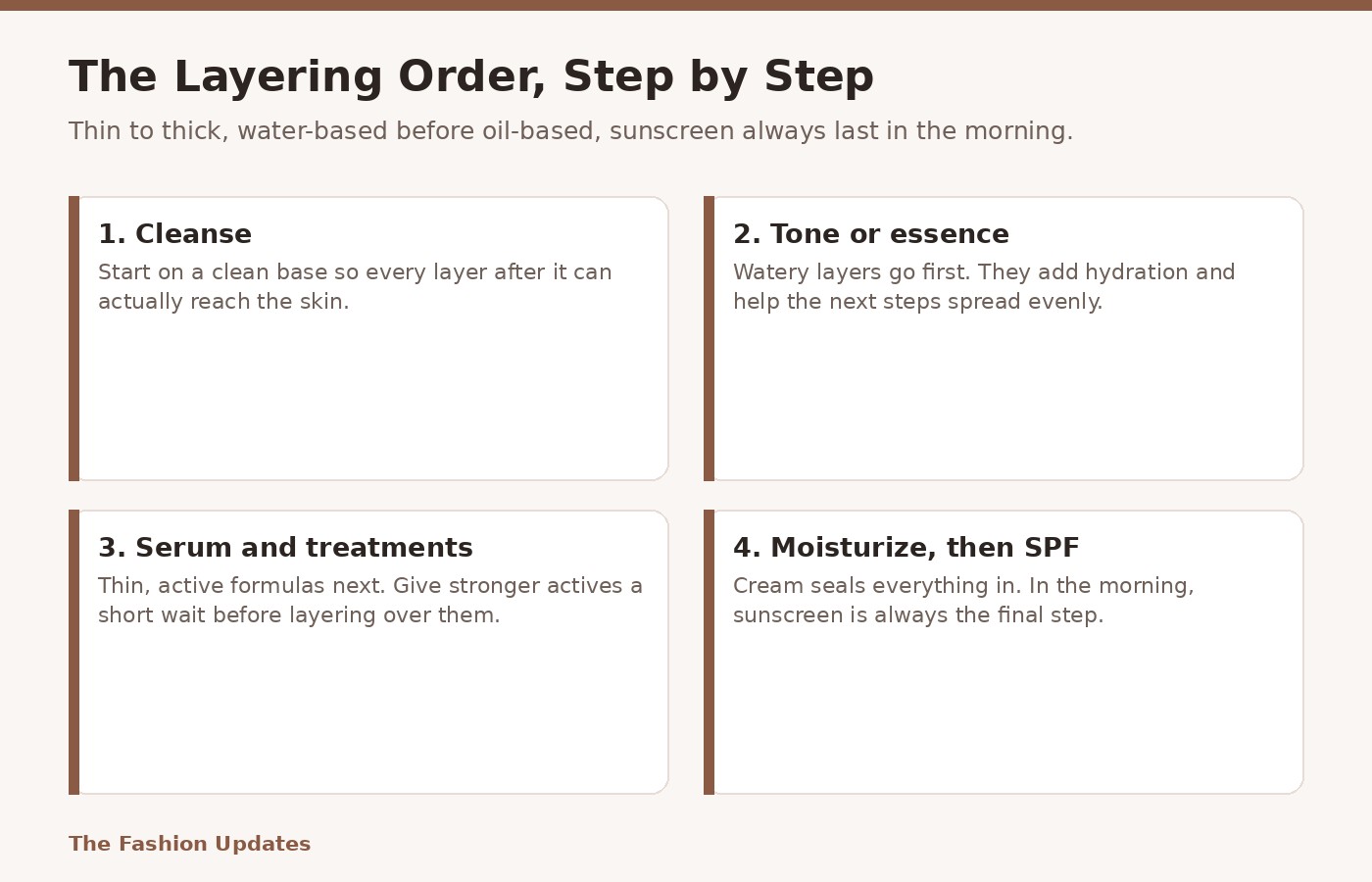
Almost every ordering question has the same answer: go from the thinnest product to the thickest. Cleveland Clinic states the rule directly in its product order guide, ordering a routine from lightest to heaviest so that a thin serum is never trapped under a thick cream. CeraVe gives the same instruction in its layering guidance, noting that formulas absorb more efficiently when they are layered from the thinnest consistency to the thickest. The table below is the whole guide in miniature.
| Step | What it does | Morning, evening, or both | Wait time |
|---|---|---|---|
| Cleanser | Removes oil, dirt, sunscreen, and makeup residue | Both | None, pat skin dry or leave it slightly damp |
| Toner | Adds light hydration and removes last traces after cleansing | Both, optional | None, apply the next layer while skin is barely damp |
| Serum | Delivers a concentrated ingredient in a thin, fast-absorbing layer | Both, type differs by time of day | Until the surface no longer feels wet, usually under a minute |
| Treatment | Targets one concern, such as spots, uneven tone, or fine lines | Mostly evening | Follow the label: some need a few minutes, retinoids on dry skin may need longer |
| Eye cream | Moisturizes the thinner skin around the eyes | Both, optional | None |
| Moisturizer | Seals in water and supports the skin barrier | Both | A minute or two before sunscreen, so layers do not slide |
| Sunscreen, SPF 30 or higher | Protects against UVA and UVB rays | Morning only, reapply outdoors | Let it set for a few minutes before makeup |
Why thin goes before thick
Thin, watery products absorb quickly, but they cannot push through a heavy cream or an oil. Thick products are designed to sit on top: they slow water loss and seal in whatever is underneath. Paula’s Choice explains the same sequence in its application guide, moving from cleanser to toner to leave-on exfoliant, then to the remaining products in order of texture, from fluid boosters up to moisturizers. Reverse the order and the thin layer loses, sitting on the surface instead of reaching the skin. The same logic governs makeup, which is why base products in our best makeup foundations guide sit on top of, never under, your final skincare layer.
The two exceptions to the rule
The first exception is sunscreen. However thin it feels, it is always the last morning step, because it needs to form an even film over everything else. CeraVe makes this explicit in its layering guidance: apply sunscreen last, even if it is thinner than your moisturizer. The second exception is a prescription treatment, which goes on early, onto clean skin, because it needs direct contact. Mayo Clinic follows that sequence in its dry skin guidance: after washing, apply any medicine first, wait a few minutes or as the package directs, then moisturize. Your skin undertone guide results will not change this order, but they help later, when makeup shades go over the finished routine.
The Morning Order, Step by Step
The morning routine has one job: protect. Cleveland Clinic frames the split plainly in its step-by-step routine guide, describing the morning as protecting the skin and the night as repairing it. That framing decides the order: cleansing first, an optional antioxidant layer second, moisturizer to seal, and sunscreen last, every day, before any makeup from our makeup brushes guide touches your face.
Step 1: Cleanse, gently and briefly
Wash with lukewarm water and a gentle cleanser, using your fingertips, then pat dry rather than rubbing. The American Academy of Dermatology sets out that technique in its face washing guidance: use a gentle, non-abrasive cleanser, apply it with your fingertips, and limit washing to twice a day and after sweating. Cleveland Clinic adds a practical detail in its product order guide: a nickel-sized amount is enough, and your hands are less abrasive than a washcloth. Dry or sensitive skin may only need a rinse in the morning, a point covered again in the skin type section below.
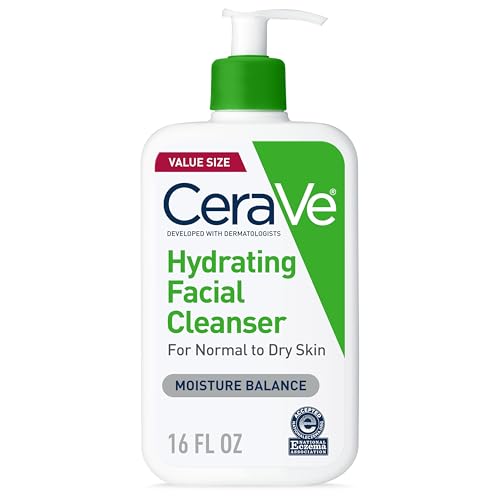
CeraVe Hydrating Cleanser with Hyaluronic Acid, Gentle Face Cleanser,16oz | Daily Face Wash & Makeup Remover with Glycerin, Skin Care for Men and Women, National Eczema Association Certified
Offer 14.24 $
List Price
Steps 2 and 3: Toner, then serum
If you use a toner, it goes on now, while skin is still barely damp, applied with fingertips or a reusable cotton round. Paula’s Choice places toner immediately after cleansing in its application guide, before any leave-on exfoliant or serum. Serum follows the toner. Cleveland Clinic recommends only one serum at a time in its product order guide, and notes that a morning antioxidant serum such as vitamin C supports sunscreen rather than replacing it. Keep the layer thin and even, and let it settle until the surface no longer feels wet before moving on. Readers who layer fragrance later in the day will find the same thin-to-thick thinking in our best perfumes for women guide, where lighter applications always come first.
Steps 4 and 5: Moisturizer, then sunscreen last
Moisturizer comes next, sealing in the water left from cleansing and the layers beneath it. Mayo Clinic advises moisturizing while some moisture stays on the skin in its skin care tips, patting skin dry gently rather than drying it completely. Then sunscreen, in full: broad spectrum, SPF 30 or higher, applied as its own layer rather than mixed into the moisturizer. The American Academy of Dermatology answers the common amount and timing questions in its sunscreen FAQs, and the FDA explains in its sunscreen guidance that broad spectrum means protection against both UVA and UVB rays, while SPF mainly measures UVB protection. Give the sunscreen a few minutes to set before makeup, so the film stays even.

The Evening Order, Step by Step
The evening routine repeats the same skeleton, cleanser first and moisturizer last, but the middle steps change because the goal changes from protection to repair. Cleveland Clinic lays out the evening sequence in its step-by-step routine guide: makeup remover, cleanser, optional toner, then the repairing layer. There is no sunscreen at night, which frees the final slot for a richer moisturizer or a treatment sealed underneath it, much as a nighttime routine in our hair care tips guide leaves the heaviest conditioning step for last.
Step 1: Remove makeup, then cleanse
Most cleansers do not remove all makeup on their own, so a makeup remover, micellar water, or cleansing balm goes first when you have worn makeup or water-resistant sunscreen. Cleveland Clinic makes that recommendation directly in its step-by-step routine guide, suggesting a remover before the cleanser and fragrance-free wipes if wipes are used. Follow with your regular cleanser, using the same gentle fingertip technique described in the AAD face washing guidance. One thorough cleanse is the goal. Cleveland Clinic cautions in its product order guide that double cleansing can do more harm than good for many skin types, so treat a second cleanse as an option for very oily skin, not a default.
Steps 2 and 3: Treatment first, moisturizer to seal
With skin clean, apply the treatment layer: a serum, a leave-on exfoliant, or a retinoid, but not all of them stacked on the same night. The Ordinary builds its evening regimens in exactly this shape in its regimen guide, placing cleanser first, treatments in the middle, and moisturizer last. Retinoids belong at night because sunlight can deactivate them and they can raise sun sensitivity, a point Cleveland Clinic explains in its product order guide, where retinols and retinoids replace the morning serum as the evening second step. Use a pea-sized amount for the whole face, then finish with moisturizer. If your evening also includes detail work such as the steps in our how to apply nail polish guide, do the skincare first, so creams do not spoil a fresh finish.

CeraVe Moisturizing Cream, Face & Body Moisturizer for Dry Skin, 19oz | Skin Care with Hyaluronic Acid, Skin Barrier Repair, Ceramide Moisturizer, Fragrance Free, Non-Comedogenic, Daily Use
Offer 15.17 $
List Price
Wait Times: What Actually Needs a Pause
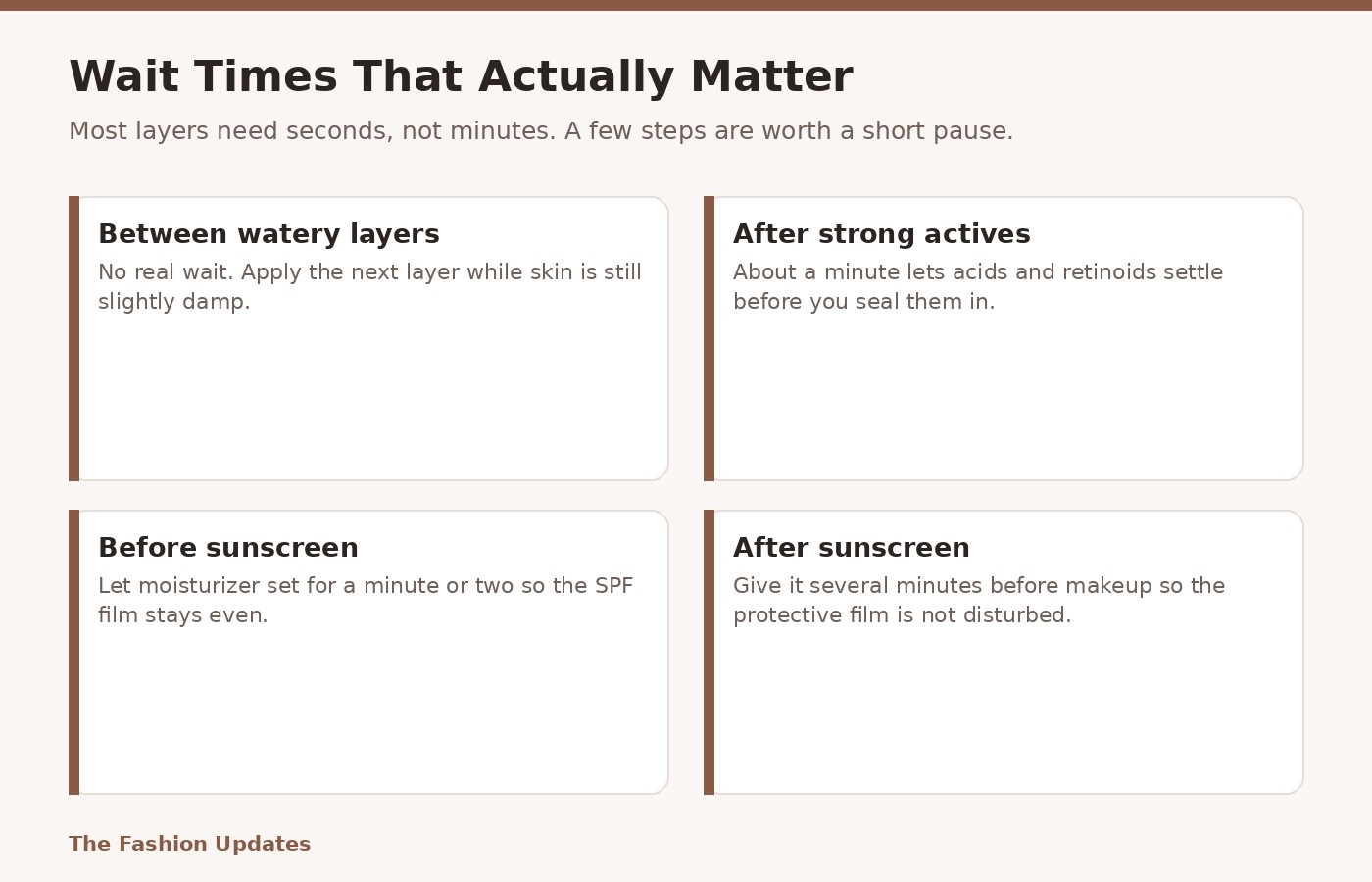
Wait times are where routine advice becomes folklore. The honest answer is that most layers need no clock at all: apply the next product when the previous one no longer feels wet on the surface. Paula’s Choice states this plainly for exfoliants in its application guide: after a leave-on AHA or BHA exfoliant, there is no need to rinse and no need to wait before the next step. CeraVe’s layering guidance is built on the same practical test, texture and absorption, rather than fixed minutes between every bottle.
The waits that do matter
Three pauses are worth keeping. First, prescription treatments: Mayo Clinic instructs readers in its dry skin guidance to apply medicine to damp skin after washing, wait a few minutes or as directed on the package, and only then moisturize. Second, sunscreen before makeup: give the film a few minutes to set so brushes and sponges do not move it around, advice consistent with the application order in the AAD sunscreen FAQs. Third, sunscreen before going outdoors and reapplication while you are out: the FDA recommends reapplying at least every two hours in its sun safety guidance, and the NHS gives the same two-hour interval in its sunscreen and sun safety advice, with immediate reapplication after swimming, sweating, or towel drying.
The waits you can drop
You do not need to stand idle between toner and serum, or between serum and moisturizer, waiting for a timer. What matters is sequence and surface feel, not minutes. A layer that is still dripping wet will dilute the next one and make both slide, so a brief pause until the shine settles is enough for ordinary cosmetic products. Cleveland Clinic’s whole ordering system in its product order guide rests on relative thickness, not on timed gaps. If products roll into small pills on your skin, the cause is usually too much product, or a heavy layer under a light one, rather than a wait that was too short, a distinction that also helps when layering the lighter formulas discussed in our best lip plumpers guide.
Where Treatments, Eye Cream, and Face Oils Fit
Once the core order is clear, the optional products slot in by texture and purpose. Spot treatments and exfoliants sit early, eye cream sits in the middle, and face oils sit late. Cleveland Clinic places each of these in its product order guide, and Paula’s Choice uses the same texture ladder in its application guide, so the placements below are consistent across both systems.
Spot treatments, exfoliants, and prescription products
A spot treatment goes on as the second step, right after cleansing, so its ingredients reach the spot without a cream barrier in the way. Cleveland Clinic gives that placement in its product order guide for salicylic acid and benzoyl peroxide treatments, and adds that sunscreen matters even more on days you use them, because they can increase sun sensitivity. Leave-on exfoliants occupy the same early territory, after toner and before serums, as Paula’s Choice sets out in its application guide. Use one early treatment at a time on a given night. The precision habit here is the same one that helps with targeted products in our hair removal creams guide: right product, right place, nothing extra layered over it too soon.
Eye cream and face oil
Eye cream, if you use one, goes between serum and moisturizer. Cleveland Clinic gives exactly that slot in its product order guide, while noting that many people can simply use moisturizer around the eyes and skip a separate product. Face oil sits at the opposite end: oils are occlusive, so they belong right before moisturizer, or as the final evening layer over it, and Cleveland Clinic advises caution with oils for acne-prone skin in the same product order guide. If you cannot name an optional product’s slot in one sentence, it probably duplicates a step you already have, the same duplication problem our revlon nail polish guide warns about when shades are bought without a place in a rotation.

Layering Mistakes That Undo Good Products
Most layering failures are order failures, amount failures, or patience failures, and all three are fixable without buying anything. Harvard Health makes the underlying point in its skin care overview: despite the abundance of products on sale, only a few have good scientific evidence behind them, so choosing and using a small set carefully beats collecting a large one. The AAD reaches a similar conclusion in its healthier-looking skin guidance, which favors simple, consistent basics over complicated routines.
Too many actives, applied at once
Stacking a strong exfoliant, a retinoid, and a brightening serum in one evening is the fastest route to stinging, peeling, and a routine you abandon. Cleveland Clinic warns in its product order guide that the more products you use, the greater the chance of side effects, and advises testing new products and watching for irritation. Alternate strong treatments on different nights instead. The Ordinary structures its concern-based regimens the same way in its regimen guide, separating morning and evening formulas rather than piling every active into both. If a product stings or burns persistently, stop it: that is irritation, not a sign that it is working, a caution the AAD repeats in its healthier-looking skin guidance.
Diluting sunscreen and rushing makeup
Mixing sunscreen into moisturizer or foundation dilutes it, so the protection on your face no longer matches the SPF on the label. Keep sunscreen as its own final layer, in the full amount. The FDA explains why the label value depends on proper use in its sunscreen guidance, noting that SPF is measured under test conditions and that broad spectrum coverage must be present for UVA protection. The NHS adds the amount problem in its sunscreen and sun safety advice: most people do not apply enough, and applying it too thinly reduces the protection given. Then wait a few minutes before makeup, so tools like those in our makeup brushes guide glide over the film instead of dragging it into patches. Color choices come after protection is set, which is why our nail polish colors for skin tone guide treats shade selection as a finishing step, not a starting one.

EltaMD UV Clear Untinted Face Sunscreen with Zinc Oxide, SPF 46, 1.7 oz | Calms and Protects Acne-Prone Skin and Rosacea, Oil-Free, No White Cast, Dermatologist Recommended
Offer 36.00 $
List Price
Adjusting the Order for Your Skin Type
The order itself does not change with skin type. What changes is how many layers you use, how rich they are, and whether a step is daily or occasional. Cleveland Clinic makes this point in its step-by-step routine guide: a routine should be tailored to each person’s skin type and goals, and it does not have to be complicated to work.
Dry and sensitive skin: fewer layers, more buffering
Dry skin does best with the shortest version of the order: a gentle cleanse, one hydrating layer if wanted, and a rich moisturizer applied while skin is still slightly damp. Mayo Clinic advises exactly that timing in its dry skin guidance, applying moisturizer while skin is damp and choosing gentle, alcohol-free cleansers. Sensitive skin can also buffer a strong treatment: apply moisturizer first, let it settle, then apply the retinoid, then a second light layer of moisturizer if needed. Mayo Clinic describes that moisturizer-first option for drying treatments in the same dry skin guidance. Fragrance is a common irritant in this group, which is why the fragrance-free staple above earns its place, and why our best women’s deodorant guide applies the same fragrance caution to daily products.
Oily and combination skin: lighter layers, same sequence
Oily skin still needs moisturizer: skipping it can leave the surface dehydrated while oil production continues. Keep the sequence and lighten the textures: a gel or lotion instead of a cream, one serum instead of two, and toner only if it genuinely helps. Cleveland Clinic notes in its step-by-step routine guide that some toners are alcohol-based and can strip natural oils, so an alcohol-heavy toner has no place in this order. Sunscreen choice matters most here: a lighter formula is the one you will actually apply in full each morning, and Mayo Clinic reminds readers in its skin care tips to reapply sunscreen every two hours outdoors, or more often when swimming or sweating.
Building a Routine You Will Actually Keep
A correct order only helps if the routine survives busy mornings. Keep the core at three steps in the morning, cleanse, moisturize, protect, and three at night, cleanse, treat if needed, moisturize, then add optional layers one at a time. The AAD’s healthier-looking skin guidance supports that restraint, recommending daily sunscreen, gentle cleansing, and moisturizer suited to your skin type as the foundation everything else builds on.
Add one product at a time
Introduce a single new product, use it for a while, and only then judge it. Cleveland Clinic advises introducing products one at a time in its step-by-step routine guide, because many formulas contain preservatives or fragrances that can irritate, and one-at-a-time testing shows you which product caused a reaction. For sensitive skin, the same guide suggests testing a pea-sized dot behind the ear or along the jawline and waiting a day or two before full use. The Ordinary gives parallel advice in its regimen guide, reminding users to patch test when introducing new products into a regimen. This slow approach is also how the routines in our best fashion magazine guide are best read: as systems to adopt gradually, not hauls to copy overnight.
When to stop, simplify, or seek advice
If your skin becomes persistently red, itchy, or uncomfortable, the correct move is to subtract, not add. Return to cleanser, moisturizer, and sunscreen until things calm down. Harvard Health advises choosing products and treatments with care in its skin care overview, checking the evidence and the source before committing. Ongoing problems, a changing spot, or a rash that does not settle belong with a dermatologist or another healthcare professional, not with another layer. Cleveland Clinic closes its step-by-step routine guide with the same advice: talk to a healthcare provider about unusual or persistent skin symptoms. A short routine done daily, in the right order, will outperform an elaborate one done twice, which is the principle behind every guide on this site, from skincare to our best makeup foundations recommendations.
Our view
Order is the cheapest upgrade in skincare. You do not need more products: you need the ones you have in the right sequence, thinnest to thickest, treatments onto clean skin, moisturizer to seal, and sunscreen alone at the top each morning, given its full amount and a few minutes to set. Keep waits short and purposeful, alternate strong treatments instead of stacking them, and add one product at a time. A three-step routine in the correct order, repeated daily, beats a crowded shelf applied at random.
— The Fashion Updates
Frequently Asked Questions
What is the correct skincare routine order in the morning?
Cleanse, apply toner if you use one, apply one serum, moisturize, then apply broad-spectrum sunscreen with SPF 30 or higher as the final step. Makeup goes on after the sunscreen has had a few minutes to set.
What is the correct order at night?
Remove makeup first if needed, cleanse, apply toner if you use one, then apply your treatment or serum, with retinoids used at this stage, and finish with moisturizer. There is no sunscreen at night, so moisturizer is the last layer.
How long should I wait between skincare layers?
For most cosmetic layers, no fixed wait is needed: move on once the previous layer no longer feels wet. Keep real pauses for prescription treatments, where the label may direct a few minutes before moisturizer, and for sunscreen, which needs a few minutes to set before makeup.
Does moisturizer go before or after sunscreen?
Before. Moisturizer seals in the layers beneath it, and sunscreen must sit on top as an even, undiluted film to deliver its labeled protection. At night, moisturizer is simply the final step.
Can I mix sunscreen into my moisturizer or foundation to save time?
No. Mixing dilutes the sunscreen, so the protection no longer matches the SPF on the label, and coverage becomes uneven. Apply sunscreen as its own layer, in full, and put makeup over it once it has set.
Where does retinol fit in the order?
At night, after cleansing and after any toner, in place of a morning-style serum. Use a pea-sized amount, then moisturize. If your skin is sensitive or dry, applying moisturizer first and the retinoid after it settles can reduce irritation.
How We Pick What We Recommend
Every guide on The Fashion Updates follows the same review process — what we compare, what we check, and what we leave out.
Sources
- American Academy of Dermatology — Face Washing 101
- American Academy of Dermatology — Sunscreen FAQs
- American Academy of Dermatology — 10 Skin Care Secrets for Healthier-Looking Skin
- Cleveland Clinic — The Correct Order for Skin Care Products
- Cleveland Clinic — Skin Care Routine: A Step-by-Step Guide
- Mayo Clinic — Skin Care: 5 Tips for Healthy Skin
- Mayo Clinic — Dry Skin: Diagnosis and Treatment
- FDA — Tips to Stay Safe in the Sun: From Sunscreen to Sunglasses
- FDA — Sunscreen: How to Help Protect Your Skin from the Sun
- NHS — Sunscreen and Sun Safety
- Paula’s Choice — The Best Way to Apply Skin Care Products
- The Ordinary — Skincare Regimens for Beginners
- CeraVe — How to Layer Skincare and Build a Routine
- Harvard Health — Skin Care and Repair